AETN Reshuffles Leadership and Equity as Filings Signal Rapid Structural Changes
AETN
When an OTC ticker drops a late-filing notice closely trailed by boardroom departures and private share issuances, retail traders should look past the headline ticker and inspect the mechanics. AETERNUM HEALTH, INC. (AETN) has spent the summer of 2026 overhauling its corporate scaffolding, leaving behind a paperwork trail that demands a closer look.
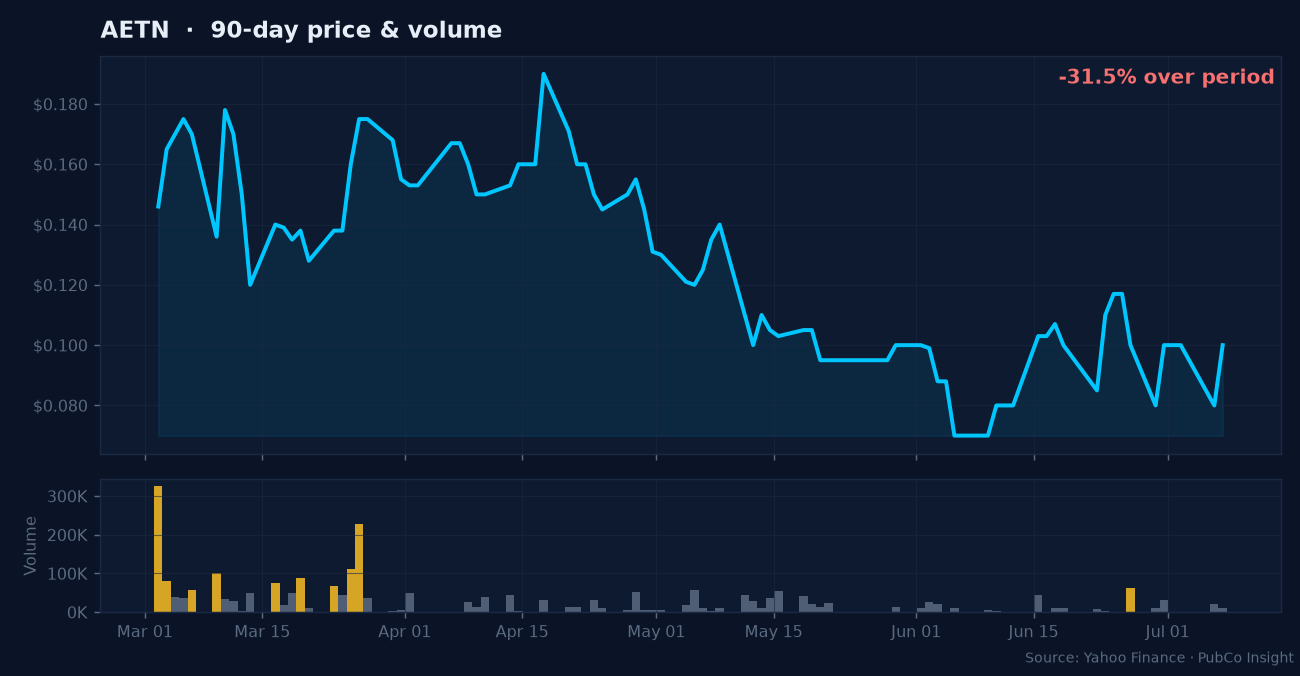
The momentum began in July 2026, when an 8-K revealed a full change in control alongside an asset acquisition and an Item 3.02 unregistered equity issuance. For a corporate shell categorised under miscellaneous electrical machinery, equipment, and supplies, such an abrupt pivot is classic micro-cap restructuring. Controlling hands shifted, new assets arrived, and equity was printed to seal the deal without the requirement of broad shareholder votes.
By mid-August, the administrative strain was visible. AETN filed an NT 10-Q on August 14, alerting markets that its quarterly books would be delayed, only to submit the completed 10-Q days later on August 19. Yet even as the ledger caught up, the financing machinery did not stop. Just prior to the delayed quarterly filing, another 8-K disclosed entry into a material definitive agreement accompanied by yet another Item 3.02 unregistered sales of equity securities, compounding potential dilution risk for existing common holders.
Governance changes quickly followed the new shares. On September 1, AETN submitted an 8-K under Item 5.02 regarding its officers and directors, paired with a definitive information statement on DEF 14C. Information statements of this type typically notify passive shareholders of majority-backed actions taken by written consent, bypassing the traditional annual meeting where smaller accounts can ask questions. When a new controlling group takes power and amends charters or capital structures via 14C filings, common retail investors find themselves along for the ride rather than steering the ship.
The mechanics here are straightforward: an entity undergoing rapid ownership transition, issuing restricted equity behind closed doors, and delivering delayed accounting. There is no need to guess at management intentions when the disclosure record speaks for itself. Investors watching AETN should verify the scale of these recent issuances and ensure they understand how much ownership the new paper has already carved away.
Primary sources (SEC EDGAR)
DEF 14C 2026-09-01: https://www.sec.gov/Archives/edgar/data/764630/000149315226040956/formdef14c.htm8-K 2026-09-01: https://www.sec.gov/Archives/edgar/data/764630/000149315226040954/form8-k.htmPRE 14C 2026-08-21: https://www.sec.gov/Archives/edgar/data/764630/000149315226039600/formpre14c.htm10-Q 2026-08-19: https://www.sec.gov/Archives/edgar/data/764630/000149315226039164/form10-q.htmNT 10-Q 2026-08-14: https://www.sec.gov/Archives/edgar/data/764630/000149315226038480/formnt10-q.htm8-K 2026-08-13: https://www.sec.gov/Archives/edgar/data/764630/000149315226037609/form8-k.htmSee the dilution and promotion flags before you see the pitch.
Each week: the micro and small-caps now showing dilution or paid-promotion signals, with the SEC filing behind every flag. No recommendations, no price targets.