APAD: A Series of 8-Ks, but Little Clarity on Enhanced Group Inc.'s Path
APAD
Enhanced Group Inc. (APAD) has recently filed a series of 8-K reports, signaling various material agreements and corporate changes, but these disclosures provide scant information regarding actual business operations or financial health. While the market may react to the sheer volume of filings, a closer look at the content reveals more structural shifts than tangible progress for this OTC-listed entity.
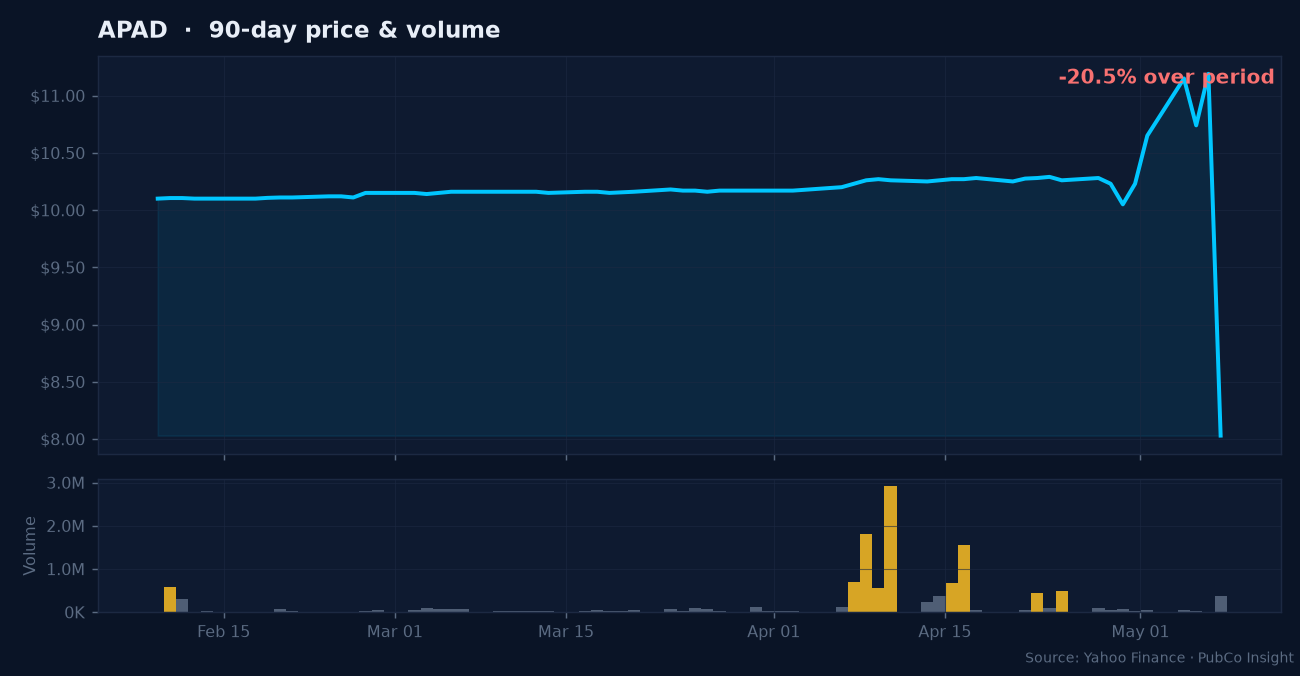
The June 15, 2026, 8-K filing, for example, notes material agreements and the issuance of securities, yet the specific nature and financial impact of these agreements are not detailed in a way that allows for meaningful investor analysis. This follows a pattern seen in earlier 8-K filings from May, which also reported material agreements and changes of control without providing the typical financial statements or operational context one might expect from a public company. The absence of routine financial reports, such as 10-Qs or 10-Ks, leaves a significant gap in understanding APAD's current state.
The company's SIC description, "Services-Miscellaneous Amusement & Recreation," offers a broad classification but without corresponding operational details, it provides little insight into how Enhanced Group Inc. intends to generate revenue or sustain itself. The series of Schedule 13D and 13G filings confirm changes in beneficial ownership, which is a common occurrence in micro-cap companies, but again, these do not illuminate the underlying business prospects.
For retail investors considering APAD, the challenge lies in the informational vacuum. The filings indicate corporate activity, particularly around agreements and ownership, but they do not offer the data points crucial for assessing value or risk. There is no public market capitalization or share count provided in the available data, making even basic valuation metrics impossible to calculate.
Without current financial statements, a clear description of ongoing operations, or any reported revenue streams, investors are left to speculate on the implications of these corporate actions. The public record, as it stands, outlines a company undergoing structural adjustments without revealing the economic substance behind them. Knowing what you own means understanding the business, not just the corporate maneuvers.
Primary sources (SEC EDGAR)
SCHEDULE 13D/A 2026-06-16: https://www.sec.gov/Archives/edgar/data/1956439/000119312526273135/xslSCHEDULE_13D_X02/primary_doc.xml8-K 2026-06-15: https://www.sec.gov/Archives/edgar/data/1956439/000162828026043029/apadu-20260614.htmSCHEDULE 13G 2026-05-15: https://www.sec.gov/Archives/edgar/data/1956439/000091957426003193/xslSCHEDULE_13G_X02/primary_doc.xmlSCHEDULE 13D 2026-05-14: https://www.sec.gov/Archives/edgar/data/1956439/000119312526224576/xslSCHEDULE_13D_X02/primary_doc.xmlSCHEDULE 13D 2026-05-14: https://www.sec.gov/Archives/edgar/data/1956439/000162827926000613/xslSCHEDULE_13D_X02/primary_doc.xmlSCHEDULE 13G/A 2026-05-14: https://www.sec.gov/Archives/edgar/data/1956439/000107680926000044/xslSCHEDULE_13G_X02/primary_doc.xmlSee the dilution and promotion flags before you see the pitch.
Each week: the micro and small-caps now showing dilution or paid-promotion signals, with the SEC filing behind every flag. No recommendations, no price targets.