Behind the Curtain at Enhanced Group Inc.: SEC Filings Reveal the Reality of APAD Stock Issuance
APAD
While promotional narratives often paint a picture of seamless corporate expansion, the regulatory paper trail for Enhanced Group Inc. (APAD) tells a much more complex story of structural changes and incoming share supply. Over a remarkably compressed timeframe in mid-2026, the company has executed a sequence of material agreements, control shifts, and equity registrations that retail investors cannot afford to overlook.
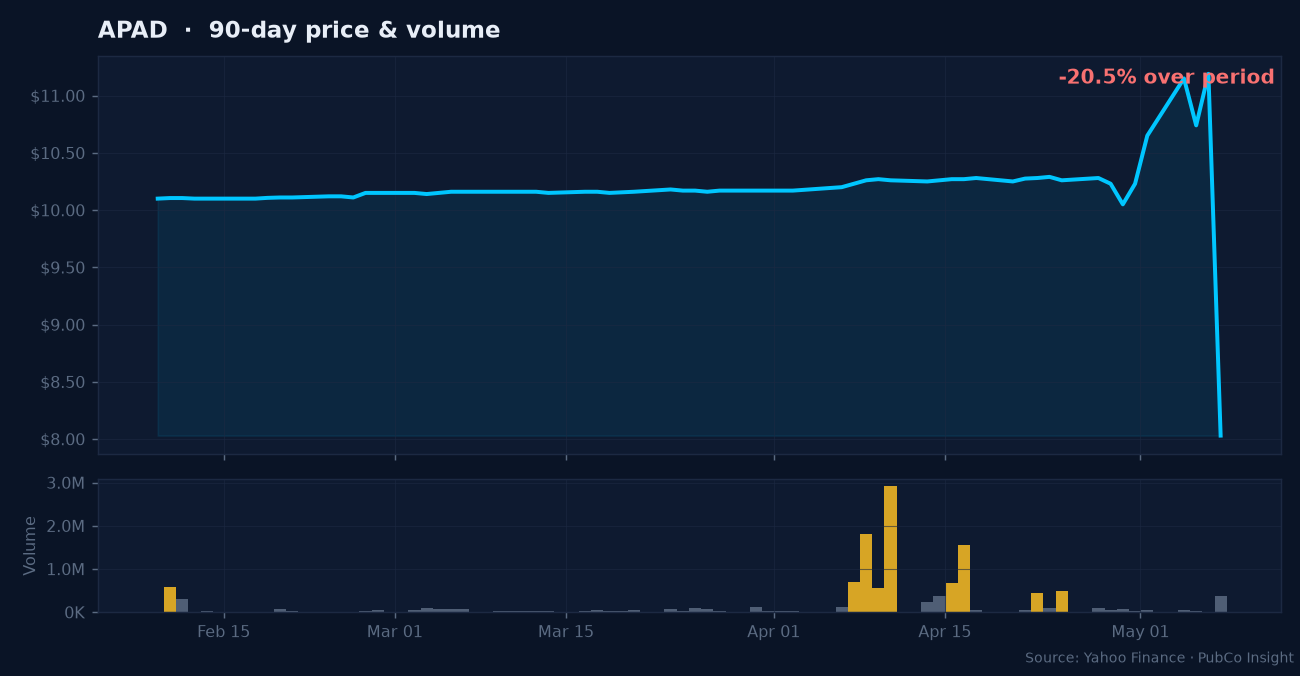
The transformation began in earnest in May 2026, when Enhanced Group Inc. filed an 8-K detailing a change of control, an acquisition, and a series of material agreements. This was not a minor administrative tweak, but a fundamental rewriting of the corporate structure, accompanied by the issuance of unregistered equity. When a micro-cap company undergoes a rapid change of control, the existing share structure is rarely left untouched, and the subsequent filings show exactly how that equity is making its way toward the public markets.
By June 2026, the pace accelerated with another 8-K reporting additional material agreements and unregistered sales of equity securities under Item 3.02. This was quickly followed by a 424B3 prospectus supplement on June 25, 2026, which formally facilitates the resale of shares by selling stockholders. For retail investors holding APAD, this prospectus represents a direct pipeline of potential market supply, introducing significant dilution risk as these newly registered shares find their way onto the OTC market.
The paper trail did not stop there. In early July 2026, Enhanced Group Inc. filed a PRE 14C preliminary information statement, signaling further corporate actions approved by majority written consent, bypassing the need for a formal shareholder meeting. Days later, on July 8, 2026, the company registered more shares under an S-8 filing, typically used for employee benefit plans. Piece by piece, the outstanding share count is being restructured, and the supply of tradeable stock is expanding.
Understanding the mechanics of these filings is critical for anyone tracking APAD. The combination of a recent change of control, ongoing private placements, and active registration statements for resale means that the supply-demand dynamics of the stock are highly fluid. Before buying into the story of a corporate turnaround, investors must account for the structural dilution already coded into the company's recent SEC filings.
Primary sources (SEC EDGAR)
S-8 2026-07-08: https://www.sec.gov/Archives/edgar/data/1956439/000162828026047692/enhanced-formsx84934x9182x.htmPRE 14C 2026-07-06: https://www.sec.gov/Archives/edgar/data/1956439/000162828026047312/enhanced-dec14ccooleydraft.htm424B3 2026-06-25: https://www.sec.gov/Archives/edgar/data/1956439/000162828026045589/enhanced-prosupp424bresale.htmSCHEDULE 13D/A 2026-06-16: https://www.sec.gov/Archives/edgar/data/1956439/000119312526273135/xslSCHEDULE_13D_X02/primary_doc.xml8-K 2026-06-15: https://www.sec.gov/Archives/edgar/data/1956439/000162828026043029/apadu-20260614.htmSCHEDULE 13G 2026-05-15: https://www.sec.gov/Archives/edgar/data/1956439/000091957426003193/xslSCHEDULE_13G_X02/primary_doc.xmlSee the dilution and promotion flags before you see the pitch.
Each week: the micro and small-caps now showing dilution or paid-promotion signals, with the SEC filing behind every flag. No recommendations, no price targets.