Financing Realities and New Debt Obligations Cloud the Horizon for AppTech Payments Corp. (APCX)
APCX
AppTech Payments Corp. (APCX) continues to position itself as an emerging fintech player, but the company's recent regulatory filings reveal a persistent reliance on structured financing to keep the lights on. While promotional narratives often focus on long-term software potential, the actual paperwork filed with the SEC paints a more sobering picture of a micro-cap navigating tight liquidity.
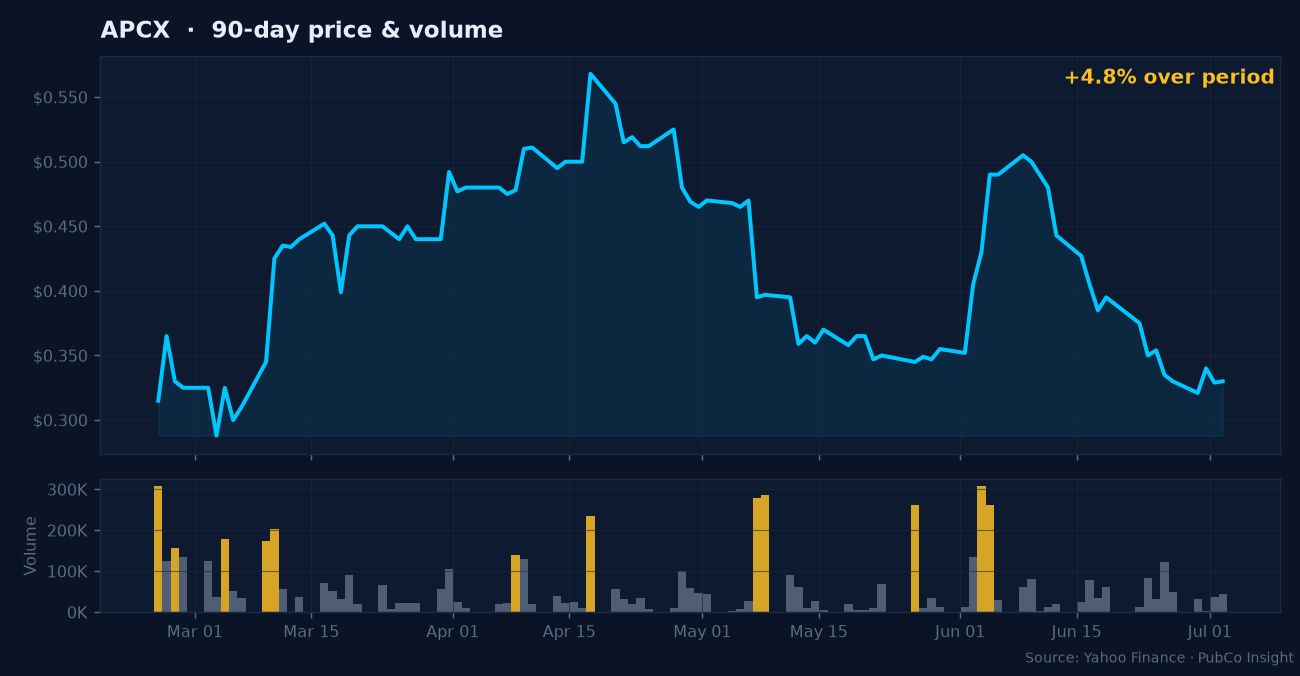
The critical tension in the APCX story is highlighted by the company's July 2, 2026, Form 8-K filing. This document details a new material definitive agreement under Item 1.01 and the creation of a direct financial obligation under Item 2.03. Entering into these debt agreements provides immediate cash but adds another layer of senior obligations that must be serviced or eventually converted, often at the expense of common shareholders.
This is not an isolated event. Earlier in the year, on April 10, 2026, AppTech Payments Corp. executed a similar transaction involving a material agreement and the unregistered sale of equity securities under Item 3.02. This pattern of periodic debt issuance and equity-linked financing is a classic mechanism for micro-caps with limited cash flow, representing a steady, structural dilution risk for retail investors holding the common stock.
Furthermore, recent Form 4 filings from May and June 2026 show shifting insider ownership patterns, alongside a Form 5.07 filing on June 2, 2026, which recorded the outcomes of shareholder voting. When a company with a market capitalization of under 14 million dollars frequently adjusts its capital structure through debt and private placements, the voting power and equity value of public market participants can quickly become secondary priorities.
For retail investors eyeing APCX, the lesson is written directly into the footnotes of its financial disclosures. A business cannot fund itself through financing agreements indefinitely without impacting its equity structure. Understanding these structural risks, rather than relying on high-level fintech promises, is essential before committing capital to this highly volatile tier of the market.
Primary sources (SEC EDGAR)
8-K 2026-07-02: https://www.sec.gov/Archives/edgar/data/1070050/000168316826005262/apptech_8k.htm4 2026-06-11: https://www.sec.gov/Archives/edgar/data/1070050/000168316826004758/xslF345X06/ownership.xml4 2026-06-04: https://www.sec.gov/Archives/edgar/data/1070050/000168316826004569/xslF345X06/ownership.xml8-K 2026-06-02: https://www.sec.gov/Archives/edgar/data/1070050/000168316826004438/apptech_8k.htm4 2026-05-27: https://www.sec.gov/Archives/edgar/data/1070050/000168316826004323/xslF345X06/ownership.xml3/A 2026-05-27: https://www.sec.gov/Archives/edgar/data/1070050/000168316826004322/xslF345X06/ownership.xmlSee the dilution and promotion flags before you see the pitch.
Each week: the micro and small-caps now showing dilution or paid-promotion signals, with the SEC filing behind every flag. No recommendations, no price targets.