AppTech Payments Corp. (APCX) Stacks Up Financing Agreements as Filings Roll In
APCX
When a micro-cap software firm repeatedly logs material definitive agreements alongside direct financial obligations, retail traders should pay attention to the plumbing beneath the ticker. AppTech Payments Corp. (APCX) recently dropped its latest Form 10-Q and a companion Form 8-K on the same day, marking the third time in under two months that the company has reported new debt or material obligations under Item 1.01 and Item 2.03.
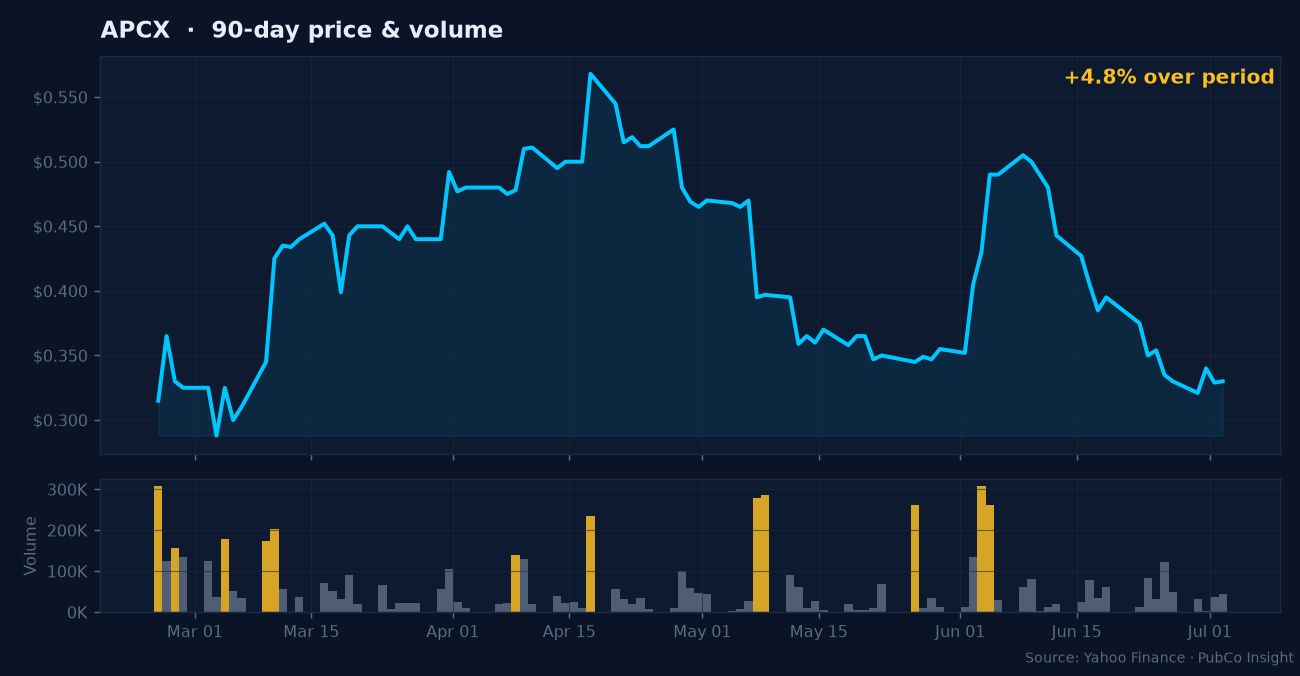
With a market capitalization sitting near $15.9 million spread across roughly 33.28 million shares, capital management is everything. The parade of filings began in early July, continued through late July, and landed again in mid-August. Each filing tagged Item 2.03, which explicitly denotes the creation of a direct financial obligation or an off-balance sheet arrangement. In plain English, the company is actively structuring and restructuring its commitments.
Multiple debt arrangements often carry future structural implications for equity holders. When small public companies enter material financial commitments, the terms frequently involve conversion features, interest burdens, or covenants that can increase long-term pressure. Keeping tabs on how these obligations translate into common share counts is essential, making tools like the PubCo Insight dilution risk tracker a practical stop for assessing structural risk.
Alongside the debt disclosures, the regulatory docket shows regular Form 4 and Form 4/A activity through early August. While executive transactions can stem from various administrative or equity-plan mechanisms, layering insider adjustments on top of active financing agreements means the cap table is far from static.
AppTech Payments Corp. continues to operate in the competitive prepackaged software arena, but its filings reveal a company actively navigating capital arrangements. Investors looking at APCX need to look beyond product narratives and inspect the binding terms in those 8-K exhibits to see what is really supporting the structure.
Primary sources (SEC EDGAR)
8-K 2026-08-14: https://www.sec.gov/Archives/edgar/data/1070050/000168316826006467/apptech_8k.htm10-Q 2026-08-14: https://www.sec.gov/Archives/edgar/data/1070050/000168316826006441/apptech_i10q-063026.htm4 2026-08-12: https://www.sec.gov/Archives/edgar/data/1070050/000168316826006291/xslF345X06/ownership.xml4 2026-08-07: https://www.sec.gov/Archives/edgar/data/1070050/000168316826006107/xslF345X06/ownership.xml4/A 2026-08-05: https://www.sec.gov/Archives/edgar/data/1070050/000168316826005990/xslF345X06/ownership.xml4 2026-08-04: https://www.sec.gov/Archives/edgar/data/1070050/000168316826005941/xslF345X06/ownership.xmlSee the dilution and promotion flags before you see the pitch.
Each week: the micro and small-caps now showing dilution or paid-promotion signals, with the SEC filing behind every flag. No recommendations, no price targets.