AppTech Payments Corp. Files Repeated Debt Accords as APCX Balances Working Capital Pressures
APCX
When a microcap software company files three separate 8-K disclosures detailing material agreements and new financial obligations in six weeks, the story is no longer about narrative. For AppTech Payments Corp., the SEC ledger shows a steady drumbeat of balance-sheet management that retail traders should track carefully.
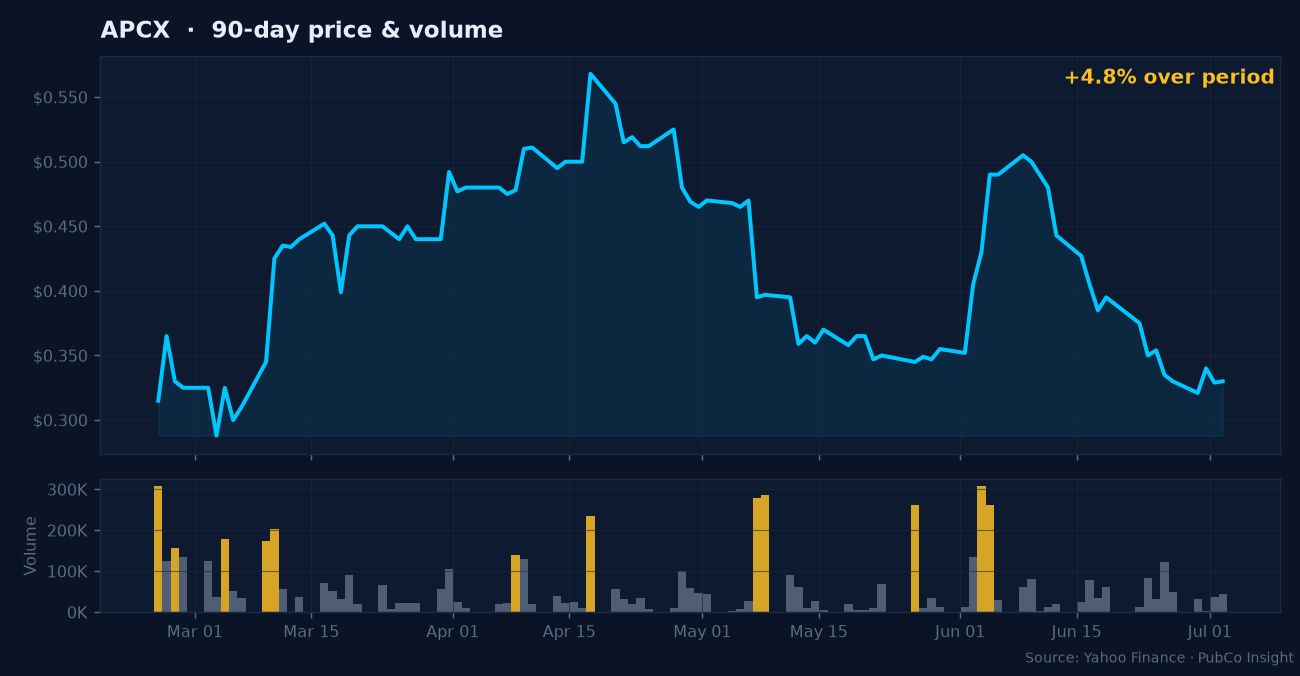
The company, which trades over the counter under the ticker APCX with a market capitalization near 15 million dollars across 33.28 million shares outstanding, filed its latest Form 10-Q in mid-August. Paired with that quarterly report was another Form 8-K triggering Items 1.01 and 2.03, reflecting material definitive agreements and the creation of direct financial obligations.
This August filing was not an isolated event. AppTech Payments Corp. recorded similar Item 1.01 and Item 2.03 entries in late July and early July, demonstrating repeated reliance on structured obligations to keep operations funded. When small software operators return to the financing window every few weeks, monitoring ongoing dilution risk becomes essential for anyone holding common stock.
Alongside the financing filings, several Form 4 insider transaction reports landed throughout early and mid-August. While microcaps frequently lean on debt and structured agreements to bridge cash flow gaps, accumulating direct liabilities often creates subsequent equity conversion pressures down the road.
Investors evaluating APCX must look beyond broad fintech ambitions and weigh the mechanics of recurring financial obligations against the company's operating scale. Understanding the covenants and capital structure spelled out in the filings is the only way to avoid surprises when debt comes due.
Primary sources (SEC EDGAR)
4 2026-08-20: https://www.sec.gov/Archives/edgar/data/1070050/000168316826006635/xslF345X06/ownership.xml4 2026-08-17: https://www.sec.gov/Archives/edgar/data/1070050/000168316826006536/xslF345X06/ownership.xml8-K 2026-08-14: https://www.sec.gov/Archives/edgar/data/1070050/000168316826006467/apptech_8k.htm10-Q 2026-08-14: https://www.sec.gov/Archives/edgar/data/1070050/000168316826006441/apptech_i10q-063026.htm4 2026-08-12: https://www.sec.gov/Archives/edgar/data/1070050/000168316826006291/xslF345X06/ownership.xml4 2026-08-07: https://www.sec.gov/Archives/edgar/data/1070050/000168316826006107/xslF345X06/ownership.xmlSee the dilution and promotion flags before you see the pitch.
Each week: the micro and small-caps now showing dilution or paid-promotion signals, with the SEC filing behind every flag. No recommendations, no price targets.