AppTech Payments Corp. (APCX) Q2 Filing Shows Ongoing Liquidity Challenges
APCX
AppTech Payments Corp. (APCX) recently filed its Q2 2026 10-Q, disclosing a net loss of $3.0 million for the quarter and a working capital deficit of $2.4 million as of June 30, 2026. This financial picture comes alongside an explicit disclosure from management that there is "substantial doubt about the Company's ability to continue as a going concern." While the company has announced various agreements via 8-K filings in recent months, the underlying financial health as presented in the quarterly report indicates a persistent need for external capital to sustain operations.
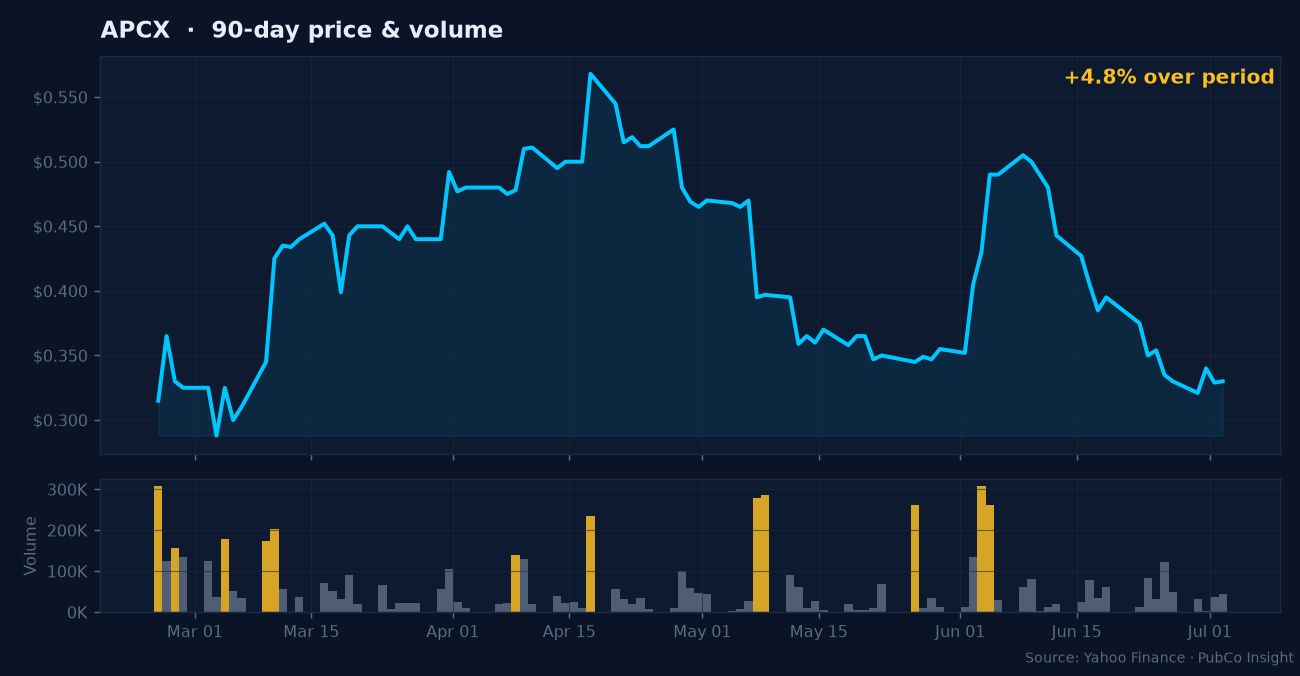
The 10-Q details that APCX's ability to continue as a going concern is contingent upon its capacity to obtain additional financing, generate sufficient revenue, and manage operating expenses. This is not a new disclosure; similar language has appeared in previous filings. What makes the current situation noteworthy is the backdrop of recent 8-K filings, such as the August 14, 2026 report detailing a material agreement. While these agreements might signal operational progress, they do not, by themselves, resolve the liquidity issues highlighted in the 10-Q.
A company in this position typically finances its operations through a combination of debt and equity raises. For shareholders, this often translates to the risk of dilution as new shares are issued to secure necessary funds. The 10-Q confirms that AppTech has historically relied on debt and equity financings to fund its operations, and it expects to continue doing so. The issuance of new shares increases the total share count, spreading ownership over a larger base and potentially impacting the per-share value of existing holdings.
The company's shares outstanding stood at 33.28 million as of the latest data. Any future equity raises to address the going concern issue would add to this count. While the specific terms of future financings are not detailed in the Q2 10-Q, the consistent disclosure of a going concern warning indicates that such events are a distinct possibility, if not a probability, in the company's near-term future.
Investors evaluating APCX should understand that the operational developments announced in 8-K filings, while potentially positive for the business long-term, need to be viewed in the context of the company's immediate financial needs. The 10-Q paints a clear picture of a company still navigating significant liquidity challenges and relying on future capital infusions to continue its operations.
Understanding the interplay between announced business developments and the hard financial realities disclosed in quarterly reports is crucial for any investor in the micro-cap space. For AppTech Payments Corp., the recent 10-Q underscores that the path forward will likely involve further capital raises and the potential for dilution to existing shareholders.
Primary sources (SEC EDGAR)
4 2026-08-26: https://www.sec.gov/Archives/edgar/data/1070050/000168316826006735/xslF345X06/ownership.xml4 2026-08-26: https://www.sec.gov/Archives/edgar/data/1070050/000168316826006733/xslF345X06/ownership.xml4 2026-08-20: https://www.sec.gov/Archives/edgar/data/1070050/000168316826006635/xslF345X06/ownership.xml4 2026-08-17: https://www.sec.gov/Archives/edgar/data/1070050/000168316826006536/xslF345X06/ownership.xml8-K 2026-08-14: https://www.sec.gov/Archives/edgar/data/1070050/000168316826006467/apptech_8k.htm10-Q 2026-08-14: https://www.sec.gov/Archives/edgar/data/1070050/000168316826006441/apptech_i10q-063026.htmSee the dilution and promotion flags before you see the pitch.
Each week: the micro and small-caps now showing dilution or paid-promotion signals, with the SEC filing behind every flag. No recommendations, no price targets.