AppTech Payments Corp. (APCX) Debt Conversion Raises Red Flags for Retail Investors
APCX
AppTech Payments Corp. (APCX) recently announced a string of material agreements and debt conversions, a common maneuver in the micro-cap space that often comes at the expense of existing shareholders. An October 2026 8-K filing detailed a new financing agreement and the issuance of common stock to convert outstanding debt, a move that bears close scrutiny for anyone holding shares.
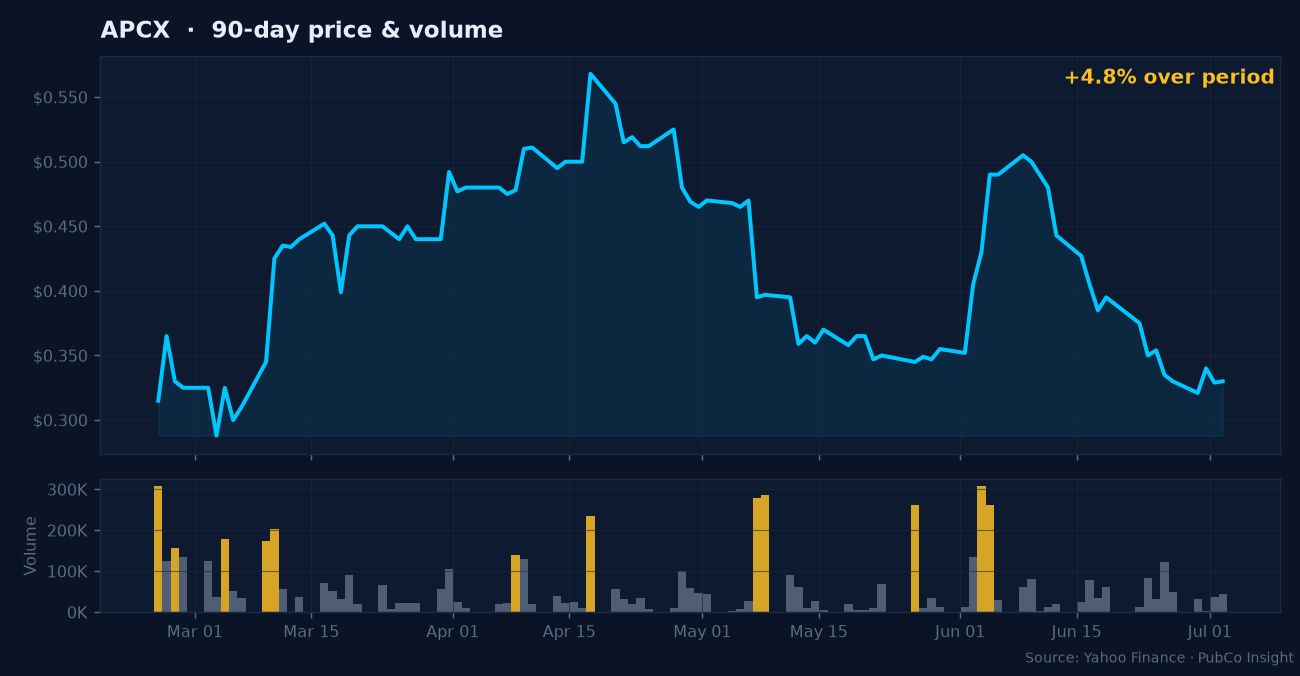
Specifically, the 8-K filed on October 5, 2026, under Items 1.01, 2.03, and 3.02, outlines a new financing arrangement and the conversion of principal and interest from a promissory note into common stock. While the company obtains capital, these conversions increase the number of shares outstanding, effectively diluting the ownership stake of current shareholders without necessarily improving underlying operational value. This isn't a one-off event; prior 8-K filings in August and July 2026 also highlighted similar material agreements and debt conversions, suggesting a pattern of financing activities that rely on issuing new equity.
For a company with a market capitalization around $9.4 million and 33.28 million shares outstanding, as indicated by recent data, each new share issued can have a noticeable impact. Retail investors often overlook the mechanics of these debt-to-equity swaps, focusing instead on headlines about new capital. However, the true cost can be a steady erosion of per-share value as the share count climbs.
These types of financing activities are a recurring theme for many micro-cap companies. While they address immediate capital needs, they also create a constant overhang of potential future dilution. Investors watching APCX should be aware that the company's reliance on converting debt into equity could continue to expand the share count, which can put downward pressure on the stock price in the long run. Understanding these mechanics is crucial to assessing the true risk and reward in such situations.
The repeated nature of these debt conversions, as evidenced by multiple 8-K filings over recent months, indicates a financing strategy that may continue to dilute existing equity holders. It's a prime example of why investors in the OTC market need to dig into the filings themselves, rather than relying on promotional materials. For more on this dynamic, see our dilution risk tool.
Knowing what you own in the micro-cap space means understanding how a company finances itself. For AppTech Payments Corp. (APCX), the recent filings clearly point to a strategy that involves regular conversions of debt into common stock, a reality that every shareholder should factor into their assessment of the investment.
Primary sources (SEC EDGAR)
8-K 2026-10-05: https://www.sec.gov/Archives/edgar/data/1070050/000168316826007621/apptech_8k.htm4 2026-09-03: https://www.sec.gov/Archives/edgar/data/1070050/000168316826006934/xslF345X06/ownership.xml4 2026-08-31: https://www.sec.gov/Archives/edgar/data/1070050/000168316826006834/xslF345X06/ownership.xml4 2026-08-31: https://www.sec.gov/Archives/edgar/data/1070050/000168316826006833/xslF345X06/ownership.xml4 2026-08-26: https://www.sec.gov/Archives/edgar/data/1070050/000168316826006735/xslF345X06/ownership.xml4 2026-08-26: https://www.sec.gov/Archives/edgar/data/1070050/000168316826006733/xslF345X06/ownership.xmlSee the dilution and promotion flags before you see the pitch.
Each week: the micro and small-caps now showing dilution or paid-promotion signals, with the SEC filing behind every flag. No recommendations, no price targets.