AppTech Payments Corp. (APCX) Logs Unregistered Equity Sales and Heavy Borrowing
APCX
When a micro-cap software firm repeatedly taps financing agreements while selling unregistered equity, common shareholders usually pay the tab. AppTech Payments Corp. (APCX), currently trading on the OTC market with an equity market capitalization hovering near $5.88 million against roughly 33.28 million shares outstanding, is demonstrating how capital constraints translate directly into structural dilution risk.
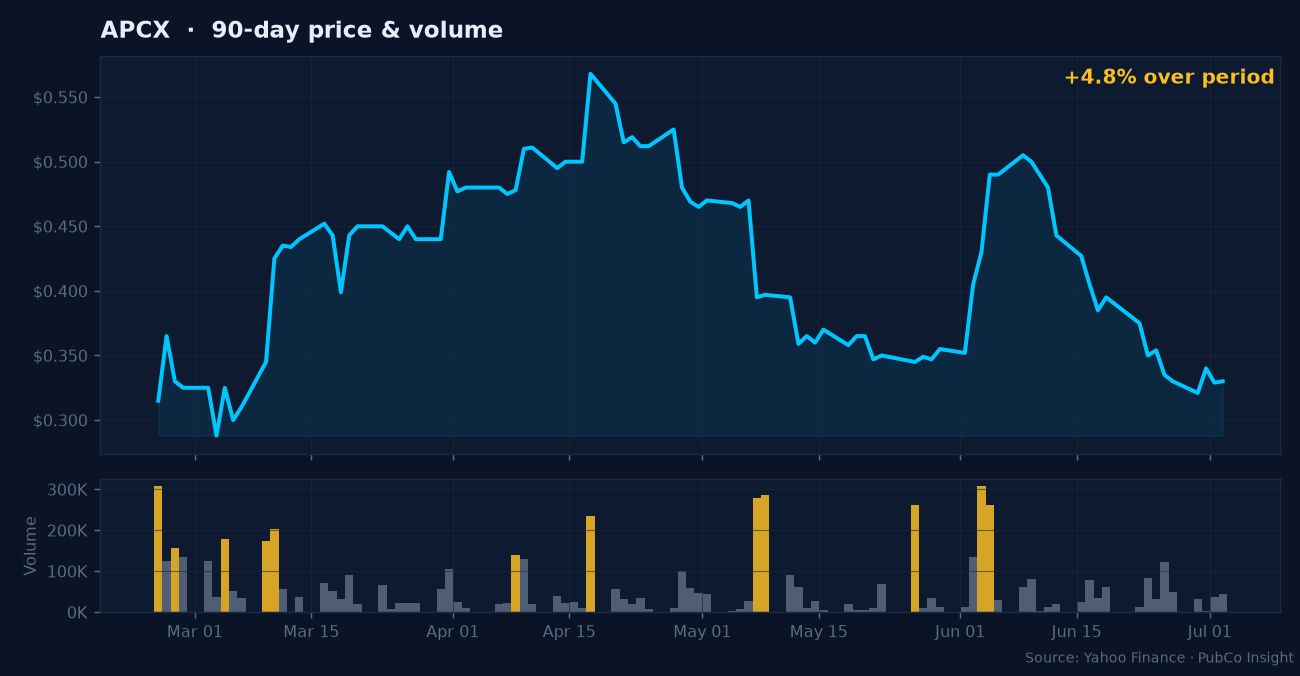
The paper trail in recent Form 8-K filings outlines the pattern clearly. On October 5, 2026, AppTech Payments Corp. filed a current report checking four distinct boxes: Item 1.01 for an entry into a material definitive agreement, Item 2.03 for the creation of a direct financial obligation, and critically, Item 3.02 for the unregistered sales of equity securities. For retail investors monitoring our dilution risk tools, an Item 3.02 disclosure alongside fresh borrowing obligations is an immediate red flag that the company is relying on private share issuances to support its balance sheet.
This October financing event is far from an isolated occurrence. Company filings from earlier in the year reveal a recurring drumbeat of leverage. AppTech Payments Corp. filed similar 8-K reports on August 14, 2026, and July 21, 2026, each triggering Items 1.01 and 2.03 for material agreements and direct financial obligations. When debt piles onto a sub-$6 million market cap entity in successive quarters, the mechanics of repayment frequently involve convertible structures or further equity concessions that expand the share base.
Adding to the uncertainty, the governance deck shifted immediately after the latest funding transaction. On October 6, 2026, the company submitted an 8-K citing Item 5.02, which governs the departure or appointment of directors, principal officers, or key executives. Leadership turnover arriving within twenty-four hours of an unregistered equity transaction underscores an unstable operational backdrop, occurring alongside a series of Form 4 insider filings recorded in late August and early September 2026.
AppTech Payments Corp. operates in a competitive prepackaged software market where executing on growth requires steady, predictable capital. What the SEC filings show instead is an ongoing reliance on debt arrangements paired with unregistered share creation and corporate management changes. Anyone looking past the headline buzz must evaluate whether future operating performance can outrun the compounding dilution embedded in these financial obligations.
Primary sources (SEC EDGAR)
8-K 2026-10-06: https://www.sec.gov/Archives/edgar/data/1070050/000168316826007665/apptech_8k.htm8-K 2026-10-05: https://www.sec.gov/Archives/edgar/data/1070050/000168316826007621/apptech_8k.htm4 2026-09-03: https://www.sec.gov/Archives/edgar/data/1070050/000168316826006934/xslF345X06/ownership.xml4 2026-08-31: https://www.sec.gov/Archives/edgar/data/1070050/000168316826006834/xslF345X06/ownership.xml4 2026-08-31: https://www.sec.gov/Archives/edgar/data/1070050/000168316826006833/xslF345X06/ownership.xml4 2026-08-26: https://www.sec.gov/Archives/edgar/data/1070050/000168316826006735/xslF345X06/ownership.xmlSee the dilution and promotion flags before you see the pitch.
Each week: the micro and small-caps now showing dilution or paid-promotion signals, with the SEC filing behind every flag. No recommendations, no price targets.