Data443 Risk Mitigation (ATDS): Billions of Shares and Persistent Financing
ATDS
Data443 Risk Mitigation, Inc. (ATDS) reported over 1.3 billion shares outstanding in its latest 10-Q, a figure that continues to grow as the company relies on financing structures that convert debt into equity. Recent 8-K filings on July 20, 2026, detail new material agreements and the issuance of convertible promissory notes, signaling a continuation of this financing strategy.
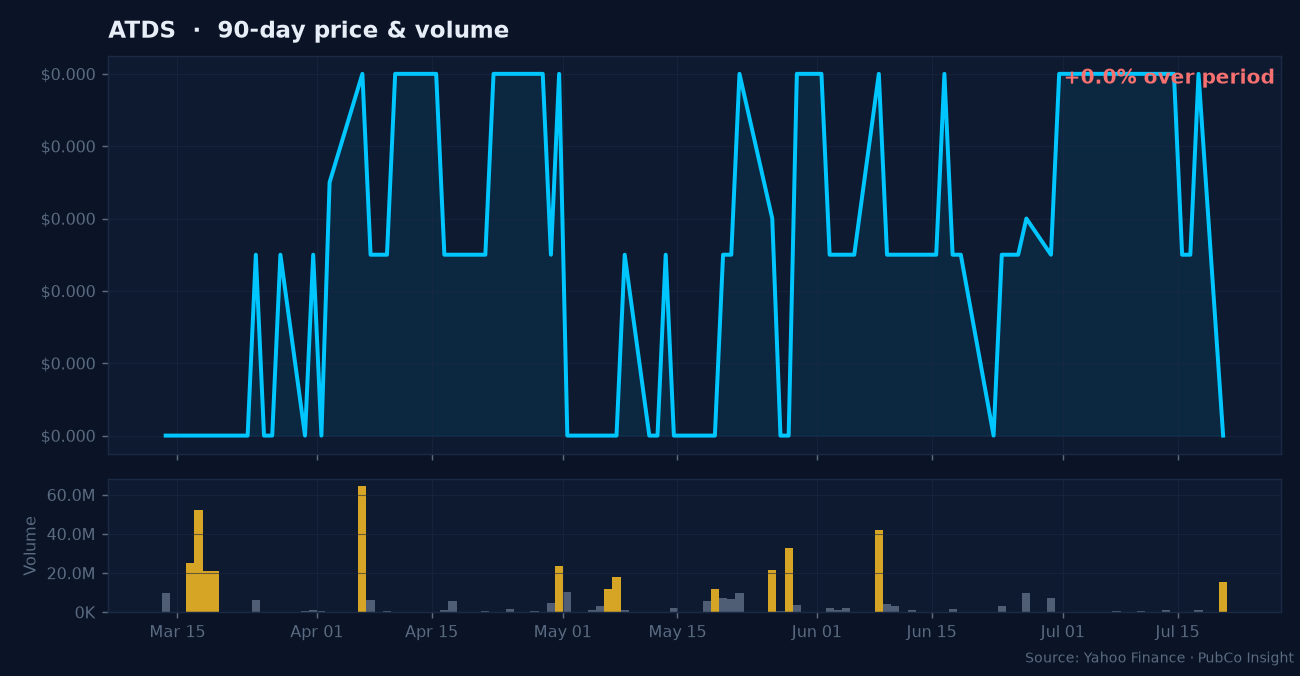
These convertible notes, by their very nature, allow lenders to convert their debt into common stock, frequently at a discount to the market price. While necessary for operations, this mechanism creates a persistent overhang of potential dilution for existing shareholders. With a market capitalization under $1 million and an already massive share count, even small conversions can represent a significant percentage of the company's value.
The 10-K filed on April 16, 2026, and the subsequent 10-Q on May 14, 2026, both underscore the company's need for external financing. The NT 10-K filing on March 31, 2026, indicated a delay in filing the annual report, a common signal of operational or financial strain, though the 10-K was ultimately filed.
For a company with such a large share base, the incremental impact of new share issuances from convertible debt can be substantial. The market often discounts companies with a history of significant dilution, as the path to meaningful per-share value growth becomes increasingly steep. Understanding the mechanics of these financings is crucial for anyone considering ATDS.
Investors should recognize that ongoing reliance on convertible debt often means that the share count will continue to expand. While these agreements provide necessary capital, they also continuously re-price the ownership stake of existing shareholders. This structural element is a key consideration when evaluating the long-term prospects of Data443 Risk Mitigation, Inc. Our dilution risk tool provides more context on these types of financing structures.
In micro-cap companies like ATDS, every financing decision can have a magnified effect on the share structure and, by extension, on shareholder value. Knowing what you own means understanding how the company funds itself and the direct implications of those methods on your investment.
Primary sources (SEC EDGAR)
8-K 2026-07-20: https://www.sec.gov/Archives/edgar/data/1068689/000149315226033834/form8-k.htm8-K 2026-07-20: https://www.sec.gov/Archives/edgar/data/1068689/000149315226033828/form8-k.htm10-Q 2026-05-14: https://www.sec.gov/Archives/edgar/data/1068689/000149315226023102/form10-q.htm10-K 2026-04-16: https://www.sec.gov/Archives/edgar/data/1068689/000149315226016943/form10-k.htmNT 10-K 2026-03-31: https://www.sec.gov/Archives/edgar/data/1068689/000149315226014175/formnt10-k.htmSee the dilution and promotion flags before you see the pitch.
Each week: the micro and small-caps now showing dilution or paid-promotion signals, with the SEC filing behind every flag. No recommendations, no price targets.