Data443 Risk Mitigation (ATDS) navigates a complex financial landscape, per recent filings
ATDS
Data443 Risk Mitigation, Inc. (ATDS) has been active on the SEC filing front, with recent 8-K disclosures detailing new material agreements that warrant a closer look. While the company operates in the prepackaged software sector, its financial disclosures paint a picture of a micro-cap firm with persistent funding needs and an ongoing struggle for profitability.
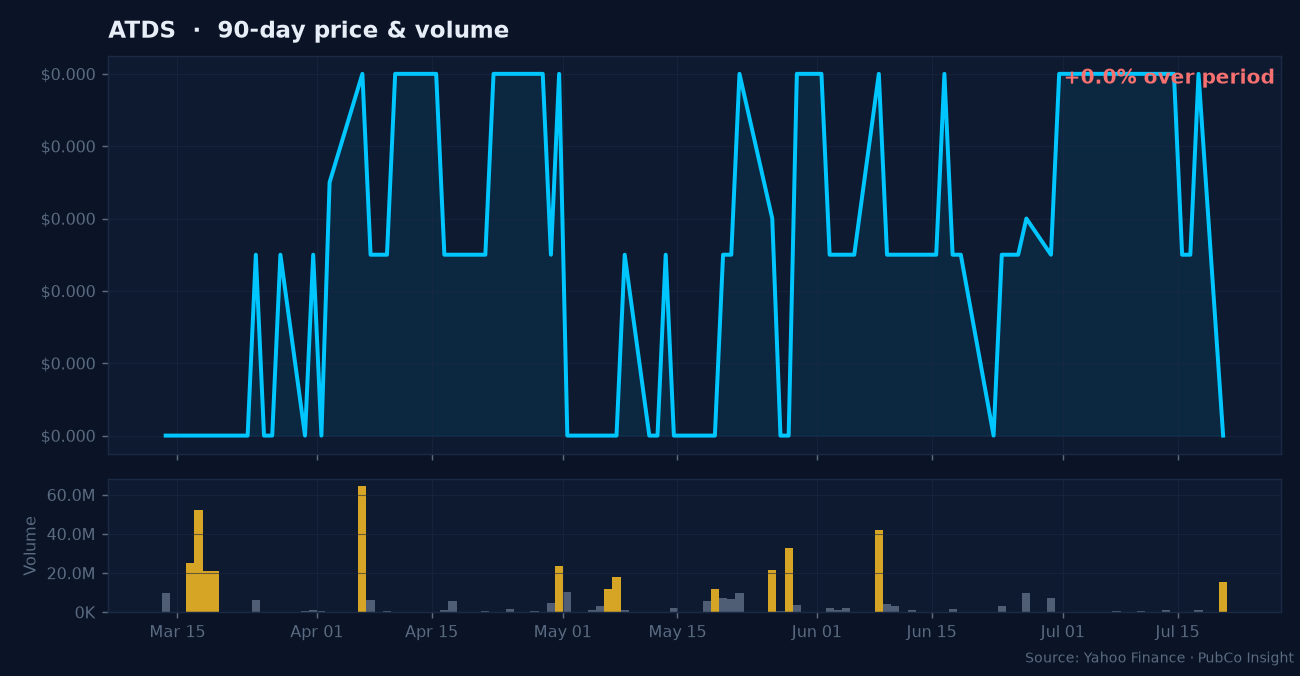
The 10-Q filed on May 14, 2026, for the period ending March 31, 2026, includes a standard 'going concern' qualification from management. This is not a new development for ATDS, but it is a recurring signal that the company's ability to continue as a viable entity for the next twelve months is dependent on securing additional financing. The filing also reports an accumulated deficit of approximately $175 million as of March 31, 2026, a substantial figure for a company with a market capitalization around $0.19 million. Such a deficit means the company has been consistently losing money since its inception.
Adding to the complexity are two identical 8-K filings on July 20, 2026, both disclosing material agreements. While the specifics of these agreements would require a deep dive into the exhibits, the repeated disclosure of Item 1.01 points to ongoing efforts to restructure debt or secure new financing. These types of agreements often involve the issuance of convertible notes or other dilutive securities, a common practice for micro-cap companies seeking capital. This constant capital raising can lead to significant dilution for existing shareholders as more shares are issued to new investors or to convert debt.
The company's share count stands at over 1.3 billion shares, a large number that can make even small price movements represent significant changes in market value. When a company with such a large share base repeatedly engages in material agreements to secure funding, the risk of further dilution is amplified. Retail investors should recognize that each new financing round, especially those involving convertible instruments, can add more shares to the market, potentially depressing the per-share value of existing holdings. For a closer look at how these mechanisms impact share value, consult our dilution risk resources.
The NT 10-K filing on March 31, 2026, indicated a delay in submitting its annual report, which can sometimes precede further compliance issues. While the 10-K was subsequently filed on April 16, 2026, the initial delay is a data point to consider in assessing operational efficiency and financial reporting rigor.
Investing in micro-cap companies like Data443 Risk Mitigation, Inc. requires a clear understanding of the financial realities presented in the SEC filings. The ongoing going concern warning, substantial accumulated deficit, and repeated material financing agreements are all factors that underscore the inherent risks. Investors should focus on the data, not just the narrative, to truly know what they own.
Primary sources (SEC EDGAR)
8-K 2026-07-20: https://www.sec.gov/Archives/edgar/data/1068689/000149315226033834/form8-k.htm8-K 2026-07-20: https://www.sec.gov/Archives/edgar/data/1068689/000149315226033828/form8-k.htm10-Q 2026-05-14: https://www.sec.gov/Archives/edgar/data/1068689/000149315226023102/form10-q.htm10-K 2026-04-16: https://www.sec.gov/Archives/edgar/data/1068689/000149315226016943/form10-k.htmNT 10-K 2026-03-31: https://www.sec.gov/Archives/edgar/data/1068689/000149315226014175/formnt10-k.htmSee the dilution and promotion flags before you see the pitch.
Each week: the micro and small-caps now showing dilution or paid-promotion signals, with the SEC filing behind every flag. No recommendations, no price targets.