Data443 Risk Mitigation (ATDS): Heavy Share Count Meets New Debt Obligations
ATDS
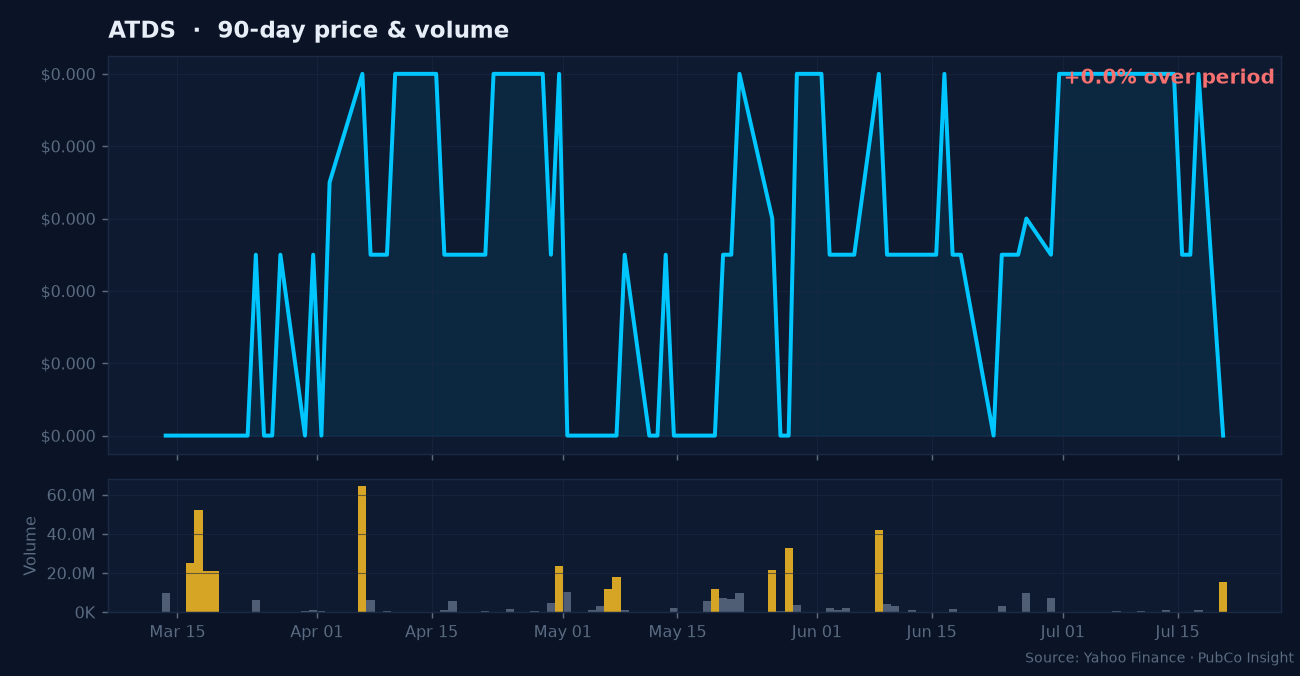
When a software company trades at a market capitalization of roughly $130,000 across a share base exceeding 1.3 billion shares, every new regulatory filing deserves scrutiny. Data443 Risk Mitigation, Inc. (ATDS) has spent recent quarters navigating the severe structural math that defines sub-penny OTC software firms, where common shares are plentiful and market value is minimal.
The company recently logged a pair of Form 8-K filings on July 20, 2026, disclosing events under Item 1.01 for entry into material definitive agreements and Item 2.03 for the creation of direct financial obligations. For micro-cap companies operating at this scale, new financial commitments typically mean debt, structured notes, or creditor accommodations designed to maintain liquidity.
These debt-related filings follow a sequence that began earlier in the year with an NT 10-K late-filing notice in March, eventually leading to a 10-K in April and a 10-Q in May. In the micro-cap arena, the combination of late annual reporting and subsequent material financial obligations is often a hallmark of tight balance sheet management. Investors monitoring capital structures can evaluate these mechanics with our dilution risk tracker.
With 1,313.42 million shares outstanding and minimal market capitalization backing the equity, any additional claims on assets or potential conversions from new debt instruments carry heavy structural weight. When debt obligations stack on top of a massive existing share count, the common equity sits at the very end of the repayment line.
Understanding the exact nature of newly created direct financial obligations is critical for anyone tracking ATDS. When the filings indicate fresh agreements and debt, the primary question is not just product traction, but how the capital structure will absorb the load.
Primary sources (SEC EDGAR)
8-K 2026-07-20: https://www.sec.gov/Archives/edgar/data/1068689/000149315226033834/form8-k.htm8-K 2026-07-20: https://www.sec.gov/Archives/edgar/data/1068689/000149315226033828/form8-k.htm10-Q 2026-05-14: https://www.sec.gov/Archives/edgar/data/1068689/000149315226023102/form10-q.htm10-K 2026-04-16: https://www.sec.gov/Archives/edgar/data/1068689/000149315226016943/form10-k.htmNT 10-K 2026-03-31: https://www.sec.gov/Archives/edgar/data/1068689/000149315226014175/formnt10-k.htmSee the dilution and promotion flags before you see the pitch.
Each week: the micro and small-caps now showing dilution or paid-promotion signals, with the SEC filing behind every flag. No recommendations, no price targets.