Data443 Risk Mitigation (ATDS) has 1.3 billion shares outstanding and a history of significant dilution
ATDS
Data443 Risk Mitigation, Inc. (ATDS) currently has an eye-popping 1.3 billion shares outstanding, a figure that dwarfs many micro-cap peers and sets a high bar for any meaningful per-share appreciation. The sheer volume of shares means that even modest capital raises or debt conversions can have a dramatic impact on existing shareholders, a dynamic that has been a consistent feature in the company's recent filings.
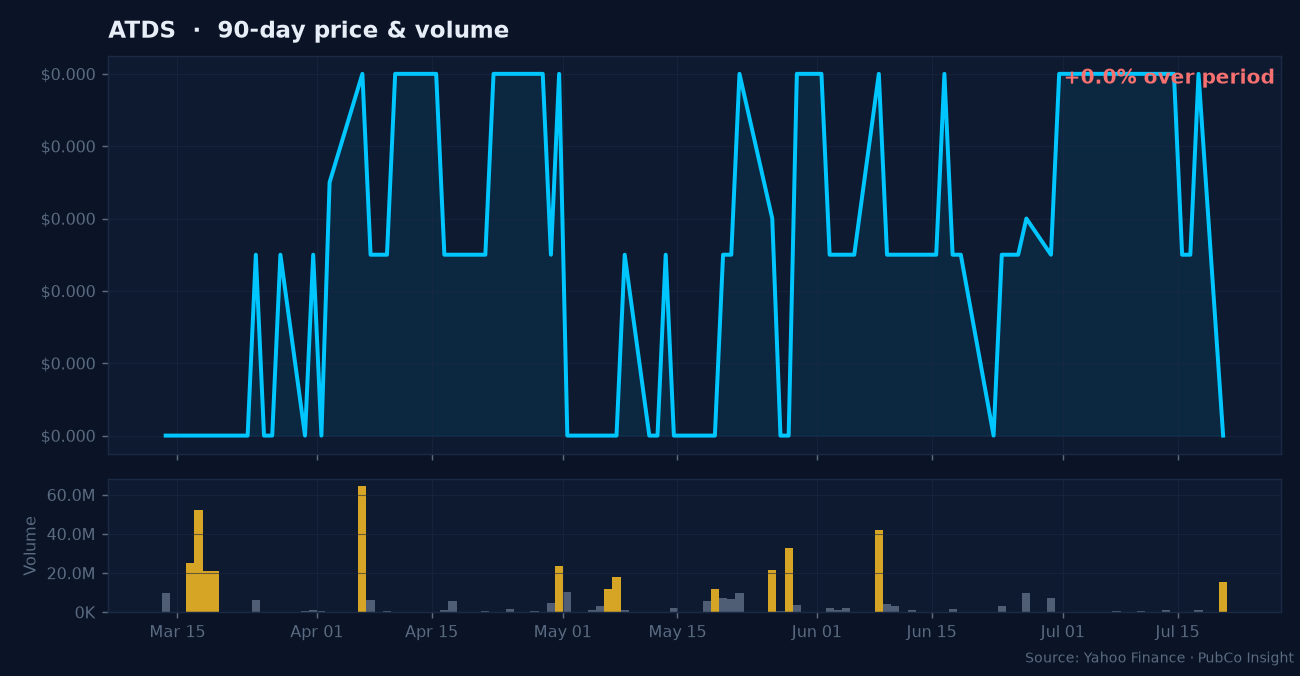
A review of the 10-Q filed on August 14, 2026, and the 10-K filed on April 16, 2026, reveals a capital structure frequently impacted by financing activities. These filings, along with recent 8-Ks detailing material agreements, consistently point to instruments that convert into common stock. This isn't just a theoretical concern; it's a practical mechanism for ongoing dilution that has contributed to the current share count.
For instance, the 8-K filed on September 2, 2026, describing a material agreement, and two similar 8-Ks filed on July 20, 2026, all under Item 1.01, signal continued adjustments to the company's financial arrangements. While the specifics of each agreement vary, the pattern of frequent financing events in a company with such a large existing share base suggests that the path to profitability, if achieved, will be spread across an ever-wider pool of common stock.
Understanding the implications of a billion-plus share count is crucial. Each new share issued, whether for debt repayment, operational funding, or acquisitions, reduces the ownership percentage of existing shareholders. This constant overhang can make it challenging for the stock price to gain traction, as any positive news is spread thinly across a massive number of shares. For more on how this impacts retail investors, see our dilution risk guide.
Investors in Data443 Risk Mitigation, Inc. (ATDS) should recognize that the company operates with a capital structure that has historically been very flexible in issuing new shares. This isn't necessarily a judgment on the business itself, but a factual observation of how the company has funded its operations and managed its liabilities. Knowing this reality is key to understanding the potential long-term value proposition.
The dry reality from the filings is that ATDS has a lot of shares, and has shown a willingness to issue more. Retail investors should ensure they are aware of the implications of this capital structure on their potential returns before making any investment decisions.
Primary sources (SEC EDGAR)
8-K 2026-09-02: https://www.sec.gov/Archives/edgar/data/1068689/000149315226041246/form8-k.htm10-Q 2026-08-14: https://www.sec.gov/Archives/edgar/data/1068689/000149315226038395/form10-q.htm8-K 2026-07-20: https://www.sec.gov/Archives/edgar/data/1068689/000149315226033834/form8-k.htm8-K 2026-07-20: https://www.sec.gov/Archives/edgar/data/1068689/000149315226033828/form8-k.htm10-Q 2026-05-14: https://www.sec.gov/Archives/edgar/data/1068689/000149315226023102/form10-q.htm10-K 2026-04-16: https://www.sec.gov/Archives/edgar/data/1068689/000149315226016943/form10-k.htmSee the dilution and promotion flags before you see the pitch.
Each week: the micro and small-caps now showing dilution or paid-promotion signals, with the SEC filing behind every flag. No recommendations, no price targets.