Data443 Risk Mitigation, Inc. (ATDS) and the persistent question of share count
ATDS
Data443 Risk Mitigation, Inc. (ATDS) has a market capitalization of $0.13 million, yet its share count stands at over 1.3 billion. This disparity, a hallmark of many micro-cap operations, raises immediate questions about per-share value and the mechanics of capital formation. While the company provides its required filings, the sheer volume of shares outstanding suggests a history of substantial equity financing, which often comes with a cost to existing shareholders.
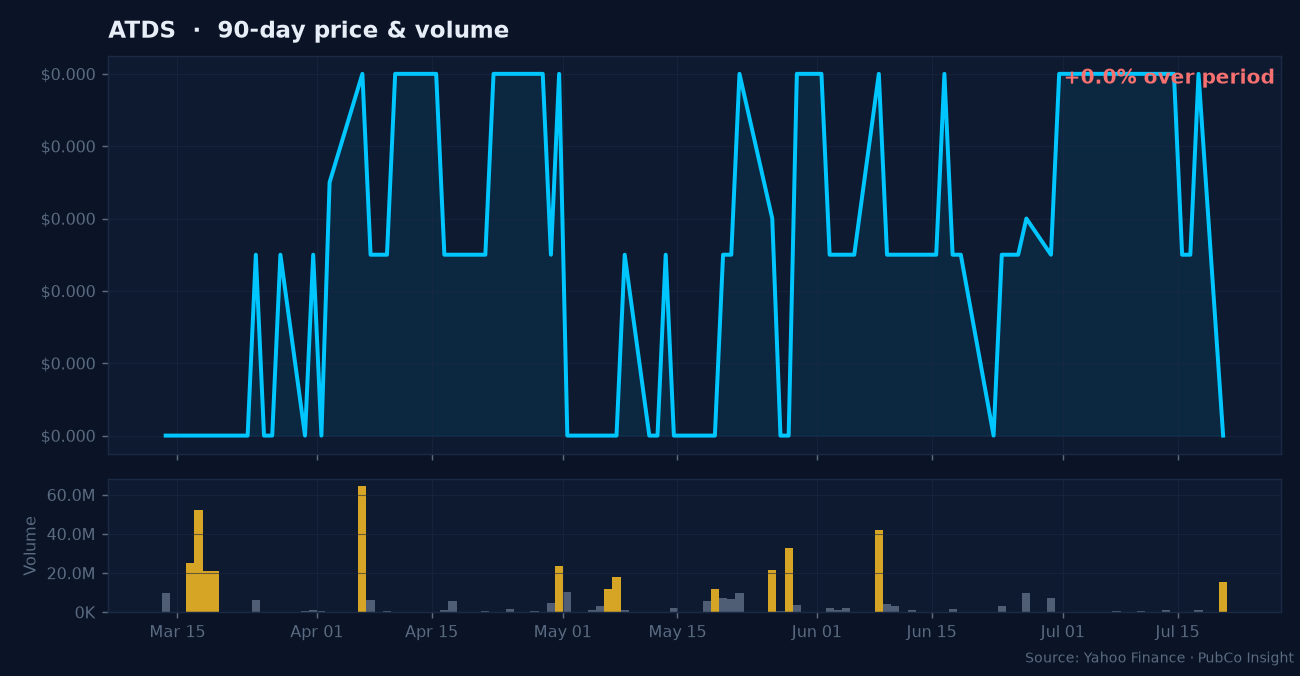
Recent 8-K filings from July and September 2026 detail material agreements. For a company with ATDS's profile, such agreements frequently precede or accompany further capital raises, often through the issuance of new shares or convertible instruments. These events, while necessary for operations or growth in some cases, can lead to significant dilution, eroding the ownership stake and potential returns for retail investors.
The company's latest 10-Q, filed in August 2026, would normally provide more granular detail on its financial health and any recent changes in its capital structure. However, the consistent pattern of material agreement 8-Ks suggests an ongoing need for financing. This constant capital acquisition cycle is a critical point of analysis for any micro-cap, as it directly impacts the denominator of all per-share metrics.
For investors tracking ATDS, understanding the full scope of these material agreements and their potential for future dilution is paramount. The market cap to share count ratio indicates that each share represents an extremely small fraction of the company's overall valuation. Any additional equity issuances, even small ones in dollar terms, could represent a substantial percentage increase in the total number of shares outstanding.
The financial statements and footnotes within the 10-Q and 10-K filings are the primary sources for understanding the true cost of these financing activities. Without a clear pathway to profitability or self-sustaining operations, companies in this position often rely on frequent capital raises, which can create a perpetual dilution treadmill for shareholders. Investors should carefully review these filings to gauge the extent and terms of recent and potential future share issuances. For more on how these mechanisms work, see our dilution risk primer.
It is not enough to simply note the share count; it is essential to trace its trajectory and the mechanisms driving its growth. For Data443 Risk Mitigation, Inc., the pattern of material agreements and a high share count signal a need for investors to remain vigilant about the potential for further dilution and its impact on their investment.
Primary sources (SEC EDGAR)
8-K 2026-09-02: https://www.sec.gov/Archives/edgar/data/1068689/000149315226041246/form8-k.htm10-Q 2026-08-14: https://www.sec.gov/Archives/edgar/data/1068689/000149315226038395/form10-q.htm8-K 2026-07-20: https://www.sec.gov/Archives/edgar/data/1068689/000149315226033834/form8-k.htm8-K 2026-07-20: https://www.sec.gov/Archives/edgar/data/1068689/000149315226033828/form8-k.htm10-Q 2026-05-14: https://www.sec.gov/Archives/edgar/data/1068689/000149315226023102/form10-q.htm10-K 2026-04-16: https://www.sec.gov/Archives/edgar/data/1068689/000149315226016943/form10-k.htmSee the dilution and promotion flags before you see the pitch.
Each week: the micro and small-caps now showing dilution or paid-promotion signals, with the SEC filing behind every flag. No recommendations, no price targets.