A Total Facelift for Avalanche Treasury Corp: Inside the June Flurry of Filings at AVAT
AVAT
When a micro-cap company drops an 8-K filing that triggers nearly a dozen different disclosure items at once, it is time to stop reading the press releases and start digging into the regulatory plumbing. On June 17, 2026, Avalanche Treasury Corp (AVAT) did exactly that, filing a massive Form 8-K that signaled a complete structural overhaul, including a change of control, material acquisitions, and a total shake-up of its leadership team.
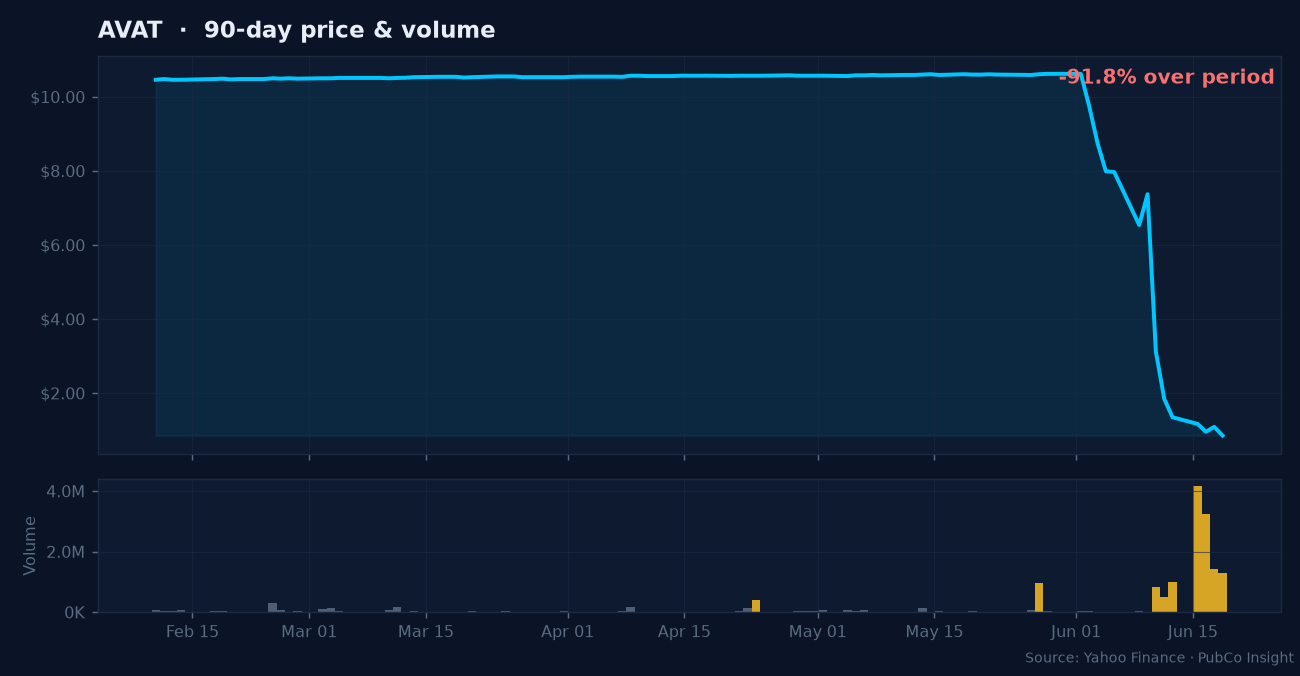
The sheer density of the disclosures is enough to give any retail investor pause. The June 17 filing checked boxes for Item 1.01 (Material Agreements), Item 2.01 (Acquisition or Disposition of Assets), Item 3.02 (Unregistered Sales of Equity Securities), and Item 5.01 (Changes in Control of Registrant). In the world of OTC stocks, this is the equivalent of a corporate heart transplant, wrapping up a series of transactions that fundamentally alters what AVAT actually is and who owns it.
This flurry of activity was already in motion earlier in the month. On June 11, 2026, the company filed multiple Form 3 statements indicating new beneficial ownership, alongside an Item 8.01 8-K. When control changes hands so rapidly, the risk of dilution and structural shifts spikes. The inclusion of Item 3.02 in the subsequent June 17 filing confirms that unregistered equity securities were part of the mix, a classic mechanism that can dilute existing shareholders before the public even fully understands the new business model.
To cap off this frantic month, Avalanche Treasury Corp filed its 10-Q on June 29, 2026. For a company valued at approximately 23.4 million dollars on the OTC exchange, these rapid-fire governance and balance sheet adjustments require close scrutiny. The combination of new management, unregistered share issuances, and fresh material agreements means that the historical financials in the 10-Q represent a past version of a company that has already been rewritten.
Investors looking at AVAT must look past the ticker symbol and realize they are evaluating a brand-new entity disguised under an old name. When a company reorganizes this quickly, the primary risk is not just operational execution, but understanding who holds the newly issued equity and on what terms. Know what you own, and keep a very close eye on the share count in the coming quarters.
Primary sources (SEC EDGAR)
10-Q 2026-06-29: https://www.sec.gov/Archives/edgar/data/2092446/000110465926078841/tmb-20260331x10q.htm8-K 2026-06-17: https://www.sec.gov/Archives/edgar/data/2092446/000110465926075150/tm2615904d7_8k.htm8-K 2026-06-11: https://www.sec.gov/Archives/edgar/data/2092446/000110465926072831/tm2615904d6_8k.htm3 2026-06-11: https://www.sec.gov/Archives/edgar/data/2092446/000110465926072830/xslF345X06/tm2617458-3_3seq1.xml3 2026-06-11: https://www.sec.gov/Archives/edgar/data/2092446/000110465926072829/xslF345X06/tm2617458-4_3seq1.xml3 2026-06-11: https://www.sec.gov/Archives/edgar/data/2092446/000110465926072826/xslF345X06/tm2617458-6_3seq1.xmlSee the dilution and promotion flags before you see the pitch.
Each week: the micro and small-caps now showing dilution or paid-promotion signals, with the SEC filing behind every flag. No recommendations, no price targets.