Behind the Shell Game: Parsing the Sudden Corporate Metamorphosis at Avalanche Treasury Corp (AVAT)
AVAT
When a micro-cap company changes its name, its leadership, and its entire business model in the span of a single week, retail investors are often left chasing a narrative that is moving much faster than the actual underlying business. Such is the case with Avalanche Treasury Corp (AVAT), a micro-cap entity that has recently experienced a whirlwind of corporate restructuring. While the market often greets such rapid transformations with speculative enthusiasm, a sober look at the regulatory filings reveals a complex web of transition that demands careful scrutiny.
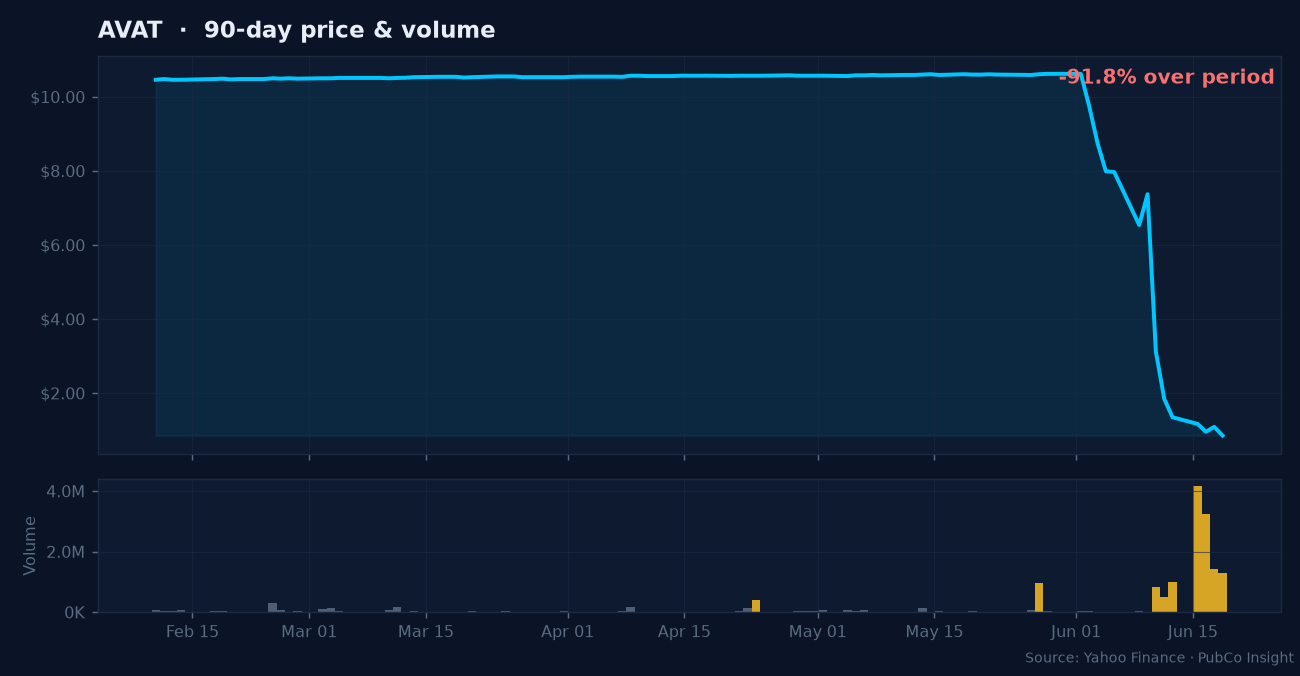
The catalyst for this sudden evolution came to light in a flurry of mid-June disclosures. On June 17, 2026, Avalanche Treasury Corp filed a comprehensive Form 8-K that triggered almost every major corporate transition alarm on the board. The filing documented a material definitive agreement, a significant acquisition, a change in control, and major amendments to the company's articles of incorporation. In short, the previous corporate shell is being rapidly hollowed out and replaced with an entirely new operational engine.
This is not a minor tune-up, it is a complete rebuild. According to the June 17 filing, the transaction included Item 3.02 for the unregistered sales of equity securities and Item 5.01 for a change of control. For retail shareholders, a change of control is a critical structural event that often leads to significant shifts in strategic direction and, crucially, dilution risk. When new controlling parties enter the picture, they frequently bring their own assets, debts, and equity-clearing arrangements that can dramatically alter the ownership slice of existing public investors.
The governance musical chairs continued into July. On July 6, 2026, Avalanche Treasury Corp filed another Form 8-K under Item 5.02, signaling further departures and appointments of key officers and directors. While fresh leadership is often marketed as a positive catalyst, consistent executive turnover can also point to a lack of operational stability. It takes time for a new management team to integrate newly acquired assets, and during these transitional phases, administrative costs can swell while actual revenue generation remains a distant milestone.
Before buying into the promise of a newly minted corporate treasury play, investors should evaluate the structural mechanics of these transactions. Rapid-fire acquisitions and equity issuances are the primary engines of dilution risk in the micro-cap ecosystem. With a market capitalization hovering around 23.5 million dollars, any significant issuance of new shares to satisfy acquisition agreements or to compensate incoming management can quickly dilute the value of public shares. Know what you own, and in the case of AVAT, that means recognizing that you are holding a company in the middle of a high-stakes, fast-moving corporate remodel where the final blueprint is still being drawn.
Primary sources (SEC EDGAR)
8-K 2026-07-06: https://www.sec.gov/Archives/edgar/data/2092446/000110465926080728/tm2619678d1_8k.htm10-Q 2026-06-29: https://www.sec.gov/Archives/edgar/data/2092446/000110465926078841/tmb-20260331x10q.htm8-K 2026-06-17: https://www.sec.gov/Archives/edgar/data/2092446/000110465926075150/tm2615904d7_8k.htm8-K 2026-06-11: https://www.sec.gov/Archives/edgar/data/2092446/000110465926072831/tm2615904d6_8k.htm3 2026-06-11: https://www.sec.gov/Archives/edgar/data/2092446/000110465926072830/xslF345X06/tm2617458-3_3seq1.xml3 2026-06-11: https://www.sec.gov/Archives/edgar/data/2092446/000110465926072829/xslF345X06/tm2617458-4_3seq1.xmlSee the dilution and promotion flags before you see the pitch.
Each week: the micro and small-caps now showing dilution or paid-promotion signals, with the SEC filing behind every flag. No recommendations, no price targets.