AVITA Medical, Inc. (AVHHL): Recent Filings Show Continuing Cash Burn
AVHHL
AVITA Medical, Inc. (AVHHL) recently filed its 10-Q for the period ending June 30, 2026, which reported a net loss of $11.2 million for the quarter. While the market often focuses on product news or strategic partnerships, the unglamorous reality of a company's financial health is found in these quarterly reports. For AVHHL, the consistent operating losses detailed in the filing are a primary point of attention for any shareholder.
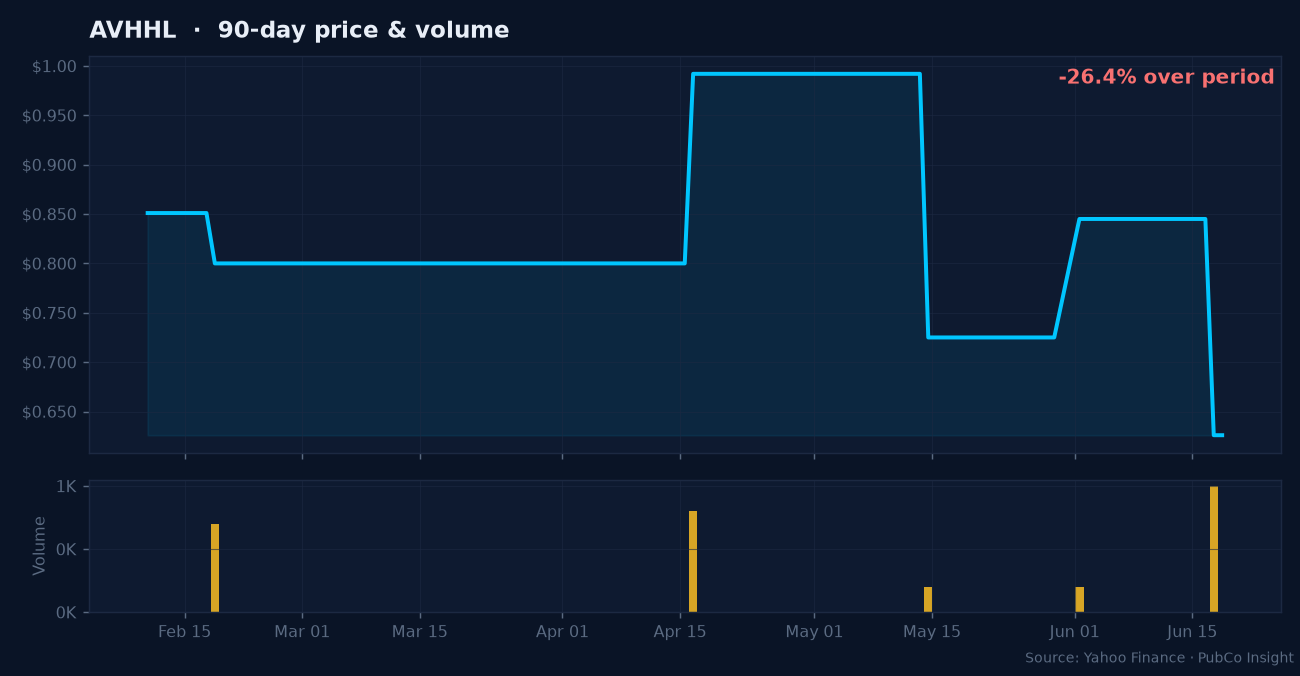
The 10-Q shows that AVITA Medical, Inc. is still in a phase where its operating expenses significantly outpace its revenue. While the company did report a material agreement on August 11, 2026, via an 8-K filing, and another on June 8, 2026, the financial impact of such agreements on the bottom line is not yet translating into profitability. Investors should consider whether these agreements are sufficient to reverse the current trend of cash consumption.
A look at the balance sheet within the 10-Q indicates that AVITA Medical, Inc. holds approximately $84.2 million in cash and cash equivalents as of June 30, 2026. While this provides a buffer, continued losses at the current rate would erode this capital over time. The company's ability to fund its operations without further dilutive financing or significant changes to its cost structure remains a key concern.
Shareholders should also be aware of the operational context. As a company in the Surgical & Medical Instruments & Apparatus sector, AVITA Medical, Inc. likely faces significant R&D and regulatory costs. These are often necessary for growth, but they also contribute to the burn rate seen in the financials. The pathway to sustained profitability in this industry can be long and capital-intensive.
The company's consistent reporting of losses in its latest 10-Q, alongside the announcement of new agreements, presents a narrative tension. On one hand, there are signals of ongoing business development. On the other, the fundamental financial reports continue to paint a picture of a company yet to achieve self-sufficiency. Retail investors should ensure they understand the implications of a business that, for now, is still spending more than it earns.
Primary sources (SEC EDGAR)
8-K 2026-08-11: https://www.sec.gov/Archives/edgar/data/1762303/000119312526344787/rcel-20260805.htm8-K/A 2026-08-06: https://www.sec.gov/Archives/edgar/data/1762303/000119312526338135/rcel-20260603.htm10-Q 2026-08-06: https://www.sec.gov/Archives/edgar/data/1762303/000119312526338101/rcel-20260630.htm8-K 2026-08-06: https://www.sec.gov/Archives/edgar/data/1762303/000119312526338011/rcel-20260806.htm4 2026-06-12: https://www.sec.gov/Archives/edgar/data/1762303/000119312526269544/xslF345X06/ownership.xml4 2026-06-10: https://www.sec.gov/Archives/edgar/data/1762303/000119312526266397/xslF345X06/ownership.xmlSee the dilution and promotion flags before you see the pitch.
Each week: the micro and small-caps now showing dilution or paid-promotion signals, with the SEC filing behind every flag. No recommendations, no price targets.