Awaysis Capital (AWCA): The Reality of Real Estate Ambitions Funded by Debt and Dilution
AWCA
Awaysis Capital, Inc. wants to be your gateway to leisure real estate, but the company's financial architecture looks more like a high-maintenance construction site. With a market capitalization hovering around 13.8 million dollars spread across a massive share count of over 409 million shares, the company's capital structure is already highly fragmented. For retail investors looking at the OTC ticker AWCA, the real story is not in the vacation brochures, but in the recurring pattern of debt and material agreements that keep the lights on.
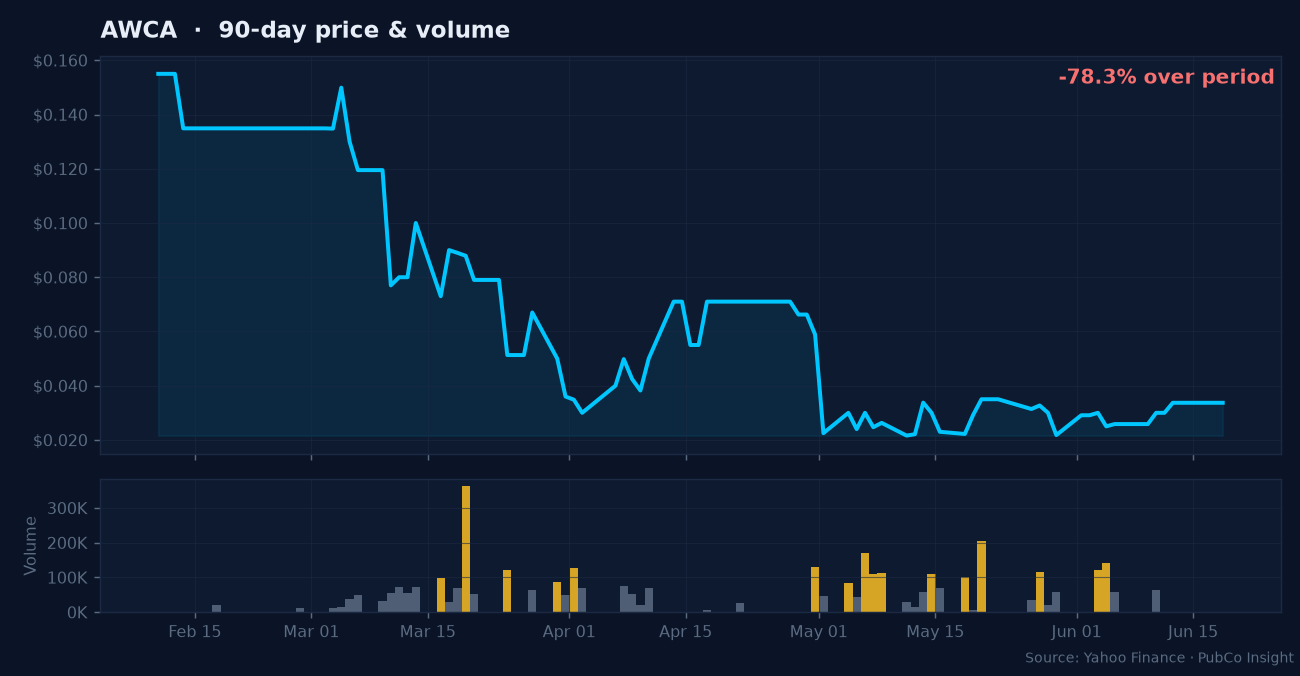
A look at the company's recent regulatory filings reveals a heavy reliance on structured financing. On April 9, 2026, Awaysis filed two separate Form 8-K reports under Items 1.01 and 2.03, signaling new material definitive agreements and the creation of direct financial obligations. This was not a one-off event. The company filed another similar pair of reports on February 17, 2026. When a micro-cap operator of nonresidential buildings repeatedly enters into these agreements, it typically means cash from operations is insufficient to fund its ambitions, forcing it to rely on external capital that often comes with dilutive strings attached.
These financing arrangements create a structural drag for common shareholders. When a company with over 409 million shares outstanding continues to leverage itself, the path to per-share value creation becomes incredibly steep. Every new debt agreement carrying conversion features or warrant attachments threatens to dilute existing investors further, while the interest obligations eat away at any potential operating income before it can ever reach the bottom line.
Sifting through the 10-Q filings from February and May of 2026 confirms that the operational reality remains small-scale, while the financial engineering is complex. Without a dramatic turn toward self-sustaining cash flow, AWCA is locked in a cycle of borrowing to fund operations, followed by filing updates to document the new debt. Investors must weigh the promise of the company's real estate portfolio against the concrete realities of its balance sheet. Know what you own, and recognize that in the micro-cap space, a cheap share price is often the result of an incredibly crowded share structure.
Primary sources (SEC EDGAR)
10-Q 2026-05-15: https://www.sec.gov/Archives/edgar/data/1021917/000149315226023863/form10-q.htm8-K 2026-04-09: https://www.sec.gov/Archives/edgar/data/1021917/000149315226015886/form8-k.htm8-K 2026-04-09: https://www.sec.gov/Archives/edgar/data/1021917/000149315226015885/form8-k.htm10-Q 2026-02-17: https://www.sec.gov/Archives/edgar/data/1021917/000149315226007178/form10-q.htm8-K 2026-02-17: https://www.sec.gov/Archives/edgar/data/1021917/000149315226007136/form8-k.htm8-K 2026-01-06: https://www.sec.gov/Archives/edgar/data/1021917/000149315226000614/form8-k.htmSee the dilution and promotion flags before you see the pitch.
Each week: the micro and small-caps now showing dilution or paid-promotion signals, with the SEC filing behind every flag. No recommendations, no price targets.