Aspira Women's Health Inc. (AWHL) Continues to Leverage Financings
AWHL
Aspira Women's Health Inc. (AWHL) recently announced a series of material agreements, including an 8-K filing on July 15, 2026, detailing a new financing arrangement. While the market often reacts to the promise of fresh capital, the mechanics of these deals, particularly for a micro-cap biotech on the OTC, frequently involve instruments that can lead to significant share dilution for existing shareholders.
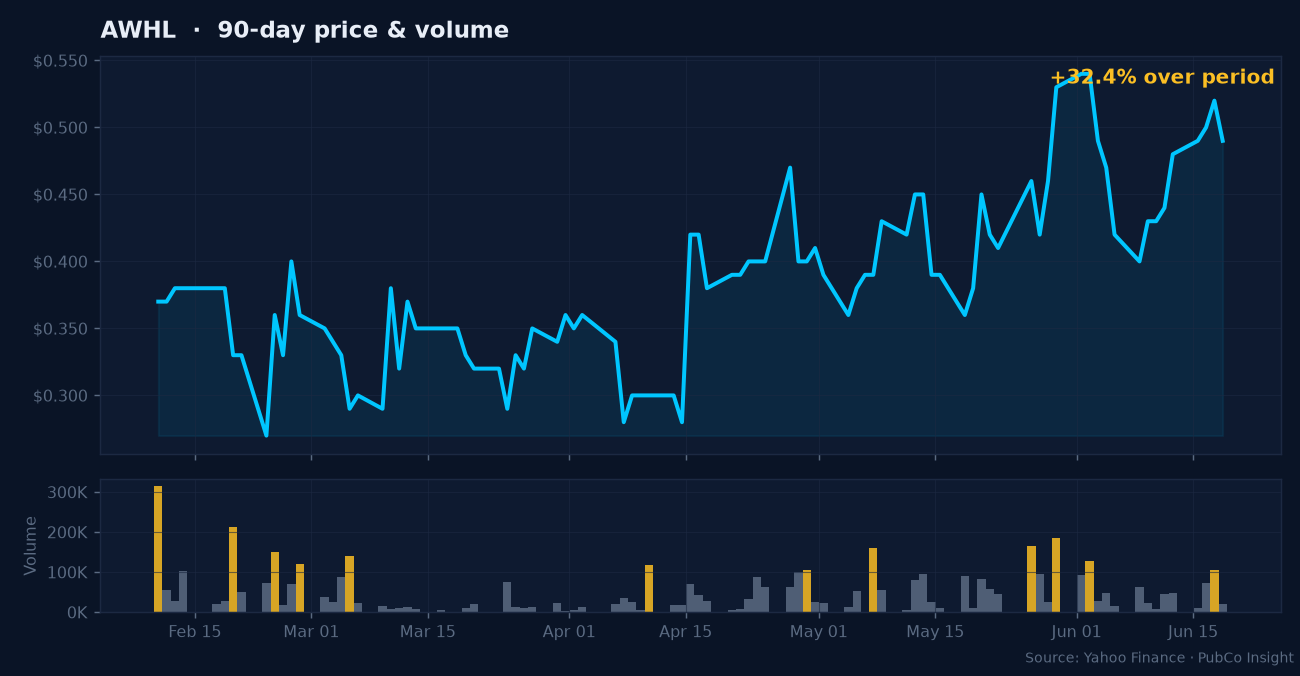
The July 15 8-K specifically highlighted items 1.01 and 2.03, indicating a material definitive agreement and the creation of a direct financial obligation or an obligation under an off-balance sheet arrangement. This follows other similar disclosures, such as an 8-K on June 9, 2026, which also referenced items 1.01 and 3.02 concerning material agreements and unregistered sales of equity securities. These filings suggest a reliance on capital raises that may convert into common stock.
For a company like AWHL, with a market capitalization around $21.58 million and 43.5 million shares outstanding, each new financing round carries the potential to significantly increase the share count. Unregistered sales of equity securities or convertible debt, while providing immediate capital, often set the stage for future dilution as those securities convert into common shares. This dynamic can suppress per-share value, even if the company's underlying business shows progress.
Investors should pay close attention to the terms of these financing agreements. When a company repeatedly uses these structures, it signals an ongoing need for capital that existing operations may not be generating. The cumulative effect of multiple rounds of convertible notes or equity sales can be substantial, and the market price may not always reflect the full impact of future conversions.
Understanding the implications of these frequent capital raises is crucial for AWHL shareholders. The company's consistent use of material agreements to secure financing, as detailed in recent 8-K filings, points to a pattern that could continue to weigh on the share structure. Investors can track these developments and their potential impact on share count at PubCo Insight's dilution risk tracker.
It is important to know what you own, especially when a company's financial strategy involves frequent recourse to capital markets through instruments that can expand the share base. The data in the filings, not just the headlines, provides the clearest picture of these structural risks.
Primary sources (SEC EDGAR)
4/A 2026-07-17: https://www.sec.gov/Archives/edgar/data/926617/000149315226033814/xslF345X06/ownership.xml4 2026-07-15: https://www.sec.gov/Archives/edgar/data/926617/000149315226033384/xslF345X06/ownership.xml8-K 2026-07-15: https://www.sec.gov/Archives/edgar/data/926617/000092661726000052/awhl-20260706x8k.htm3 2026-07-15: https://www.sec.gov/Archives/edgar/data/926617/000149315226033355/xslF345X06/ownership.xml8-K/A 2026-07-07: https://www.sec.gov/Archives/edgar/data/926617/000092661726000050/awhl-20260617x8ka.htmD 2026-06-22: https://www.sec.gov/Archives/edgar/data/926617/000110465926076151/xslFormDX01/primary_doc.xmlSee the dilution and promotion flags before you see the pitch.
Each week: the micro and small-caps now showing dilution or paid-promotion signals, with the SEC filing behind every flag. No recommendations, no price targets.