Aspira Women's Health Inc. (AWHL) Continues to Navigate Financings
AWHL
Aspira Women's Health Inc. (AWHL) has been busy on the financing front, with a series of material agreements surfacing in recent filings. While the market often focuses on product pipelines or clinical progress for biotech firms, the reality for many micro-caps like AWHL is that financing activity often dictates the immediate shareholder experience. The latest 8-K filed on July 15, 2026, details a new material agreement and a concurrent asset disposition, signaling ongoing efforts to secure capital and manage its balance sheet.
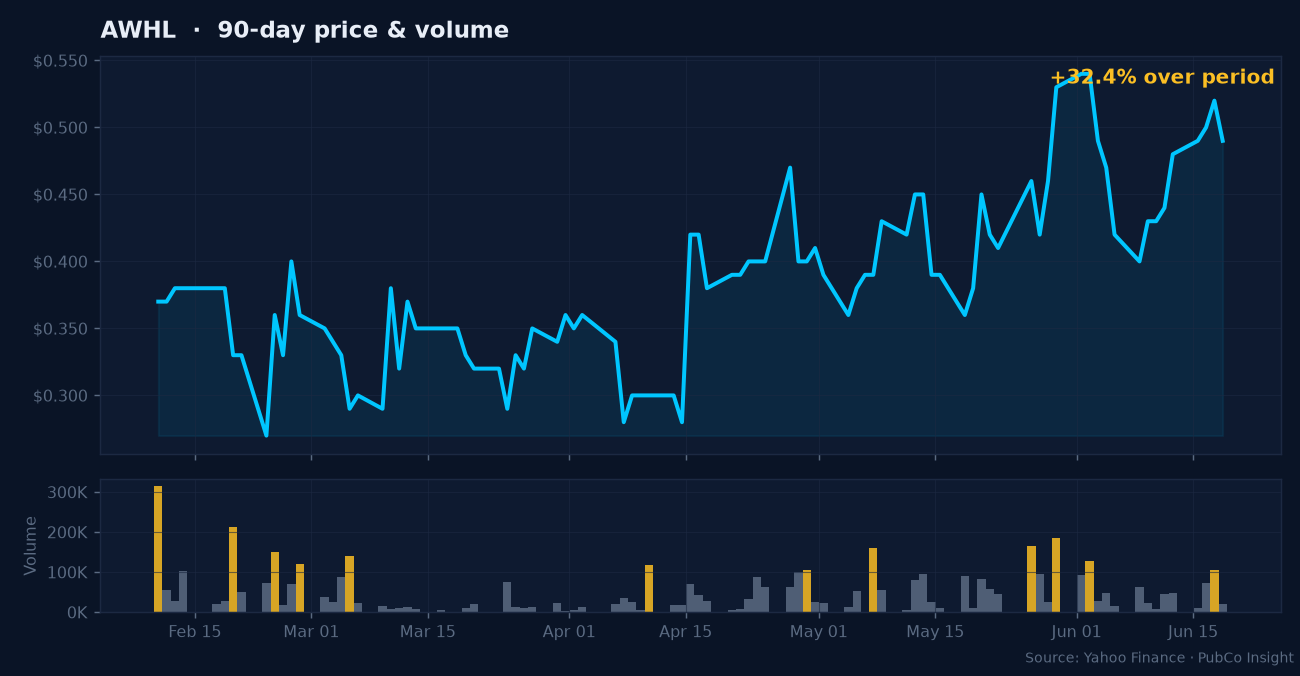
This is not an isolated event. Prior 8-K filings from June 9, 2026, and May 26, 2026, also highlighted material agreements, many of which involve debt or equity financings. For a company with a market capitalization of just over $14 million, frequent capital raises can be a double-edged sword: they provide necessary operating funds but can also lead to significant dilution for existing shareholders.
The details of these agreements, particularly the terms related to warrants, convertible notes, or new share issuances, are critical for understanding the potential future share count. Without a clear path to profitability, companies often rely on a cycle of dilutive financing to sustain operations. This can create a treadmill effect where new capital is raised at the expense of per-share value.
Investors in AWHL should be particularly attentive to the specifics of these financing arrangements. Understanding the conversion prices of any convertible instruments or the exercise prices of warrants will provide insight into the potential downward pressure on the stock from future share issuances. The company's dilution risk remains a key consideration, as indicated by its recent filing history.
While securing capital is essential for any development-stage biotech, the frequency and structure of these financings for Aspira Women's Health Inc. suggest that the company is actively managing its liquidity through methods that can impact share structure. As always, a careful review of the actual terms in the SEC filings is more informative than any promotional material.
Knowing what you own means understanding the mechanics of how a company funds itself, especially when those mechanics involve frequent capital raises that can redefine the value of each share.
Primary sources (SEC EDGAR)
4/A 2026-07-17: https://www.sec.gov/Archives/edgar/data/926617/000149315226033814/xslF345X06/ownership.xml4 2026-07-15: https://www.sec.gov/Archives/edgar/data/926617/000149315226033384/xslF345X06/ownership.xml8-K 2026-07-15: https://www.sec.gov/Archives/edgar/data/926617/000092661726000052/awhl-20260706x8k.htm3 2026-07-15: https://www.sec.gov/Archives/edgar/data/926617/000149315226033355/xslF345X06/ownership.xml8-K/A 2026-07-07: https://www.sec.gov/Archives/edgar/data/926617/000092661726000050/awhl-20260617x8ka.htmD 2026-06-22: https://www.sec.gov/Archives/edgar/data/926617/000110465926076151/xslFormDX01/primary_doc.xmlSee the dilution and promotion flags before you see the pitch.
Each week: the micro and small-caps now showing dilution or paid-promotion signals, with the SEC filing behind every flag. No recommendations, no price targets.