Aspira Women's Health Inc. (AWHL) Refinances Debt, Signals Future Capital Needs
AWHL
Aspira Women's Health Inc. (AWHL) recently announced a significant debt refinancing, converting existing notes and accrued interest into new convertible promissory notes. While presented as a strategic move to manage debt, a closer look at the 8-K filed on July 15, 2026, shows that this restructuring introduces new mechanisms for potential shareholder dilution.
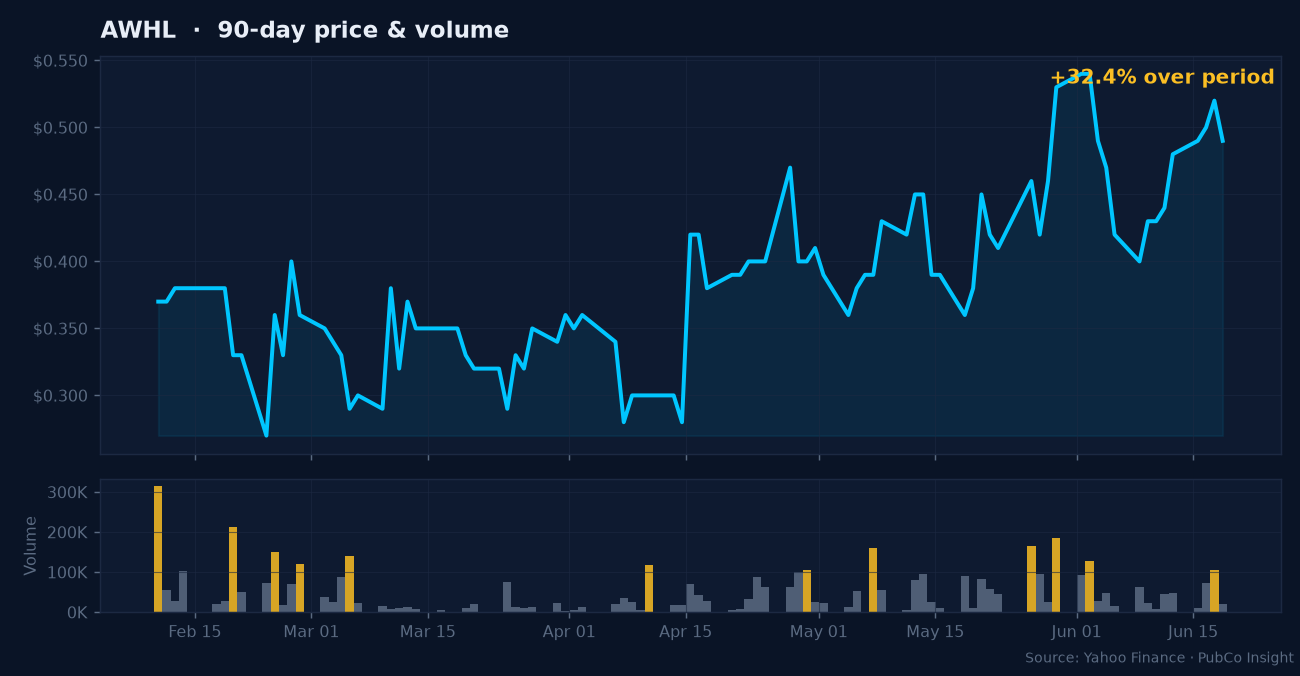
The company converted approximately $1.1 million in principal and accrued interest from prior notes into new 10% senior secured convertible promissory notes. This effectively kicks the can down the road on immediate cash repayment but introduces a new class of debt that can be converted into common stock. For retail investors, this means that while the company has addressed a near-term liquidity concern, it has done so by creating a potential overhang of future shares that could hit the market.
The terms of these new convertible notes are critical. Such instruments often come with conversion prices tied to the market price at the time of conversion, or with fixed discounts, meaning that the noteholders could convert their debt into shares at a price below the prevailing market rate. This dynamic can exert downward pressure on the stock price as new shares are issued, increasing the total share count and diluting the value of existing holdings. PubCo Insight maintains a close watch on such financings at pubcoinsight.com/dilution-risk/.
Further, the company's continuous need for financing, evidenced by multiple material agreements detailed in recent 8-K filings on June 9, 2026, and May 26, 2026, suggests an ongoing capital requirement. Biotech firms, particularly those in the diagnostic space like Aspira, often require substantial and sustained investment for research, development, and commercialization. The pattern of converting debt to equity is a common way for such companies to fund operations without immediate cash outlays, but it invariably comes at a cost to existing shareholders through dilution.
Investors should recognize that while refinancing can be a necessary step for a company to continue operations, the chosen method in this case points to a reliance on future equity issuance. The immediate relief from debt obligations is balanced by the structural risk of an expanded share count. It is not an uncommon path for micro-cap firms, but it is one that requires careful consideration of what it means for per-share value.
Understanding the implications of convertible debt is essential for any investor in Aspira Women's Health Inc. The company has secured additional runway, but that runway is paved with potential future shares. Know what you own, and what could own a piece of it in the future.
Primary sources (SEC EDGAR)
4/A 2026-07-17: https://www.sec.gov/Archives/edgar/data/926617/000149315226033814/xslF345X06/ownership.xml4 2026-07-15: https://www.sec.gov/Archives/edgar/data/926617/000149315226033384/xslF345X06/ownership.xml8-K 2026-07-15: https://www.sec.gov/Archives/edgar/data/926617/000092661726000052/awhl-20260706x8k.htm3 2026-07-15: https://www.sec.gov/Archives/edgar/data/926617/000149315226033355/xslF345X06/ownership.xml8-K/A 2026-07-07: https://www.sec.gov/Archives/edgar/data/926617/000092661726000050/awhl-20260617x8ka.htmD 2026-06-22: https://www.sec.gov/Archives/edgar/data/926617/000110465926076151/xslFormDX01/primary_doc.xmlSee the dilution and promotion flags before you see the pitch.
Each week: the micro and small-caps now showing dilution or paid-promotion signals, with the SEC filing behind every flag. No recommendations, no price targets.