Kiora Pharmaceuticals (BCLI): Inside the Regulatory Paper Trail of a $9 Million Biotech
BCLI
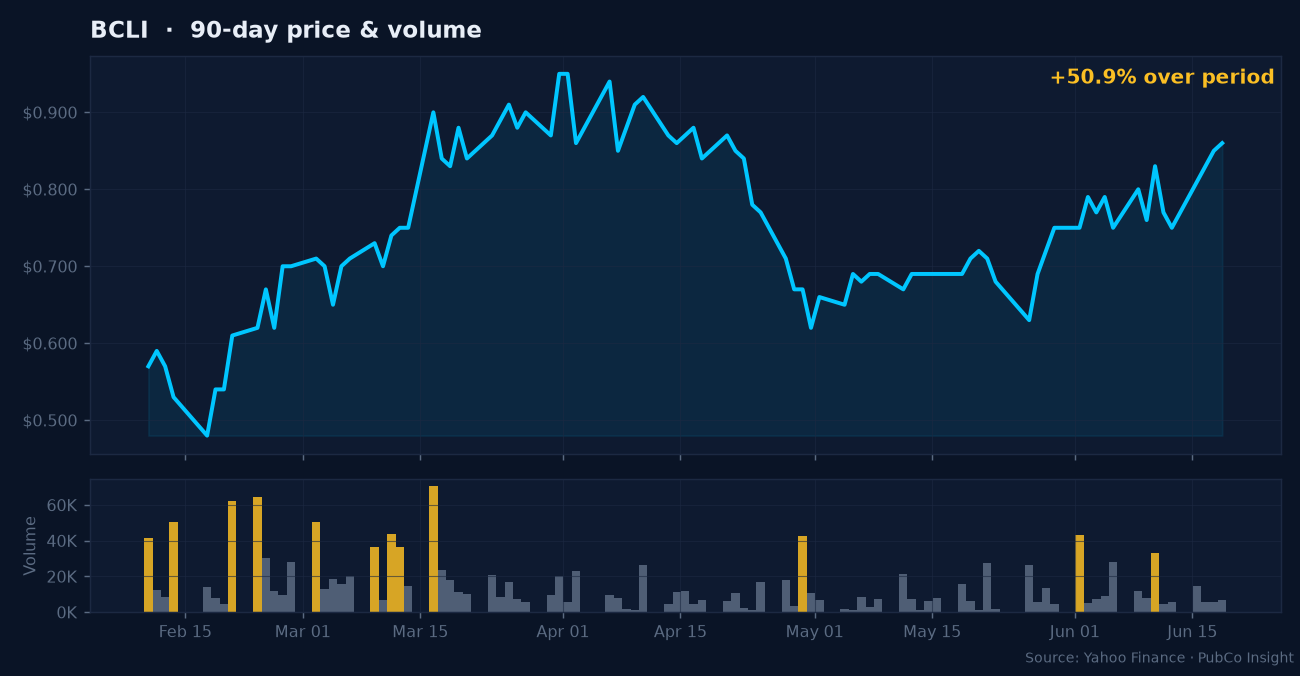
Biotech microcaps often survive on a delicate balance of regulatory filings and capital raises, and Kiora Pharmaceuticals (BCLI) is no exception. With a market capitalization hovering around 9.5 million dollars and approximately 11 million shares outstanding, this OTC-listed pharmaceutical preparation developer operates in a high-stakes environment where administrative paperwork often tells a more compelling story than the clinical headlines.
A look at the recent SEC ledger reveals a flurry of activity in mid-June 2026. Specifically, on June 12, 2026, a cluster of five Form 4 filings hit the database, indicating direct activity by company insiders. While insider transactions can sometimes signal alignment with broader shareholder interests, they also serve as a reminder of the heavily concentrated ownership structure typical of companies in this valuation tier.
Beyond the insider activity, the company’s broader filing history points to structural financing mechanisms that retail investors must monitor closely. In April 2026, Kiora filed an 8-K under Item 1.01 and Item 3.02, denoting a material definitive agreement and an unregistered sale of equity securities. These types of transactions are the lifeblood of pre-revenue drug developers, but they often come with dilution risks that chip away at existing shareholder value over time.
With a dilution risk score of 20 and a promotion risk score of 12, Kiora is not the most aggressive diluter on the OTC market, but its reliance on periodic capital injections is clear. The presence of S-filings, 424B prospectuses, and quarterly reports in its recent history confirms that the company remains on a continuous treadmill of regulatory compliance and capital seeking.
For retail investors, evaluating a microcap biotech requires looking past the potential of the pipeline to focus on the reality of the balance sheet. When a company operates with a single-digit million-dollar valuation, every unregistered equity sale and material agreement has the potential to reshape the ownership structure. Know what you own, and keep a close eye on the next quarterly filing to see how much runway this capital structure actually has left.
Primary sources (SEC EDGAR)
8-K 2026-06-18: https://www.sec.gov/Archives/edgar/data/1372514/000137251426000063/kprx-20260618.htm4 2026-06-12: https://www.sec.gov/Archives/edgar/data/1372514/000186151926000002/xslF345X06/wk-form4_1781295377.xml4 2026-06-12: https://www.sec.gov/Archives/edgar/data/1372514/000185520726000002/xslF345X06/wk-form4_1781295365.xml4 2026-06-12: https://www.sec.gov/Archives/edgar/data/1372514/000189579526000001/xslF345X06/wk-form4_1781295350.xml4 2026-06-12: https://www.sec.gov/Archives/edgar/data/1372514/000179379626000002/xslF345X06/wk-form4_1781295336.xml4 2026-06-12: https://www.sec.gov/Archives/edgar/data/1372514/000171157626000002/xslF345X06/wk-form4_1781295304.xmlSee the dilution and promotion flags before you see the pitch.
Each week: the micro and small-caps now showing dilution or paid-promotion signals, with the SEC filing behind every flag. No recommendations, no price targets.