Bio Green Med Solution, Inc. Floats Big Mergers on a Tiny Balance Sheet: Inside BGMSP
BGMSP
When a company with a market capitalization hovering around 3.3 million dollars starts filing S-4 registration statements and Form 425 merger communications, retail investors should immediately look past the press releases and focus on the cold reality of the balance sheet. Bio Green Med Solution, Inc. (BGMSP) is currently attempting to navigate complex corporate maneuvers, but the underlying numbers tell a story of a very small company taking on outsized structural complexity.
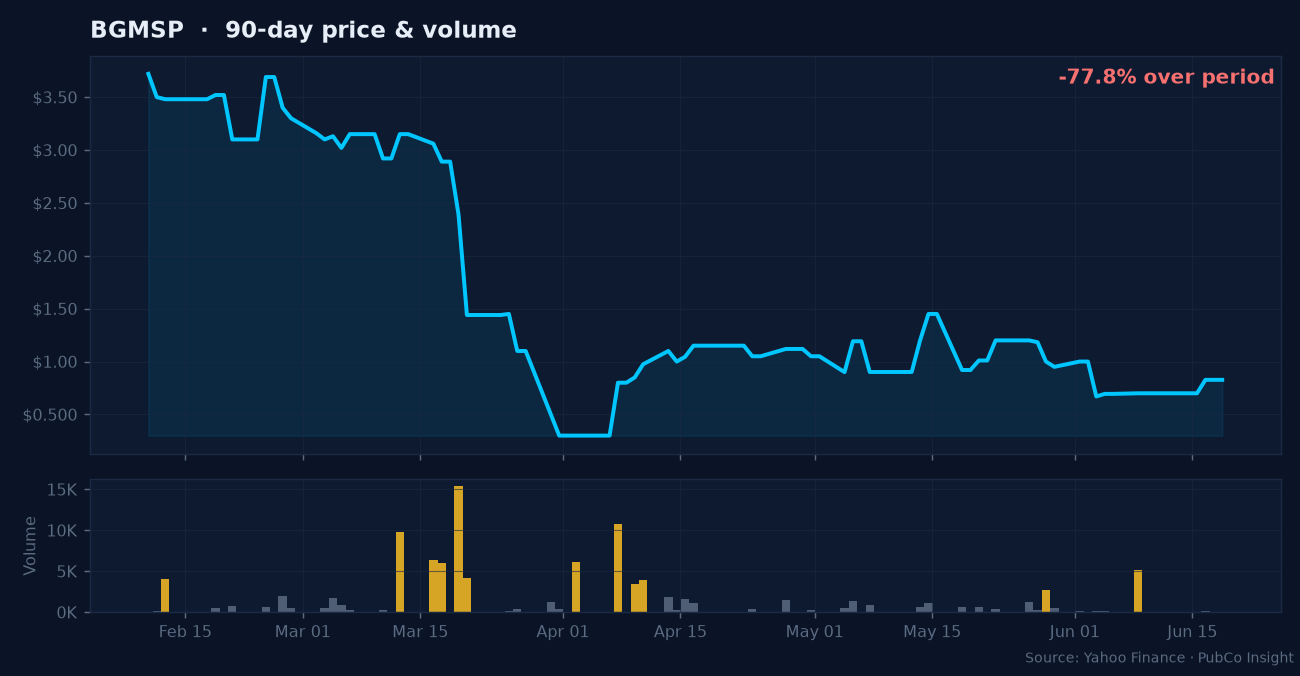
A review of the company filings from May and June of 2026 reveals a rapid-fire sequence of corporate actions. Following its quarterly report on May 15, 2026, Bio Green Med Solution, Inc. executed material agreements on June 4 and June 10, quickly followed by an S-4 filing on June 16 and a shareholder vote on June 22. This flurry of activity, including an Item 3.02 unregistered sales of equity securities, indicates that the company is actively reshaping its capital structure in ways that could dilute existing shareholders.
The risk with micro-cap companies pursuing major mergers or acquisitions is the cost of admission. With only 6.62 million shares outstanding, any significant share issuance to fund these transactions can rapidly dilute current owners. The June 10 Form 8-K specifically highlights both a material definitive agreement and an unregistered sale of equity, a classic mechanism for micro-caps to fund operations or acquisitions when traditional, non-dilutive financing is unavailable.
Furthermore, when a company of this size files an S-4, it signal that it is issuing new securities to complete a business combination. While management often frames these moves as transformative growth, the filings show that the administrative, legal, and regulatory costs of maintaining these structures can quickly drain the limited cash reserves of a 3.3 million dollar pharmaceutical preparation firm.
Investors in BGMSP must look beyond the ambition of these filings and weigh them against the financial reality. When a micro-cap company enters a cycle of rapid agreements, equity issuances, and merger filings, the primary risk is that the complexity of the corporate structure outgrows the viability of the underlying business. Know what you own, and keep a close eye on how many new shares are being minted to fund these corporate ambitions.
Primary sources (SEC EDGAR)
8-K 2026-06-22: https://www.sec.gov/Archives/edgar/data/1130166/000149315226029452/form8-k.htmS-4 2026-06-16: https://www.sec.gov/Archives/edgar/data/1130166/000149315226028882/forms-4.htm8-K 2026-06-10: https://www.sec.gov/Archives/edgar/data/1130166/000149315226028072/form8-k.htm425 2026-06-04: https://www.sec.gov/Archives/edgar/data/1130166/000149315226027294/form425.htm8-K 2026-06-04: https://www.sec.gov/Archives/edgar/data/1130166/000149315226027291/form8-k.htm10-Q 2026-05-15: https://www.sec.gov/Archives/edgar/data/1130166/000149315226023800/form10-q.htmSee the dilution and promotion flags before you see the pitch.
Each week: the micro and small-caps now showing dilution or paid-promotion signals, with the SEC filing behind every flag. No recommendations, no price targets.