Bimini Capital Management: Inside the Complexity of BMNM's Microcap Capital Structure
BMNM
Bimini Capital Management (BMNM) operates in a corner of the public markets where complexity often masks the underlying economic reality. With a market capitalization of approximately 25 million dollars spread across just over 10 million shares, this OTC traded entity represents a highly specialized bet on mortgage backed securities and advisory fee streams. While the company presents itself as a sophisticated manager of residential mortgage portfolios, the filings reveal a structure where retail shareholders sit at the very end of a long, complicated table.
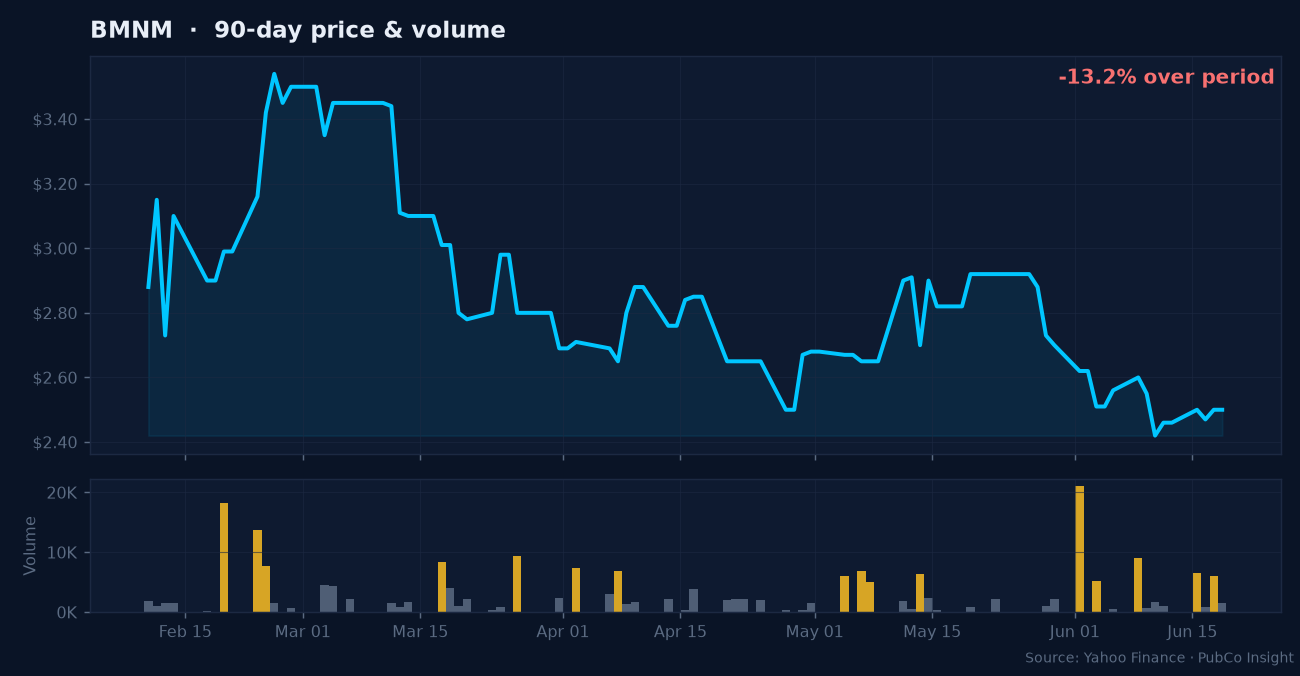
The company's recent regulatory filings, including a first-quarter 10-Q filed on May 8, 2026, and subsequent governance updates in June, highlight the intricate machinery keeping Bimini afloat. In the mortgage REIT and advisory space, performance is highly sensitive to interest rate volatility and hedging costs. For a microcap like Bimini, managing these macro headwinds is made more difficult by a capital structure that offers limited flexibility and thin liquidity, leaving ordinary investors to absorb the impact of sudden valuation swings in the underlying portfolio.
Governance and insider transactions also warrant close inspection. Recent Form 4/A amendments and 8-K filings from June 2026 detail executive transactions and voting outcomes from the annual meeting. In microcaps of this size, insider ownership can be a double edged sword. While it may align management with shareholders, it can also concentrate voting power to a degree that makes outside minority voices practically irrelevant. When a small group controls the board, strategic pivots or compensation structures can be pushed through with minimal resistance.
Furthermore, Bimini's business model relies heavily on its relationship with Orchid Island Capital, the larger REIT it manages. This fee-dependent relationship means Bimini's financial health is inextricably linked to another entity's performance and capital raising capabilities. If Orchid's assets under management contract, Bimini's advisory revenues follow suit, creating a compounding risk factor that is entirely out of BMNM shareholders' direct control.
Investing in microcap financial structures requires a sober assessment of both the balance sheet and the corporate architecture. Bimini is not a simple play on housing or interest rates, it is a complex, fee-driven vehicle with concentrated governance. Investors should look closely at the fee structures and insider control before deciding if this specialized vehicle fits their risk tolerance.
Primary sources (SEC EDGAR)
8-K/A 2026-06-17: https://www.sec.gov/Archives/edgar/data/1275477/000143774926020862/bcmi20260522_8ka.htm8-K 2026-06-09: https://www.sec.gov/Archives/edgar/data/1275477/000143774926020023/bcmi20260608_8k.htm4/A 2026-06-09: https://www.sec.gov/Archives/edgar/data/1275477/000143774926019937/xslF345X06/rdgdoc.xml4/A 2026-06-09: https://www.sec.gov/Archives/edgar/data/1275477/000143774926019935/xslF345X06/rdgdoc.xml10-Q 2026-05-08: https://www.sec.gov/Archives/edgar/data/1275477/000143774926015844/bcmi20260331_10q.htm8-K 2026-05-07: https://www.sec.gov/Archives/edgar/data/1275477/000143774926015631/bcmi20260115_8k.htmSee the dilution and promotion flags before you see the pitch.
Each week: the micro and small-caps now showing dilution or paid-promotion signals, with the SEC filing behind every flag. No recommendations, no price targets.