Bright Mountain Media (BMTM) Trades Under a Persistent Going Concern Flag
BMTM
Bright Mountain Media, Inc. (BMTM), a microcap trading on the OTC markets, carries a market capitalization just shy of $1.3 million, yet its latest 10-Q filing from May 2026 continues to highlight a going concern warning. This isn't a new development, but rather a persistent red flag that investors should note when considering the company's operational viability, especially when a business trades with 183.96 million shares outstanding at such a low valuation.
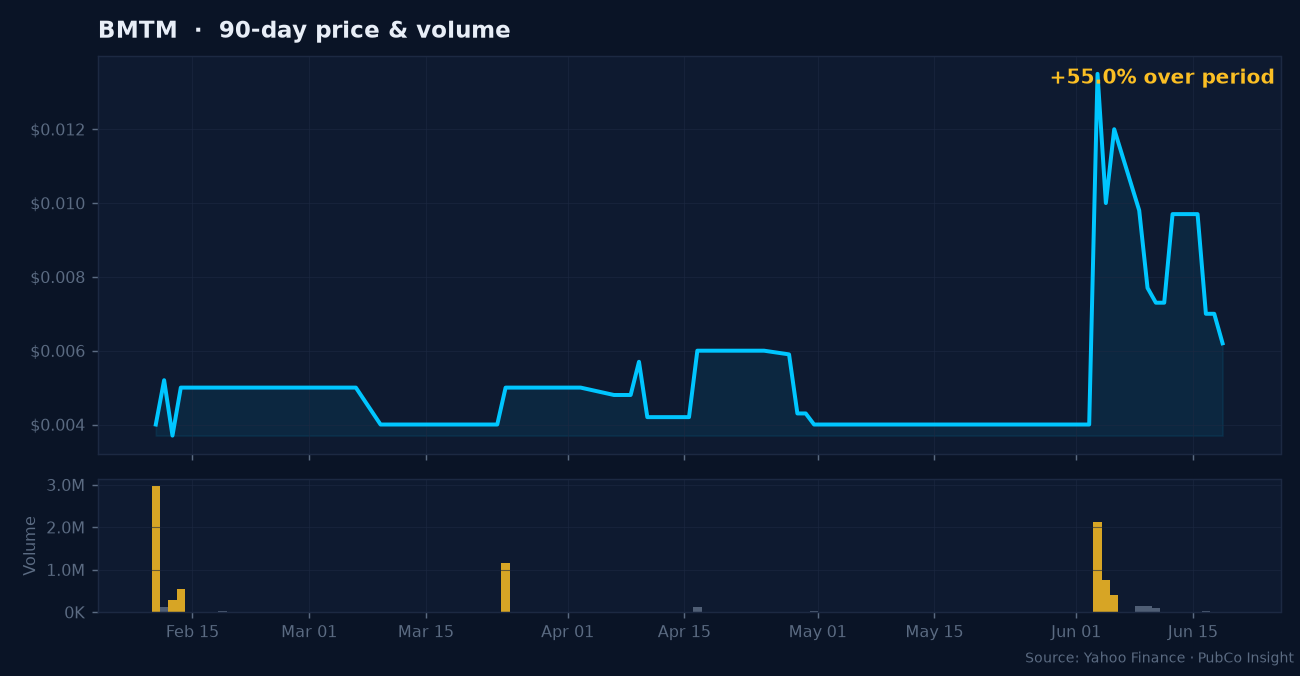
The going concern disclosure indicates substantial doubt about BMTM's ability to continue as an ongoing business, primarily due to recurring losses from operations and negative cash flows. While the company has announced various corporate actions, including an 8-K in June 2026 regarding a material agreement, these filings do not directly address the fundamental financial challenges outlined in the most recent quarterly report. Investors often focus on news events, but the quarterly filings provide the unglamorous reality of a company's financial health.
For microcap companies, a going concern warning is more than boilerplate language. It signals that the company's ability to fund its operations, meet its obligations, and avoid potential bankruptcy is uncertain. This can lead to significant shareholder dilution as the company seeks to raise capital through equity offerings, or it can result in a complete loss of investment if the company fails to secure sufficient financing.
The company's SIC description as "Services-Computer Programming Services" suggests a business that should theoretically scale with less capital intensity than, say, a manufacturing operation. However, the consistent going concern flag suggests that BMTM has struggled to achieve profitability or generate positive cash flow from its core operations, despite its sector.
Understanding the implications of a going concern warning is crucial for retail investors. It means that any investment in BMTM carries an elevated risk of capital impairment, irrespective of any short-term market movements or news. Always read the 10-Q, particularly the footnotes and management's discussion, to grasp the full financial picture behind the headlines.
Primary sources (SEC EDGAR)
8-K 2026-06-16: https://www.sec.gov/Archives/edgar/data/1568385/000119312526272407/bmtm-20260616.htm4 2026-05-19: https://www.sec.gov/Archives/edgar/data/1568385/000147450626000012/xslF345X06/primary_doc.xml3 2026-05-19: https://www.sec.gov/Archives/edgar/data/1568385/000147450626000011/xslF345X06/primary_doc.xmlSCHEDULE 13G/A 2026-05-15: https://www.sec.gov/Archives/edgar/data/1568385/000119312526226617/xslSCHEDULE_13G_X02/primary_doc.xml8-K 2026-05-12: https://www.sec.gov/Archives/edgar/data/1568385/000119312526219222/bmtm-20260512.htm10-Q 2026-05-12: https://www.sec.gov/Archives/edgar/data/1568385/000119312526219218/bmtm-20260331.htmSee the dilution and promotion flags before you see the pitch.
Each week: the micro and small-caps now showing dilution or paid-promotion signals, with the SEC filing behind every flag. No recommendations, no price targets.