Bright Mountain Media Inc (BMTM) Navigates Capital Constraints as Share Count Climbs
BMTM
Bright Mountain Media Inc has managed to accumulate a massive capital structure of 183.96 million shares outstanding, yet the market currently values the entire enterprise at just over 1.1 million dollars. This stark mathematical disconnect is the first thing that hits you when reviewing the company's regulatory filings. For an OTC-traded company, having a share count that resembles a mid-cap corporation paired with a microcap market valuation is a structural headache that is incredibly difficult to cure.
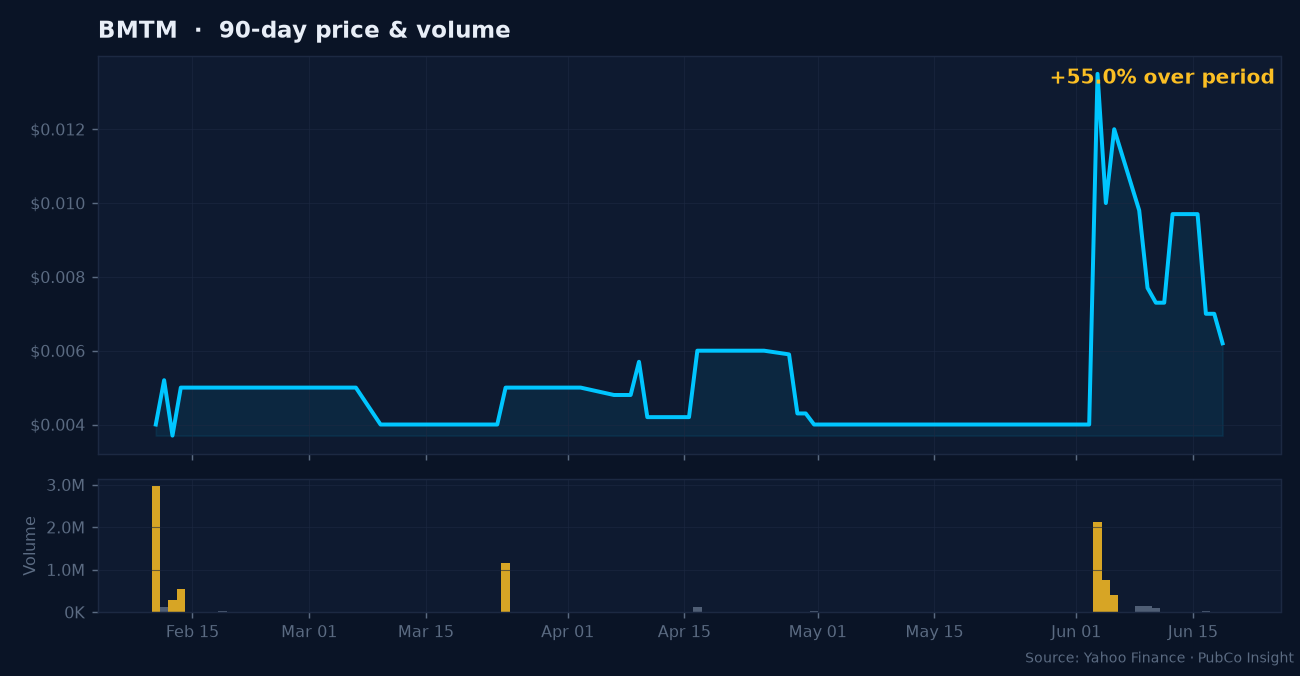
The company's recent quarterly filing on Form 10-Q, submitted on May 12, 2026, details the ongoing struggle to balance operational costs with available capital. When a company's share price drops into the sub-penny or low-penny range, any attempt to raise meaningful capital through equity issuance results in massive dilution for existing shareholders. Even small, routine financings can require issuing millions of new shares, further depressing the per-share value.
Adding to the complexity, the company filed an 8-K on June 16, 2026, disclosing a material definitive agreement under Item 1.01. While management teams often frame these agreements as strategic milestones, the cold reality of the filings is that these arrangements frequently come with strict financial covenants, fees, or equity-linked compensation that can further dilute the common equity. Without a massive, sustained turnaround in operational cash flow, these agreements simply keep the lights on while chipping away at retail shareholder value.
With a history of frequent earnings releases and corporate updates, the volume of paperwork does not mask the fundamental tightrope Bright Mountain Media is walking. Investors looking at the low nominal share price must look past the cheap entry point and focus on the sheer volume of shares already in circulation. Knowing what you own means recognizing that a massive share structure paired with tight liquidity is a difficult hurdle for any microcap to overcome.
Primary sources (SEC EDGAR)
8-K 2026-06-16: https://www.sec.gov/Archives/edgar/data/1568385/000119312526272407/bmtm-20260616.htm4 2026-05-19: https://www.sec.gov/Archives/edgar/data/1568385/000147450626000012/xslF345X06/primary_doc.xml3 2026-05-19: https://www.sec.gov/Archives/edgar/data/1568385/000147450626000011/xslF345X06/primary_doc.xmlSCHEDULE 13G/A 2026-05-15: https://www.sec.gov/Archives/edgar/data/1568385/000119312526226617/xslSCHEDULE_13G_X02/primary_doc.xml8-K 2026-05-12: https://www.sec.gov/Archives/edgar/data/1568385/000119312526219222/bmtm-20260512.htm10-Q 2026-05-12: https://www.sec.gov/Archives/edgar/data/1568385/000119312526219218/bmtm-20260331.htmSee the dilution and promotion flags before you see the pitch.
Each week: the micro and small-caps now showing dilution or paid-promotion signals, with the SEC filing behind every flag. No recommendations, no price targets.