Bright Mountain Media, Inc. (BMTM) Filings Show Thin Capitalization, Debt Activity
BMTM
Bright Mountain Media, Inc. (BMTM) recently reported a cash balance of just $21,117 as of June 30, 2026, according to its latest 10-Q filing. This figure, for a company with a market capitalization of approximately $1.65 million, suggests a very lean operational buffer. The filings reflect a pattern of financing activities that warrant a close look for retail investors.
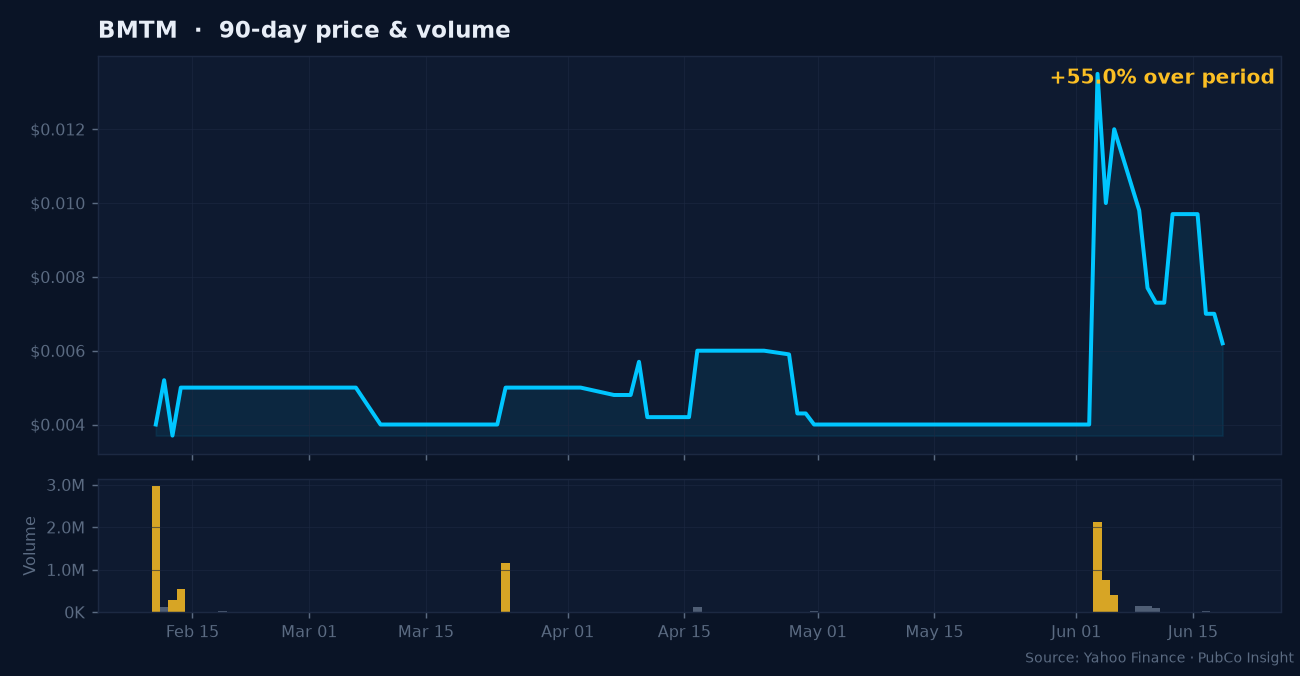
The company's quarterly report details a net loss of $1,053,913 for the three months ended June 30, 2026, with an accumulated deficit nearing $130 million. This ongoing burn rate, combined with minimal cash on hand, naturally leads to a reliance on external funding. Indeed, the 10-Q notes that the company "has historically funded its operations primarily through debt and equity financings."
Recent 8-K filings further underscore this reality. On July 7, 2026, BMTM disclosed a promissory note for $100,000. Just a month earlier, on June 16, 2026, another 8-K detailed a $250,000 promissory note. These frequent, smaller debt injections are typical of micro-cap firms navigating tight liquidity, and they can create a continuous need for additional capital.
While debt can provide necessary operating funds, a sustained reliance on it, particularly for a company with a history of net losses and low cash reserves, can lead to increased interest expenses and potential covenants that restrict future flexibility. For companies in this position, the alternative is often equity financing, which can result in dilution for existing shareholders.
Bright Mountain Media, Inc.'s filings consistently point to a company operating on a narrow financial margin. Retail investors should recognize that such a capital structure often necessitates ongoing financing activities, which carry inherent risks related to debt servicing or potential share dilution. Knowing what you own means understanding the financial mechanics that keep the lights on, not just the company's stated business.
Primary sources (SEC EDGAR)
SCHEDULE 13G/A 2026-08-10: https://www.sec.gov/Archives/edgar/data/1568385/000119312526342376/xslSCHEDULE_13G_X02/primary_doc.xml8-K 2026-08-06: https://www.sec.gov/Archives/edgar/data/1568385/000119312526338277/bmtm-20260806.htm10-Q 2026-08-06: https://www.sec.gov/Archives/edgar/data/1568385/000119312526338261/bmtm-20260630.htm8-K 2026-07-07: https://www.sec.gov/Archives/edgar/data/1568385/000119312526297404/bmtm-20260707.htm8-K 2026-06-16: https://www.sec.gov/Archives/edgar/data/1568385/000119312526272407/bmtm-20260616.htm4 2026-05-19: https://www.sec.gov/Archives/edgar/data/1568385/000147450626000012/xslF345X06/primary_doc.xmlSee the dilution and promotion flags before you see the pitch.
Each week: the micro and small-caps now showing dilution or paid-promotion signals, with the SEC filing behind every flag. No recommendations, no price targets.