Bright Mountain Media, Inc. (BMTM): Quarterly Report Flags Liquidity Concerns
BMTM
Bright Mountain Media, Inc. (BMTM) recently filed its 10-Q for the period ending June 30, 2026, revealing a going concern qualification from management. While recent 8-K filings detail operational updates and agreements, the core financial picture presented in the quarterly report indicates a company operating with significant liquidity challenges.
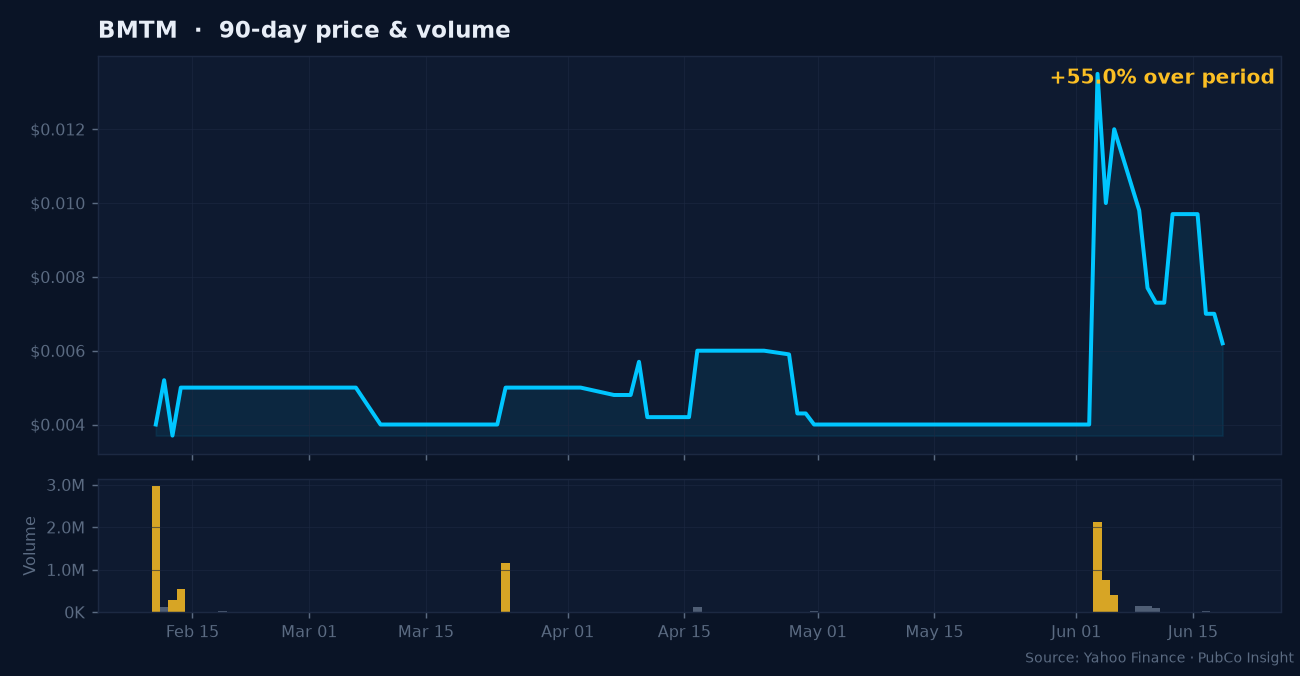
The 10-Q explicitly states, "The Company has suffered recurring losses from operations and has a net capital deficiency that raise substantial doubt about its ability to continue as a going concern." This isn't a minor disclosure; it's management's own assessment, anchored to the company's financial state. As of June 30, 2026, Bright Mountain Media reported a net loss and a working capital deficit, signaling that current liabilities outweigh current assets.
The company's ability to continue operations is, by its own admission, dependent on its capacity to obtain additional financing. This reliance on future capital raises inherently introduces dilution risk for existing shareholders, as new shares may need to be issued to secure necessary funds. Investors should consider the potential impact of such financing activities on the per-share value of their holdings.
Recent 8-K filings detail various agreements, including a June 16, 2026 filing regarding a material agreement and a July 7, 2026 filing about a creation of a direct financial obligation. These operational and debt-related disclosures should be viewed in the context of the broader financial health outlined in the 10-Q. While these agreements might signal activity, they do not, by themselves, resolve the fundamental going concern issue.
For a company with a market capitalization around $1 million and nearly 184 million shares outstanding, the financial footing described in the 10-Q is a critical data point. Investors evaluating BMTM should ensure they understand the implications of a going concern warning and the potential for future capital raises to impact their investment.
Primary sources (SEC EDGAR)
SCHEDULE 13G/A 2026-08-10: https://www.sec.gov/Archives/edgar/data/1568385/000119312526342376/xslSCHEDULE_13G_X02/primary_doc.xml8-K 2026-08-06: https://www.sec.gov/Archives/edgar/data/1568385/000119312526338277/bmtm-20260806.htm10-Q 2026-08-06: https://www.sec.gov/Archives/edgar/data/1568385/000119312526338261/bmtm-20260630.htm8-K 2026-07-07: https://www.sec.gov/Archives/edgar/data/1568385/000119312526297404/bmtm-20260707.htm8-K 2026-06-16: https://www.sec.gov/Archives/edgar/data/1568385/000119312526272407/bmtm-20260616.htm4 2026-05-19: https://www.sec.gov/Archives/edgar/data/1568385/000147450626000012/xslF345X06/primary_doc.xmlSee the dilution and promotion flags before you see the pitch.
Each week: the micro and small-caps now showing dilution or paid-promotion signals, with the SEC filing behind every flag. No recommendations, no price targets.