Bravo Multinational (BRVO) Undergoes Control Change, Capital Structure Shifts
BRVO
Bravo Multinational Inc. (BRVO) recently disclosed a change of control and a corresponding shift in its capital structure, as detailed in an 8-K filing from late September 2026. This is not merely a change in boardroom names; it represents a fundamental alteration to who holds the reins and how the company is financed, with direct implications for existing shareholders.
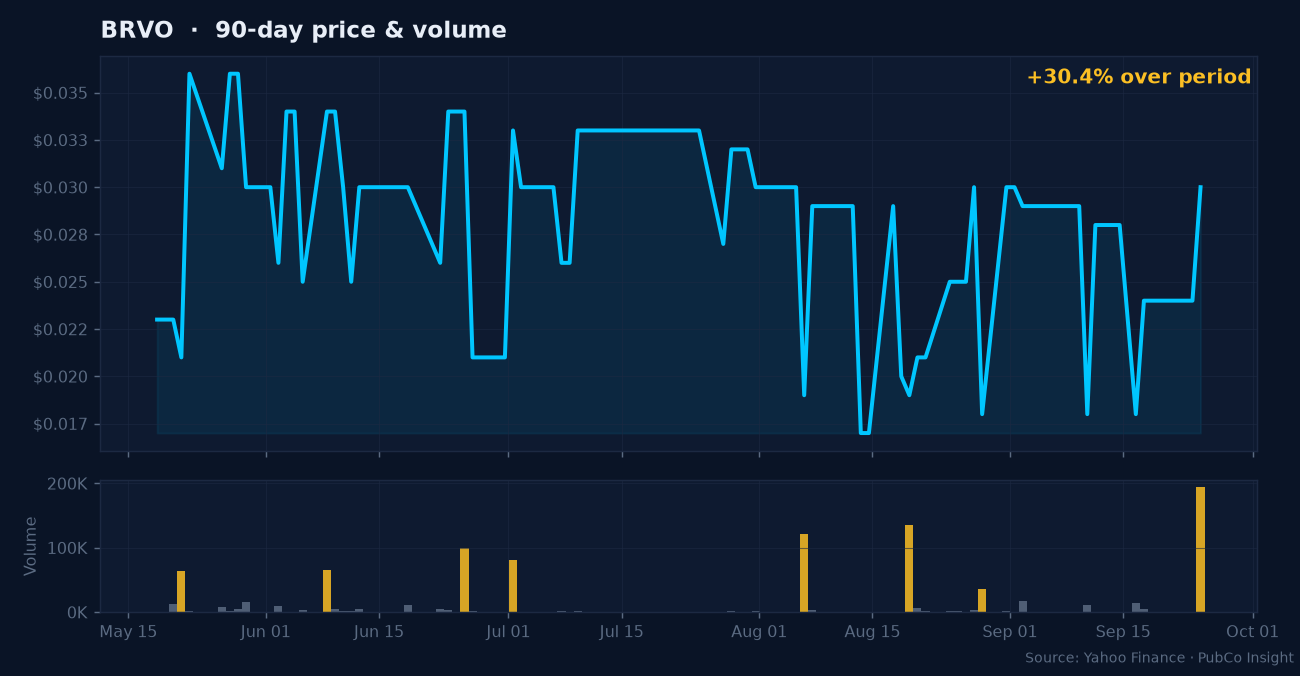
The September 24, 2026 8-K filing, under Items 1.01, 3.02, 3.03, 5.01, 5.02, and 8.01, outlines a series of events. Specifically, Item 5.01, "Change in Control of Registrant," confirms a new controlling party. This often comes with a new strategic direction, but it also invariably involves new financing arrangements. Item 3.02 and 3.03, regarding unregistered sales of equity securities and material modifications to rights of security holders, respectively, confirm these capital structure adjustments.
Further details on the ownership shift emerged in subsequent Schedule 13D and 13D/A filings from October 6, 2026. These filings are critical for understanding the mechanics of the control change, including who acquired control and on what terms. Such events frequently involve the issuance of new shares or convertible instruments to the new controlling party, which can lead to significant dilution for existing public shareholders, even if the share count remains stable on paper for a brief period. The underlying risk here is how the new ownership funds its acquisition and future operations, which often involves further equity issuance.
While the company's most recent 10-Q, filed August 19, 2026, for the period ending June 30, 2026, provides a look at the company's financial state prior to these events, it does not reflect the full impact of the control change and capital adjustments. Investors should be aware that a change of control at a micro-cap company can be a precursor to substantial changes in strategic direction, asset composition, and most importantly, the capital structure that supports it. For more on how these events can impact share value, see our dilution risk analysis.
In micro-cap investing, a change of control at a company like Bravo Multinational Inc. warrants close attention. The details in the 8-K and 13D filings are the primary source of truth, not press releases or market chatter. Understanding the terms of these changes, particularly any new equity issuances or debt conversions, is crucial for assessing ongoing shareholder risk. Know what you own, and more importantly, who owns it now.
Primary sources (SEC EDGAR)
3 2026-10-06: https://www.sec.gov/Archives/edgar/data/1444839/000089914026001097/xslF345X06/form3.xmlSCHEDULE 13D 2026-10-06: https://www.sec.gov/Archives/edgar/data/1444839/000089914026001096/xslSCHEDULE_13D_X02/primary_doc.xmlSCHEDULE 13D/A 2026-10-06: https://www.sec.gov/Archives/edgar/data/1444839/000197476226000003/xslSCHEDULE_13D_X02/primary_doc.xml8-K 2026-09-24: https://www.sec.gov/Archives/edgar/data/1444839/000109181826000148/brvo-092426_8k.htm10-Q 2026-08-19: https://www.sec.gov/Archives/edgar/data/1444839/000109181826000132/brvo-063026_10q.htm8-K/A 2026-08-18: https://www.sec.gov/Archives/edgar/data/1444839/000109181826000130/brvo-08182026_8ka.htmSee the dilution and promotion flags before you see the pitch.
Each week: the micro and small-caps now showing dilution or paid-promotion signals, with the SEC filing behind every flag. No recommendations, no price targets.