Ballston Spa Bancorp Inc. Navigates Complex Structural Changes as BSPA Moves Past Recent Acquisitions
BSPA
When a quiet regional financial institution like Ballston Spa Bancorp, Inc. begins stacking its regulatory calendar with material events, retail investors need to look past the local brand and focus on the balance sheet. Trading under the ticker BSPA on the OTC markets with a modest market capitalization of approximately 84.5 million dollars, this state commercial bank is navigating a period of rapid structural changes. The bank operates with just 1.13 million shares outstanding, meaning any shift in capital structure or debt load can have an outsized impact on per share value.
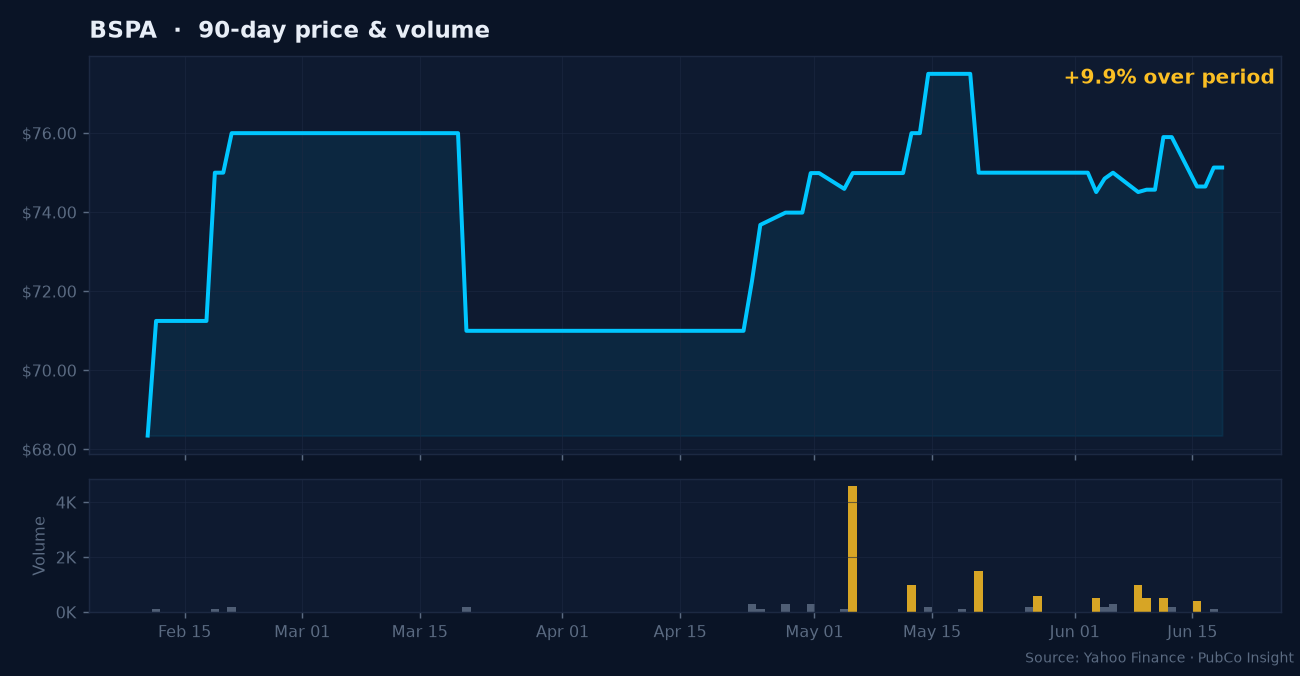
A look at the recent SEC filings reveals a flurry of activity in early 2026 that deserves close inspection. On March 25, 2026, the company filed an 8-K disclosing a material agreement and the creation of a direct financial obligation. This was quickly followed on April 1, 2026, by another 8-K documenting a major acquisition or disposition alongside additional debt obligations. While expansion can sound promising in press releases, the mechanics of these transactions often introduce new operational risks and debt service requirements that can squeeze net interest margins.
For a bank of this size, taking on new financial obligations under Item 2.03 is a double edged sword. The filings show that Ballston Spa Bancorp is actively leveraging its position, but with that leverage comes increased sensitivity to interest rate fluctuations and integration costs. The subsequent 8-K/A filed on June 12, 2026, which amended the financial statements related to these transactions, underscores that absorbing new assets or entities is rarely a seamless process.
Investors must also note the thin trading volume and limited reporting profile typical of OTC listed financial institutions. With a dilution risk factor currently rated at 4, the immediate threat of share printing may seem low compared to high cash burn tech startups, but the structural debt added in the spring of 2026 represents a senior claim on the bank's earnings. When evaluating BSPA, understanding the true cost of these recent acquisitions is far more critical than relying on historical performance. Know what you own, and keep a close eye on the upcoming quarterly reports to see how these new obligations impact the bottom line.
Primary sources (SEC EDGAR)
8-K/A 2026-06-12: https://www.sec.gov/Archives/edgar/data/2094107/000110465926073409/tm2617581d1_8ka.htm10-Q 2026-05-14: https://www.sec.gov/Archives/edgar/data/2094107/000110465926061067/tmb-20260331x10q.htmSP 15D2 2026-04-24: https://www.sec.gov/Archives/edgar/data/2094107/000110465926048543/tmb-20251231x10k.htmD 2026-04-07: https://www.sec.gov/Archives/edgar/data/2094107/000110465926040310/xslFormDX08/primary_doc.xml8-K 2026-04-01: https://www.sec.gov/Archives/edgar/data/2094107/000094337426000157/form8k_040126.htm8-K 2026-03-25: https://www.sec.gov/Archives/edgar/data/2094107/000110465926034602/tm269754d1_8k.htmSee the dilution and promotion flags before you see the pitch.
Each week: the micro and small-caps now showing dilution or paid-promotion signals, with the SEC filing behind every flag. No recommendations, no price targets.