Behind BUTLER NATIONAL CORP's $270M Market Cap: BUKS Keeps Filings Current, But Liquidity Demands Focus
BUKS
A $270 million market valuation on the over-the-counter market is usually either a mathematical artifact of an illiquid share structure or a mature operating business that simply never bothered to make the leap to a national exchange. BUTLER NATIONAL CORP (BUKS) falls into an intriguing corner of this universe, commanding roughly 63.93 million shares outstanding while continuing to report on standard quarterly and annual cycles that many of its OTC peers abandoned long ago.
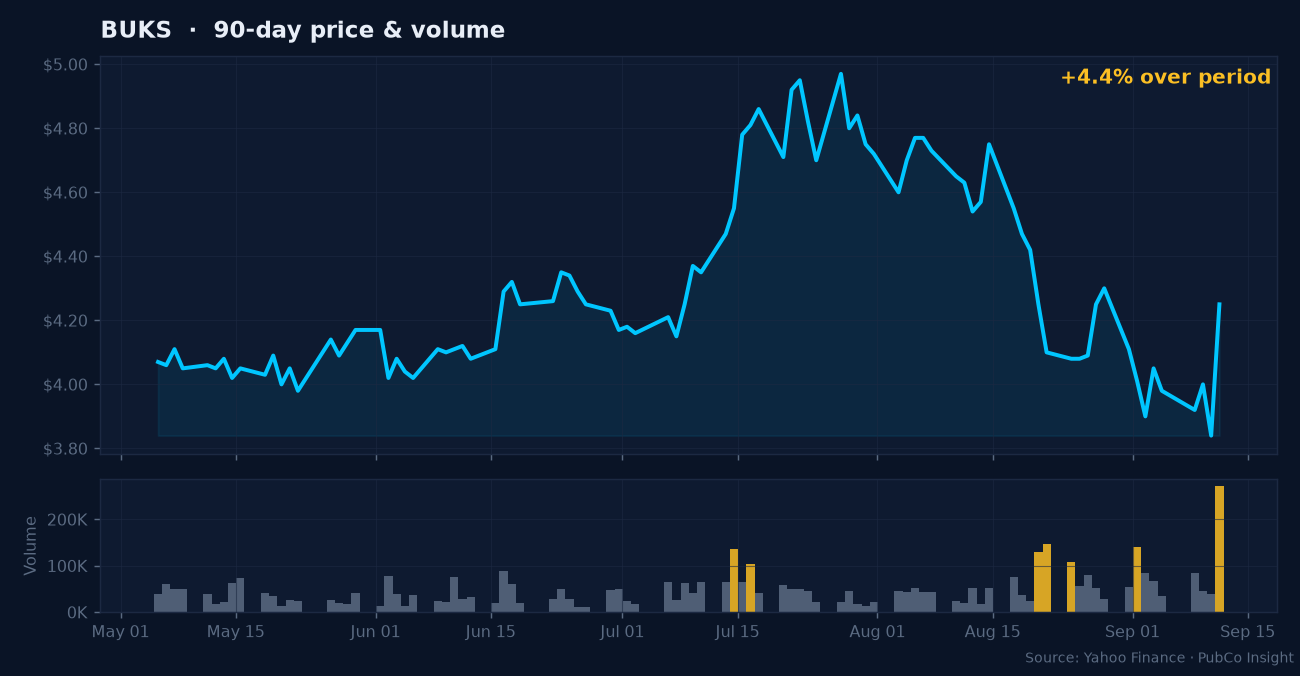
A close reading of the regulatory paper trail reveals a disciplined filing calendar rather than the promotional churn typical of sub-dollar tickers. On September 11, 2026, the company submitted both its Form 10-Q and a contemporaneous Item 2.02 Form 8-K to post operating results, following an August slate that included proxy materials (DEF 14A) and an annual report package. There are no surprise S-1 equity lines, toxic convertibles, or aggressive retail-targeted promotional spikes registering across the recent disclosures.
That operational stability is supported by an absence of immediate dilution machinery. The company has avoided trailing shelf offerings and secondary distribution filings, reflecting a notably low dilution risk score of 11. Investors can evaluate these capital structure mechanics using our dilution risk monitor, which tracks whether micro-cap balance sheets are relying on common stock issuance to maintain daily liquidity.
Still, an OTC listing carries inherent structural frictions that no orderly 10-Q can fully erase. When a company trades outside major exchanges while sustaining a valuation above a quarter of a billion dollars, bid-ask spreads, institutional trading restrictions, and fragmented retail volume can amplify price volatility on minimal transactional volume. Butler National's classified sector in miscellaneous amusement and recreation services also means corporate execution is tethered to cyclical consumer and commercial trends.
Understanding BUTLER NATIONAL CORP requires separating legitimate reporting discipline from trading liquidity. The company documents its business through standard SEC channels without resorting to distressed financing, but holding a micro-cap on the OTC always means underwriting execution risk without the liquidity cushions of an exchange-listed peer.
Primary sources (SEC EDGAR)
8-K 2026-09-11: https://www.sec.gov/Archives/edgar/data/15847/000001584726000044/buks-20260911.htm10-Q 2026-09-11: https://www.sec.gov/Archives/edgar/data/15847/000001584726000042/buks-20260731.htm8-K 2026-08-20: https://www.sec.gov/Archives/edgar/data/15847/000001584726000037/buks-20260817.htmDEFA14A 2026-08-18: https://www.sec.gov/Archives/edgar/data/15847/000001584726000035/defa14acombinedproxycard.htmARS 2026-08-18: https://www.sec.gov/Archives/edgar/data/15847/000001584726000034/bnc-arscharimanletterand10k.pdfDEF 14A 2026-08-18: https://www.sec.gov/Archives/edgar/data/15847/000001584726000032/buks-20260817.htmSee the dilution and promotion flags before you see the pitch.
Each week: the micro and small-caps now showing dilution or paid-promotion signals, with the SEC filing behind every flag. No recommendations, no price targets.