Insider Moves Follow the Filings at BUTLER NATIONAL CORP (BUKS)
BUKS
When an OTC company crosses the 300 million dollar market capitalization mark, you expect either an aggressive promotion machine or a flurry of toxic convertible paper. In the case of BUTLER NATIONAL CORP (BUKS), the EDGAR stream tells an entirely different story, dominated by standard quarterly cadences, operational updates, and a sudden cluster of Form 4 filings.
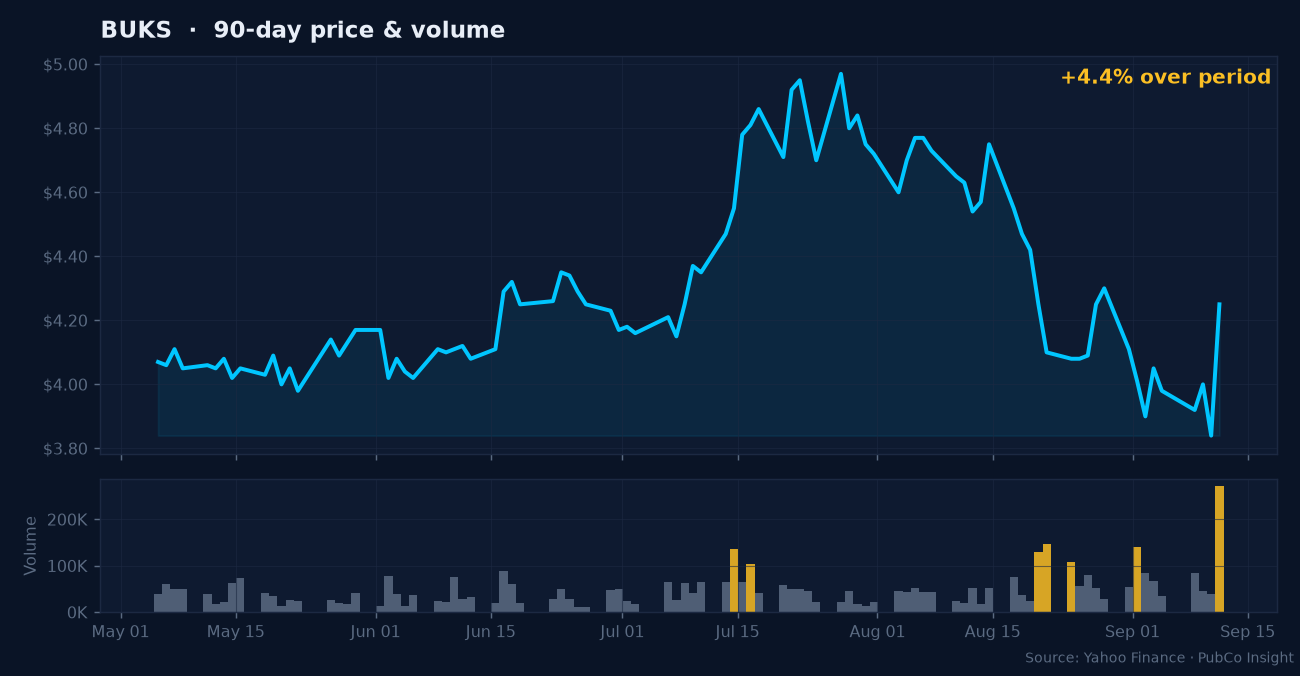
With roughly 63.93 million shares outstanding and a market value sitting near 319 million dollars, the company recently filed back-to-back earnings releases under Item 2.02 and a material definitive agreement under Item 1.01. That stream of operational reporting was immediately met by six separate Form 4 insider disclosures over a five-day stretch in mid-September, highlighting that insiders are paying very close attention to their personal equity balances.
For micro-cap traders used to dodging continuous equity distribution agreements, the dilution profile here is relatively quiet. The filing history shows no active S-filings or 424B prospectus supplements flooding the market with discounted shares, holding the company at a low dilution risk tier compared to typical OTC peers. Instead of relying on floorless notes, the corporate ledger reflects traditional corporate governance with multiple proxy filings and regular quarterly reports.
That said, operating on the OTC markets under an amusement and recreation classification leaves little room for complacency. While the lack of aggressive dilution protects against immediate structural supply overhang, multiple insider filings following major material agreements mean retail participants must watch whether leadership is accumulating or distributing.
Knowing what you own in an OTC issuer like BUTLER NATIONAL CORP means separating operational execution from capital structure risks. The numbers show a functioning enterprise with substantial equity value, but keeping an eye on executive transactions remains the clearest way to judge where confidence actually lies.
Primary sources (SEC EDGAR)
4 2026-09-22: https://www.sec.gov/Archives/edgar/data/15847/000133259626000008/xslF345X06/primary_doc.xml4 2026-09-21: https://www.sec.gov/Archives/edgar/data/15847/000203334826000014/xslF345X06/wk-form4_1790026222.xml4 2026-09-21: https://www.sec.gov/Archives/edgar/data/15847/000201240626000004/xslF345X06/wk-form4_1790025964.xml4 2026-09-21: https://www.sec.gov/Archives/edgar/data/15847/000206545926000006/xslF345X06/wk-form4_1790025721.xml4 2026-09-21: https://www.sec.gov/Archives/edgar/data/15847/000133259626000007/xslF345X06/primary_doc.xml4 2026-09-17: https://www.sec.gov/Archives/edgar/data/15847/000133259626000006/xslF345X06/primary_doc.xmlSee the dilution and promotion flags before you see the pitch.
Each week: the micro and small-caps now showing dilution or paid-promotion signals, with the SEC filing behind every flag. No recommendations, no price targets.