CAPSTONE COMPANIES, INC. (CAPC): Serial 8-Ks and the Cost of Capital
CAPC
CAPSTONE COMPANIES, INC. (CAPC) has filed a flurry of 8-K reports over recent months, detailing a series of material agreements related to financing. While the market often focuses on the potential upside of new capital, the filings themselves paint a picture of a company consistently seeking funds, often at terms that impact existing shareholders.
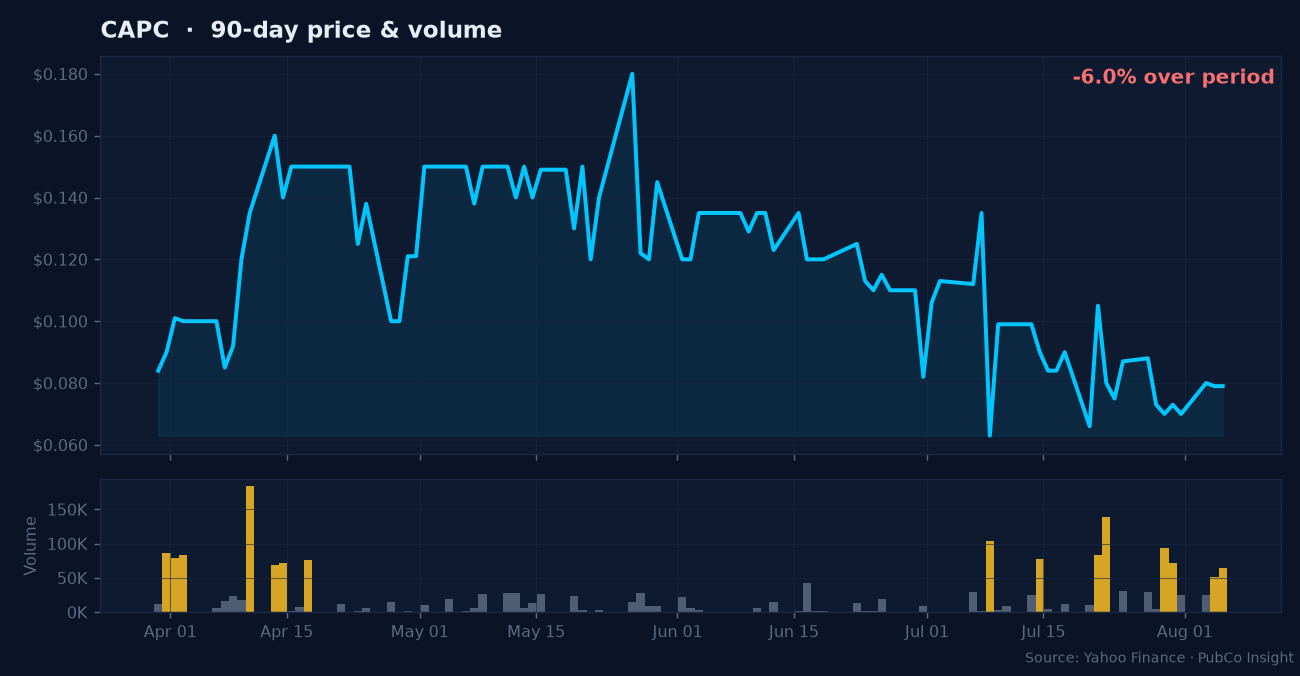
Since May, CAPC has disclosed multiple agreements for new capital. The 8-K on May 15, 2026, and subsequent amendments, along with the August 5, 2026 8-K, all point to ongoing efforts to secure funding. These are not isolated events but rather a pattern of continuous capital raises. For a micro-cap company with a market capitalization under $3 million, frequent financing is a standard operating procedure, but the terms matter.
The critical detail often buried in these 8-K filings is the nature of the financing. While the specific terms vary, these agreements frequently involve convertible notes, warrants, or other instruments that can lead to significant dilution. Each new tranche of funding, while necessary for operations, adds to the potential share count. Retail investors should recognize that these financing activities are not just about adding cash to the balance sheet; they are about expanding the capital structure, which can spread the value of the company across a larger number of shares.
Beyond the 8-K activity, the company also filed a Form 10-Q on May 14, 2026, and an NT 10-K on April 1, 2026. The NT 10-K, a notification of inability to timely file, signals reporting delays, which can be a red flag for operational consistency. While the subsequent 10-Q was filed, the pattern of needing repeated capital injections combined with filing delays underscores the ongoing challenges.
The cumulative effect of these repeated financings, particularly those involving convertible securities, is a persistent dilution risk. Every new agreement, while potentially providing a lifeline, effectively increases the pool of outstanding shares or shares that could become outstanding. This dynamic means that even if the company's underlying business improves, the per-share value might not appreciate commensurately.
Understanding CAPSTONE COMPANIES, INC. means looking beyond the headlines of new funding announcements and into the mechanics of how that funding is secured. For any micro-cap, consistent capital needs are a reality. The question for shareholders is always what price they are paying for that capital in terms of future share count and the potential impact on their ownership stake.
Primary sources (SEC EDGAR)
8-K 2026-08-05: https://www.sec.gov/Archives/edgar/data/814926/000149315226036185/form8-k.htm8-K/A 2026-07-08: https://www.sec.gov/Archives/edgar/data/814926/000149315226032552/form8-ka.htm8-K/A 2026-05-20: https://www.sec.gov/Archives/edgar/data/814926/000149315226024552/form8-ka.htm8-K 2026-05-15: https://www.sec.gov/Archives/edgar/data/814926/000149315226023414/form8-k.htm10-Q 2026-05-14: https://www.sec.gov/Archives/edgar/data/814926/000149315226022906/form10-q.htmNT 10-K 2026-04-01: https://www.sec.gov/Archives/edgar/data/814926/000190359626000122/capc_nt10k.htmSee the dilution and promotion flags before you see the pitch.
Each week: the micro and small-caps now showing dilution or paid-promotion signals, with the SEC filing behind every flag. No recommendations, no price targets.