Evaluating the Shareholder Math Behind 1606 CORP. (CBDW) as Outstanding Shares Cross the Billion Mark
CBDW
When a micro-cap company crosses the threshold of one billion outstanding shares while sporting a market capitalization of just 400,000 dollars, the financial gravity of dilution becomes impossible to ignore. For 1606 CORP., trading under the ticker CBDW, the gap between grand corporate ambitions and the reality of its capital structure is laid bare in its recent SEC filings. Investors who look past the press releases will find a persistent pattern of material agreements and share-issuance mechanics that keep the printing press running.
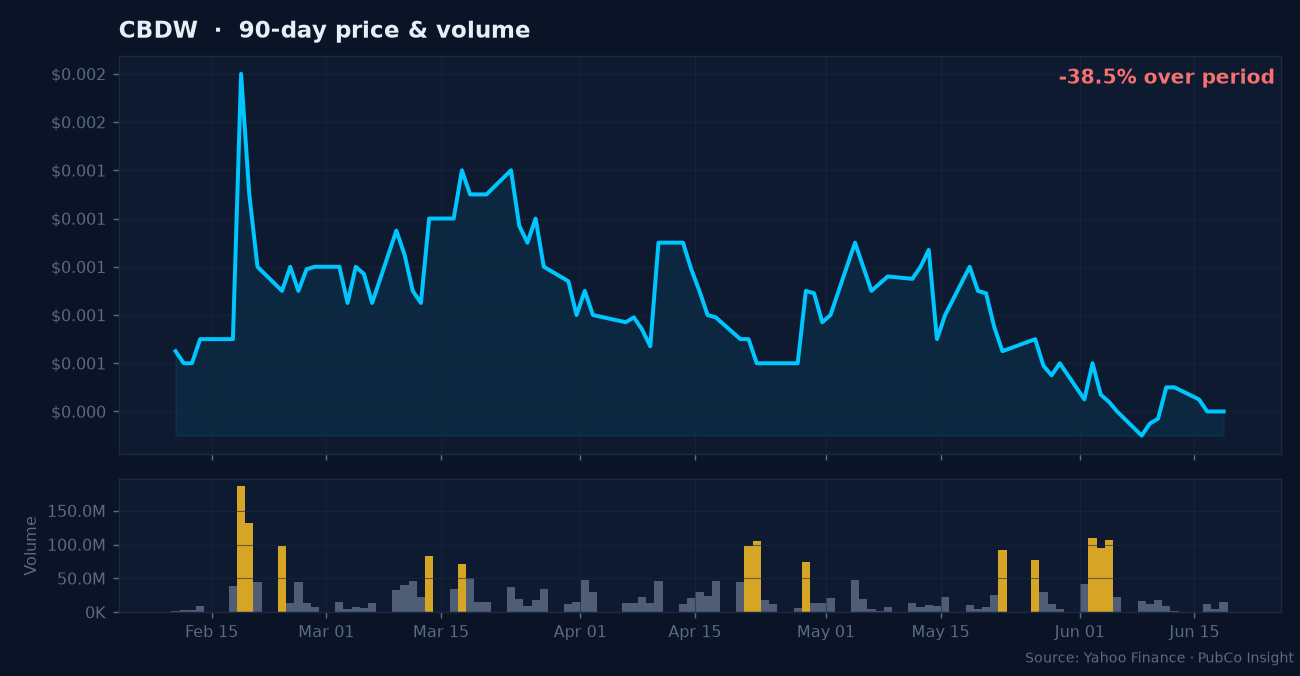
A look at the regulatory calendar shows how quickly the paperwork is piling up. On May 15, 2026, 1606 CORP. filed its quarterly 10-Q, revealing the tight financial constraints under which the prepackaged software services company operates. This was quickly followed by a series of 8-K filings, including material agreements dated May 4, 2026, and June 2, 2026. While these agreements are often framed as strategic milestones, their primary structural function in micro-cap land is frequently to facilitate the issuance of equity to keep the lights on.
The mechanics of this equity-fueled survival are further detailed in the company's 424B3 prospectus filing on April 28, 2026. These prospectus supplements represent the actual pipeline through which newly minted shares flow into the public market, putting downward pressure on existing shareholders who hold the bag. When a company with 1.01 billion shares outstanding continues to register and sell shares, the fractional ownership of retail investors is systematically chipped away.
Ultimately, 1606 CORP. presents a textbook case of why micro-cap investors must prioritize filing analysis over hype. With multiple 8-K filings in a single month and a low market cap spread across an enormous share count, the structural risks of further dilution remain exceptionally high. Know what you own, and understand that in the OTC markets, a high volume of material agreements often translates to a high volume of new shares hitting the market.
Primary sources (SEC EDGAR)
8-K 2026-06-03: https://www.sec.gov/Archives/edgar/data/1877461/000147793226003599/cbdw_8k.htm8-K 2026-06-02: https://www.sec.gov/Archives/edgar/data/1877461/000147793226003576/cbdw_8k.htm10-Q 2026-05-15: https://www.sec.gov/Archives/edgar/data/1877461/000147793226003209/cbdw_10q.htm8-K 2026-05-04: https://www.sec.gov/Archives/edgar/data/1877461/000147793226002719/cbdw_8k.htm424B3 2026-04-28: https://www.sec.gov/Archives/edgar/data/1877461/000147793226002607/cbdw_424b3.htm144 2026-04-23: https://www.sec.gov/Archives/edgar/data/1877461/000152013826000129/xsl144X01/primary_doc.xmlSee the dilution and promotion flags before you see the pitch.
Each week: the micro and small-caps now showing dilution or paid-promotion signals, with the SEC filing behind every flag. No recommendations, no price targets.