C2 Blockchain (CBLO) accelerates share issuance as filing delays and material agreements mount
CBLO
C2 Blockchain, Inc. is operating at a pace that keeps its corporate printers warm, even if public markets are barely paying attention. With a modest market capitalization of approximately 15 million dollars, this OTC-listed entity is quietly executing a series of financial maneuvers that retail investors would do well to untangle. The paperwork trail reveals a company balancing late financial reporting with a rapid-fire sequence of material agreements and equity issuances.
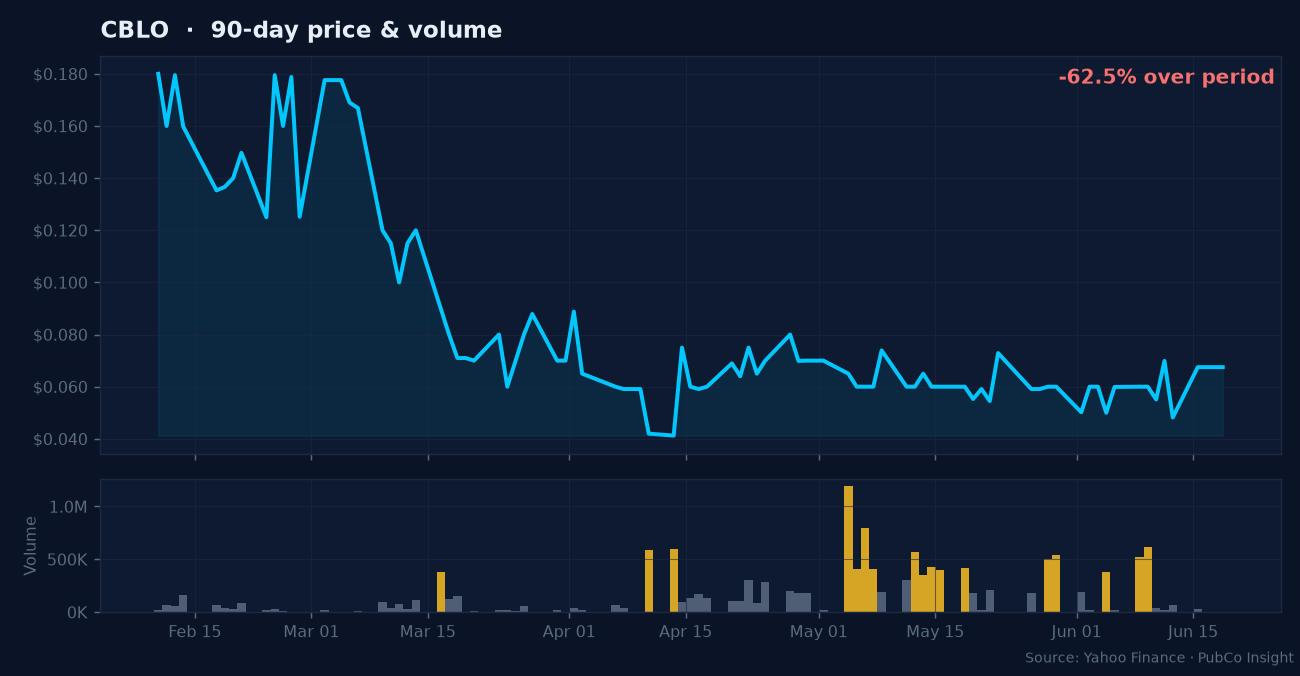
The tension began building in mid-May 2026 when CBLO filed an NT 10-Q, signaling that it could not complete its quarterly report on time. While the company managed to file the actual 10-Q five days later on May 20, 2026, the temporary filing lapse highlights the operational friction often found in micro-cap structures. Delays of this nature usually point to stretched administrative resources, a common theme for companies navigating complex transactions on a tight budget.
More critical for shareholders is the sheer frequency of unregistered equity transactions. CBLO filed three separate Form 8-Ks containing Item 3.02 disclosures for the unregistered sales of equity securities between March and June 2026. These private placements and equity issuances dilute existing retail holders, expanding the share base without the public market oversight that accompanies traditional registered offerings.
The underlying drivers of this dilution are tied to material agreements. On May 5, 2026, and again on June 2, 2026, CBLO entered into material definitive agreements accompanied by new debt creations. These arrangements, disclosed under Items 1.01 and 2.03, indicate that the company is actively relying on structured financing and debt-to-equity conversions to sustain its operations. For micro-cap companies, these agreements often come with terms that favor institutional lenders over common shareholders.
When a company with 224.74 million shares outstanding frequently taps private placement channels, the risk of equity overhang increases. Investors in CBLO are looking at a business model currently dependent on continuous balance-sheet restructuring. Keeping track of these filing dates and the terms of each new 8-K is the only way to avoid being caught on the wrong side of a sudden share expansion.
Primary sources (SEC EDGAR)
8-K 2026-06-02: https://www.sec.gov/Archives/edgar/data/1882781/000188278126000041/form8k6226o.htm10-Q 2026-05-20: https://www.sec.gov/Archives/edgar/data/1882781/000188278126000039/c2blockq3_26o.htmNT 10-Q 2026-05-15: https://www.sec.gov/Archives/edgar/data/1882781/000188278126000031/nt10q51526.htm8-K 2026-05-05: https://www.sec.gov/Archives/edgar/data/1882781/000188278126000029/form8k42326o.htm8-K 2026-04-17: https://www.sec.gov/Archives/edgar/data/1882781/000188278126000026/form8k41526o.htm8-K 2026-03-16: https://www.sec.gov/Archives/edgar/data/1882781/000188278126000024/form8k31626o.htmSee the dilution and promotion flags before you see the pitch.
Each week: the micro and small-caps now showing dilution or paid-promotion signals, with the SEC filing behind every flag. No recommendations, no price targets.