CAMBER ENERGY, INC. (CEIN) Filings Show Continued Structural Pressures
CEIN
Camber Energy, Inc. (CEIN) has been active on the SEC filing front, disclosing multiple material agreements and acquisition-related events in recent months. However, a deeper look into the associated 10-Q reveals a less glamorous financial picture that warrants investor attention.
The company’s 10-Q, filed on May 11, 2026, includes a going concern qualification from its auditors. This is a standard flag indicating that there is substantial doubt about the company's ability to continue as a going concern for the next twelve months. The filing explicitly notes that the company has incurred recurring losses from operations and has negative working capital. While material agreements and acquisitions can sometimes signal growth, the underlying financial structure suggests a persistent need for capital.
Specifically, the 8-K filed on June 4, 2026, details a significant acquisition event under Item 2.01 and a material agreement under Item 1.01. Another 8-K from April 23, 2026, also highlights a material agreement. These transactions, while potentially strategic, occur against a backdrop of financial constraints outlined in the latest quarterly report.
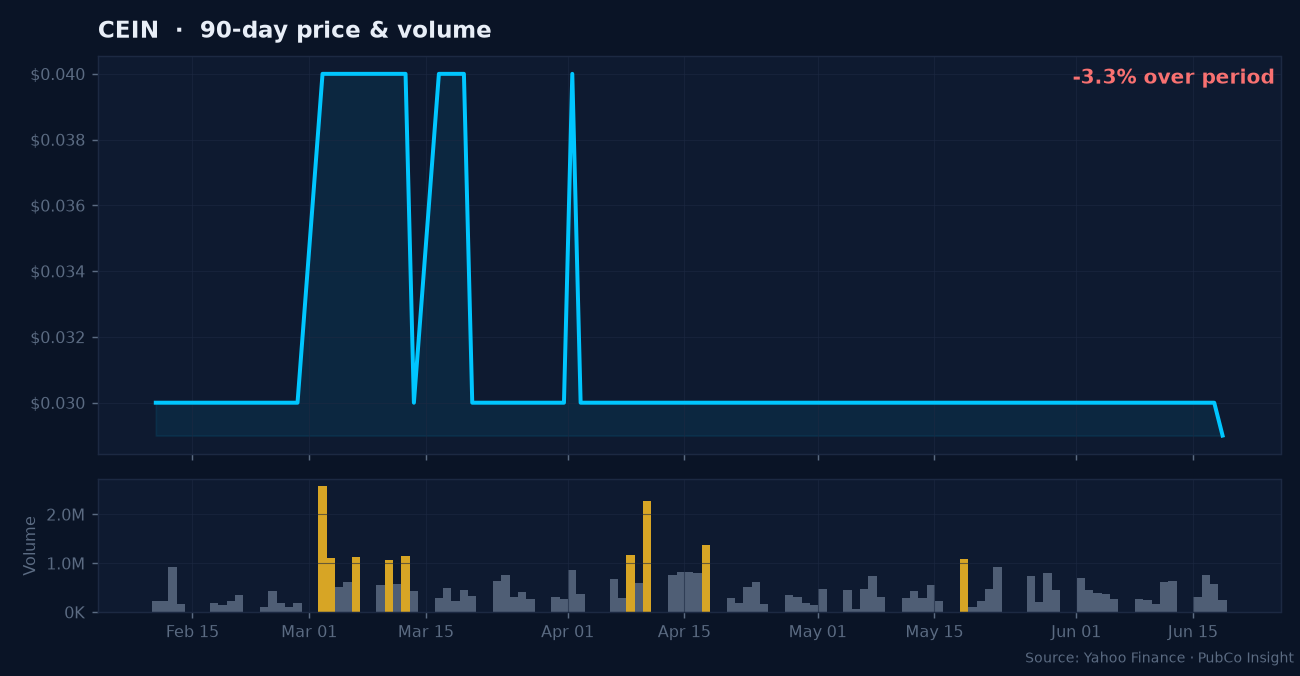
For a company with a market capitalization of approximately $7.6 million and 281.79 million shares outstanding, the combination of a going concern qualification and ongoing capital needs from negative working capital can lead to further dilution. Future financing activities, which are often necessary under these circumstances, typically involve issuing new equity, thereby increasing the share count and potentially depressing per-share value.
The company’s sector as Crude Petroleum & Natural Gas also places it in an industry that can be capital-intensive and susceptible to commodity price fluctuations. Investors should consider how CEIN plans to fund its operations and new agreements given its current financial position.
Understanding CEIN means looking beyond the headlines of new deals and focusing on the financial mechanics presented in the filings. The going concern warning and negative working capital are not minor details; they are fundamental indicators of the financial pressures the company faces. Know what you own, and in this case, that means understanding the ongoing capital requirements and the potential for shareholder dilution.
Primary sources (SEC EDGAR)
8-K 2026-06-04: https://www.sec.gov/Archives/edgar/data/1309082/000147793226003650/cei_8k.htm10-Q 2026-05-11: https://www.sec.gov/Archives/edgar/data/1309082/000147793226002957/cei_10q.htm8-K 2026-04-23: https://www.sec.gov/Archives/edgar/data/1309082/000147793226002493/cei_8k.htm8-K 2026-04-13: https://www.sec.gov/Archives/edgar/data/1309082/000147793226002141/cei_8k.htm10-K 2026-03-30: https://www.sec.gov/Archives/edgar/data/1309082/000147793226001710/cei_10k.htm8-K 2026-03-04: https://www.sec.gov/Archives/edgar/data/1309082/000147793226001157/cei_8k.htmSee the dilution and promotion flags before you see the pitch.
Each week: the micro and small-caps now showing dilution or paid-promotion signals, with the SEC filing behind every flag. No recommendations, no price targets.