CAMBER ENERGY, INC. (CEIN) Keeps Dilution and Deal Machinery Spinning in the Shadows of the OTC
CEIN
For a company with a market capitalization of just six million dollars, CAMBER ENERGY, INC. (CEIN) maintains a corporate machinery that is surprisingly busy. While the broader market rarely notices the daily grind of microcaps on the OTC, the company's regulatory filings reveal a continuous cycle of material agreements and asset maneuvers. The gap between promotional optimism and the reality of the balance sheet is where retail investors frequently get caught unawares.
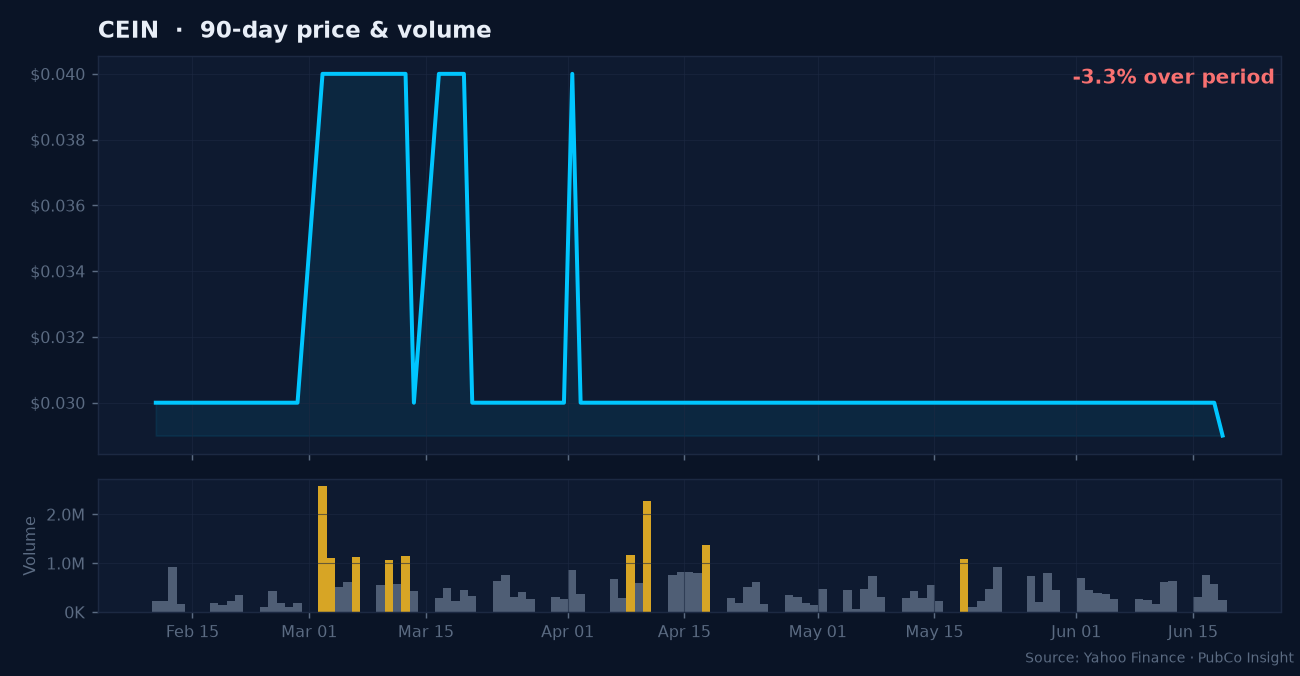
A look at the recent filing history reveals a steady stream of corporate actions. On June 4, 2026, CAMBER ENERGY, INC. submitted an 8-K filing covering Item 1.01 and Item 2.01, signaling a new material definitive agreement alongside an acquisition or disposition of assets. This followed a previous Item 1.01 filing on April 23, 2026. For a company of this size, constantly restructuring its asset base through these agreements is a double-edged sword, often requiring capital inputs that the existing operations cannot self-fund.
With 281.79 million shares outstanding, the primary risk for retail holders remains the structural mechanics of dilution. Microcaps that frequently enter into material agreements and asset adjustments often rely on dilutive financing instruments to keep the lights on and close transactions. The 10-Q filed on May 11, 2026, and the 10-K filed on March 30, 2026, outline the financial boundaries within which management must operate, highlighting the ongoing tension between ambitious dealmaking and scarce cash reserves.
Evaluating CAMBER ENERGY, INC. requires looking past the press releases and focusing entirely on the structural terms of these 8-K agreements. When a microcap company with a single-digit million market cap repeatedly buys, sells, or restructures assets, the transaction costs alone can eat up valuable capital. Investors who do not read the specific terms of the June and April agreements risk missing how these deals are funded and whether existing equity will be diluted to pay for them.
Ultimately, CEIN represents a classic OTC study in transactional complexity versus scale. Before assuming these material agreements will translate into sustainable per-share value, investors must verify the funding sources in the quarterly reports. Know what you own, and make sure you understand who pays for the next acquisition before the ink dries on the 8-K.
Primary sources (SEC EDGAR)
8-K 2026-06-04: https://www.sec.gov/Archives/edgar/data/1309082/000147793226003650/cei_8k.htm10-Q 2026-05-11: https://www.sec.gov/Archives/edgar/data/1309082/000147793226002957/cei_10q.htm8-K 2026-04-23: https://www.sec.gov/Archives/edgar/data/1309082/000147793226002493/cei_8k.htm8-K 2026-04-13: https://www.sec.gov/Archives/edgar/data/1309082/000147793226002141/cei_8k.htm10-K 2026-03-30: https://www.sec.gov/Archives/edgar/data/1309082/000147793226001710/cei_10k.htm8-K 2026-03-04: https://www.sec.gov/Archives/edgar/data/1309082/000147793226001157/cei_8k.htmSee the dilution and promotion flags before you see the pitch.
Each week: the micro and small-caps now showing dilution or paid-promotion signals, with the SEC filing behind every flag. No recommendations, no price targets.