CAMBER ENERGY, INC. Faces the Hard Math of 281 Million Shares as CEIN Capital Demands Keep Multiplying
CEIN
CAMBER ENERGY, INC. has long been a favorite of retail traders looking for a fast-moving energy play, but the regulatory filings tell a story of a company running on a treadmill of share issuance just to keep the lights on. With a micro-cap valuation of roughly 5.6 million dollars, the company has managed to balloon its outstanding share count to a staggering 281.79 million shares. When a company has that many shares outstanding at this market capitalization, every new corporate action faces the gravity of extreme share dilution.
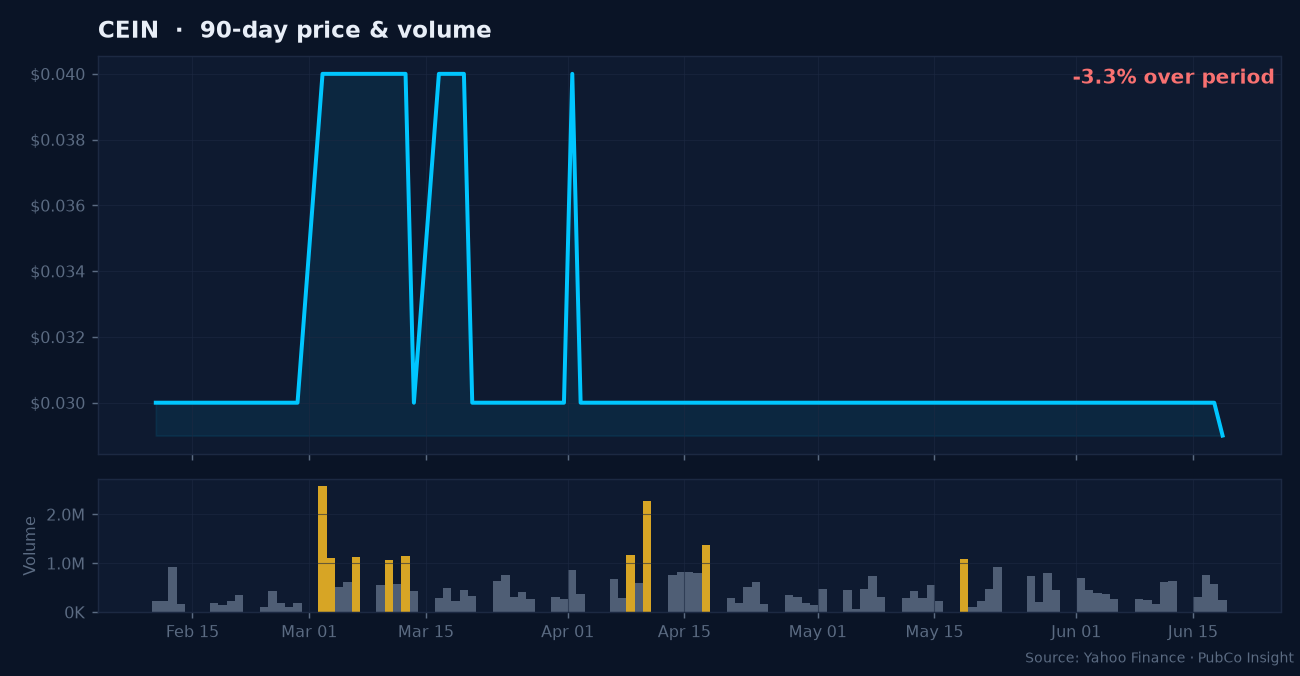
The company recently filed an 8-K on June 4, 2026, disclosing a material agreement and an acquisition. While press releases often frame these transactions as major operational milestones, the filings show the underlying machinery. To fund acquisitions and ongoing operations, CAMBER ENERGY, INC. frequently relies on structured financing and material agreements that ultimately convert into equity, putting constant pressure on existing retail shareholders who watch their ownership percentages shrink with every quarter.
A look at the May 11, 2026 quarterly filing reveals the financial strain. The balance sheet shows a business model that is capital-intensive and highly dependent on external funding. Investors who want to understand the mechanics of how these deals impact their portfolio should examine the company's historical financing structures, which carry significant dilution risk as new shares are issued to satisfy debt and acquisition terms.
With a share price deeply in micro-cap territory and a massive share float, CAMBER ENERGY, INC. remains a highly volatile vehicle. The constant stream of 8-K filings, including agreements signed in April and June of 2026, keeps the retail spotlight on the stock, but the fundamentals in the 10-Q and 10-K show that operational cash flow is not the primary driver here. Know what you own: CEIN is a highly diluted equity structure where the creation of new shares is a structural necessity, not an afterthought.
Primary sources (SEC EDGAR)
8-K 2026-06-04: https://www.sec.gov/Archives/edgar/data/1309082/000147793226003650/cei_8k.htm10-Q 2026-05-11: https://www.sec.gov/Archives/edgar/data/1309082/000147793226002957/cei_10q.htm8-K 2026-04-23: https://www.sec.gov/Archives/edgar/data/1309082/000147793226002493/cei_8k.htm8-K 2026-04-13: https://www.sec.gov/Archives/edgar/data/1309082/000147793226002141/cei_8k.htm10-K 2026-03-30: https://www.sec.gov/Archives/edgar/data/1309082/000147793226001710/cei_10k.htm8-K 2026-03-04: https://www.sec.gov/Archives/edgar/data/1309082/000147793226001157/cei_8k.htmSee the dilution and promotion flags before you see the pitch.
Each week: the micro and small-caps now showing dilution or paid-promotion signals, with the SEC filing behind every flag. No recommendations, no price targets.