CAMBER ENERGY, INC. Faces the Reality of a Six Million Dollar Market Cap and Constant Dealmaking (CEIN)
CEIN
While retail trading forums occasionally treat CAMBER ENERGY, INC. (CEIN) like a major player in the energy sector, the cold math in the SEC database reveals a different scale. With a market capitalization hovering at just over 6 million dollars and 281.79 million shares outstanding, this OTC-traded company operates in a perpetual cycle of restructuring and dealmaking that keeps its legal team busy and its balance sheet in constant motion.
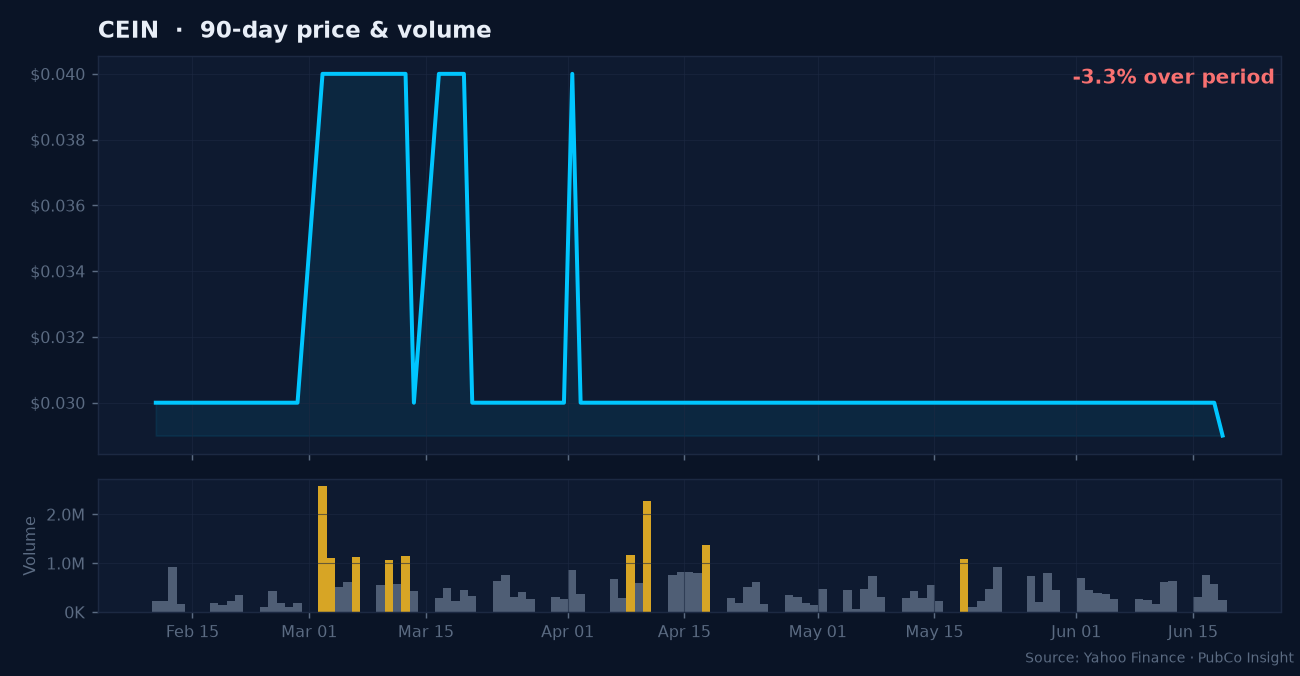
A look at the filing history shows that CAMBER ENERGY, INC. is a frequent publisher of Form 8-K. In the first half of 2026 alone, the company logged multiple material agreements and asset transactions, including a dual-item 1.01 and 2.01 filing on June 4, 2026, and another material agreement on April 23, 2026. For a micro-cap of this size, keeping track of these shifting obligations is a full-time job for investors, as every new agreement has the potential to alter the capital structure or dilute existing equity holders.
The fundamental challenge for CEIN is translating this flurry of corporate actions into sustainable, underlying value. When a company with a sub-ten-million-dollar valuation is constantly buying, selling, or entering into new material contracts, the transaction costs and complexity can quickly overwhelm any potential operational gains. Investors who do not scrutinize these frequent filings risk being caught off guard by the structural shifts occurring behind the scenes.
Understanding the financing mechanics behind these constant deals is critical. To stay informed about how these frequent agreements and capital adjustments impact your position, you can track the structural changes on our dilution risk dashboard, which monitors share counts and filing trends in real time.
Ultimately, CAMBER ENERGY, INC. remains a case study in why retail investors must look past the message boards and dive straight into the EDGAR database. When a company is this small and active, the filings are not just administrative homework, they are the only map of where your capital is actually going. Know what you own, and read the footnotes before the next 8-K drops.
Primary sources (SEC EDGAR)
8-K 2026-06-04: https://www.sec.gov/Archives/edgar/data/1309082/000147793226003650/cei_8k.htm10-Q 2026-05-11: https://www.sec.gov/Archives/edgar/data/1309082/000147793226002957/cei_10q.htm8-K 2026-04-23: https://www.sec.gov/Archives/edgar/data/1309082/000147793226002493/cei_8k.htm8-K 2026-04-13: https://www.sec.gov/Archives/edgar/data/1309082/000147793226002141/cei_8k.htm10-K 2026-03-30: https://www.sec.gov/Archives/edgar/data/1309082/000147793226001710/cei_10k.htm8-K 2026-03-04: https://www.sec.gov/Archives/edgar/data/1309082/000147793226001157/cei_8k.htmSee the dilution and promotion flags before you see the pitch.
Each week: the micro and small-caps now showing dilution or paid-promotion signals, with the SEC filing behind every flag. No recommendations, no price targets.