Behind CNVS: Debt Agreements and Prospectus Paper Meet a $52M Market Cap
CNVS
When a sub-hundred-million-dollar outfit rebrands and pivots through digital streaming, the public narrative usually focuses on distribution footprint and content scale. The actual SEC feed for Cineverse Corp. tells a far more grounded operational story. Trading over the counter with a market capitalization around $52 million on roughly 23.42 million shares outstanding, the company recently paired its regular operating disclosures with fresh balance sheet commitments.
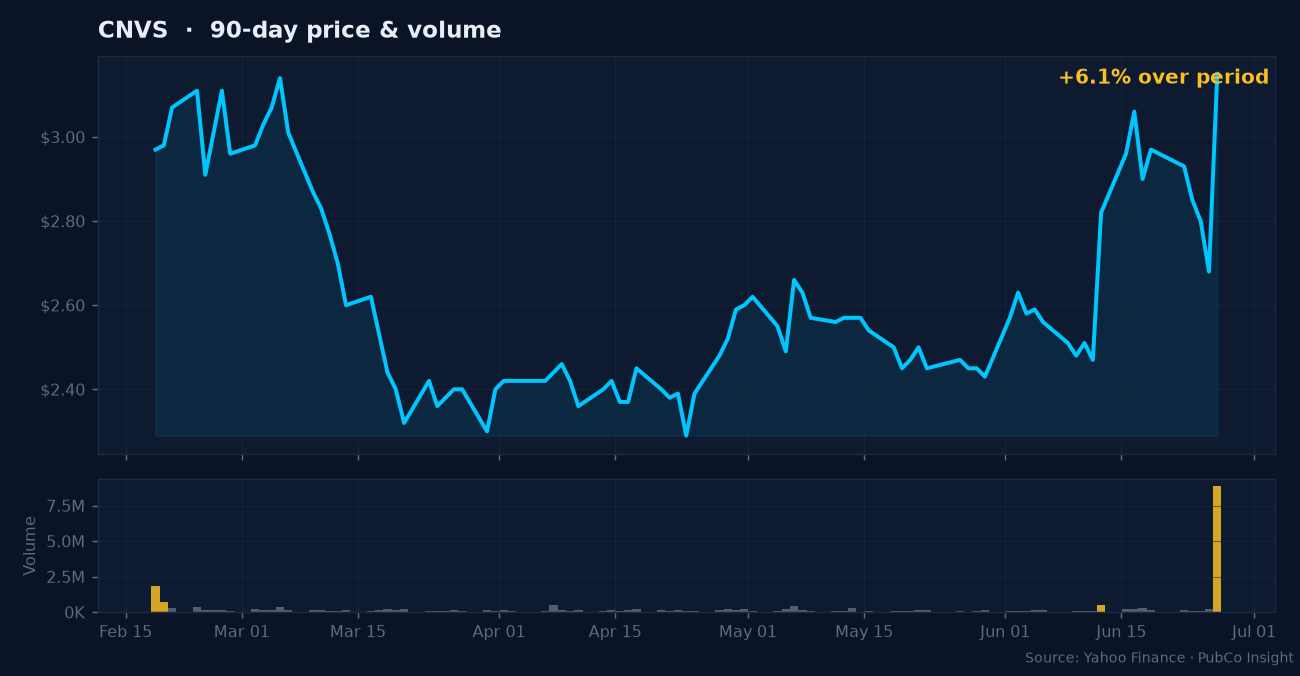
On September 4, 2026, Cineverse Corp. dropped a Form 8-K disclosing both Item 1.01 and Item 2.03. In regulatory bookkeeping, those numbers denote entering a material definitive agreement and creating a direct financial obligation. While commercial partnerships keep the lights on, new obligations carry real financial baggage. This filing arrived hot on the heels of the company's August 13 quarterly report and earnings release, indicating that capital management remains front and center as the business navigates its current quarter.
The mechanics of micro-cap balance sheets rarely stop at commercial debt. The regulatory trail shows past shelf activity and prospectus supplements, including S-filings and 424B disclosures that point to latent equity pressure. When companies with modest market capitalizations balance direct financial obligations against open financing vehicles, common equity holders often bear the brunt of any refinancing pivot. Tracking this machinery through a dilution risk check illustrates how quickly paper supply can shift underneath an otherwise quiet trading float.
Governance and insider registers have also seen recent updates, flagged by Form 4 insider transactions, a Form 144 notice, and an amended Schedule 13G filed in mid-August. While an active insider register is standard fare for a small-cap operator, it serves as a reminder that major holders and affiliates have established exits and structured positions that everyday retail participants cannot replicate.
Cineverse Corp. continues to file its regular reports, but the emergence of fresh Item 2.03 obligations on top of existing financing instruments demands attention. When evaluating CNVS, looking beyond top-line streaming headlines into the terms of new debt commitments and overhang risk is essential. The filings show a company actively handling financial obligations, and knowing what funds those obligations is the difference between investing and guessing.
Primary sources (SEC EDGAR)
8-K 2026-09-04: https://www.sec.gov/Archives/edgar/data/1173204/000119312526383714/cnvs-20260831.htm4 2026-08-20: https://www.sec.gov/Archives/edgar/data/1173204/000119312526359706/xslF345X06/ownership.xml144 2026-08-19: https://www.sec.gov/Archives/edgar/data/1173204/000195917326006234/xsl144X01/primary_doc.xmlSCHEDULE 13G/A 2026-08-14: https://www.sec.gov/Archives/edgar/data/1173204/000101359426000919/xslSCHEDULE_13G_X02/primary_doc.xml10-Q 2026-08-13: https://www.sec.gov/Archives/edgar/data/1173204/000119312526349428/cnvs-20260630.htm8-K 2026-08-13: https://www.sec.gov/Archives/edgar/data/1173204/000119312526349221/cnvs-20260813.htmSee the dilution and promotion flags before you see the pitch.
Each week: the micro and small-caps now showing dilution or paid-promotion signals, with the SEC filing behind every flag. No recommendations, no price targets.