Cineverse Corp.'s (CNVS) Debt Deals Could Pressure Shares
CNVS
Cineverse Corp. (CNVS) has been active on the financing front, but the details in recent 8-K filings suggest a path that could lead to substantial dilution for existing shareholders. While the market might focus on the company's content initiatives, the unglamorous reality of its debt structure warrants a closer look.
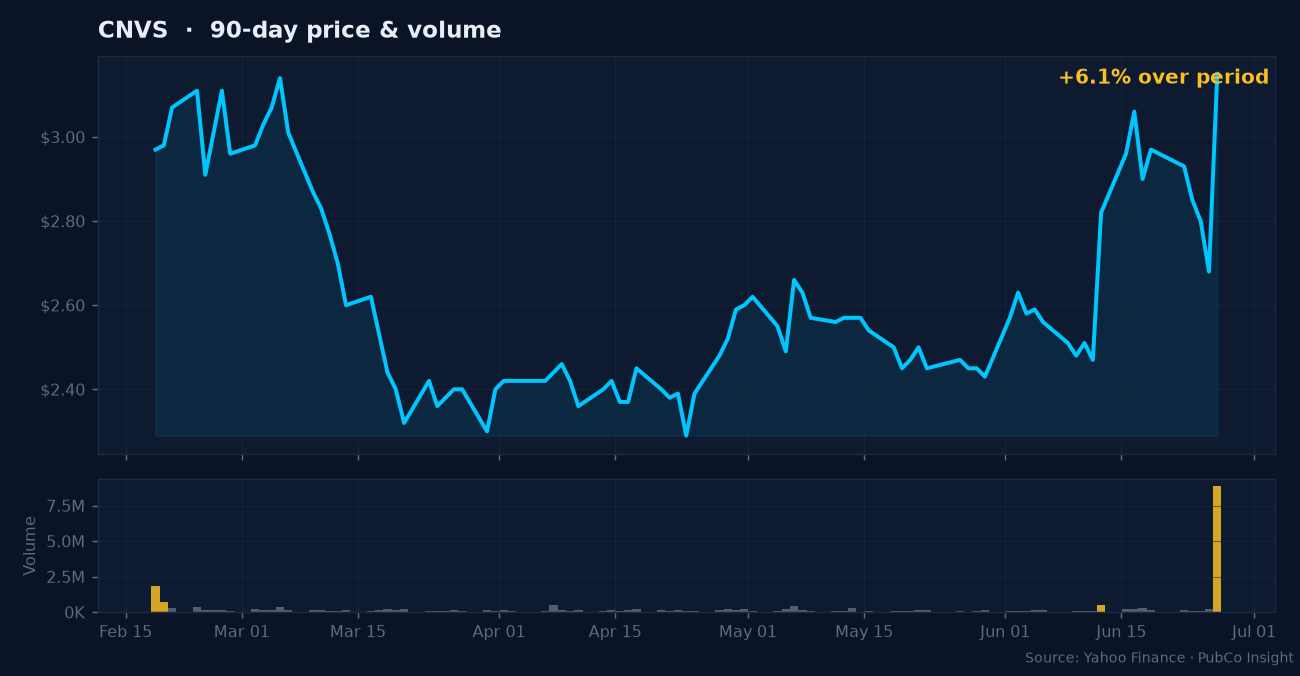
Specifically, an 8-K filed on September 4, 2026, details a new financing agreement involving the issuance of convertible promissory notes. These notes, by their very nature, carry the potential to convert into common stock. The mechanics are simple: as debt converts, more shares enter the market, increasing the total share count and, all else being equal, decreasing the value of each existing share. This is a common method for micro-cap companies to raise capital, but it shifts risk directly to equity holders.
The company's latest 10-Q, filed August 13, 2026, already shows a financial position that makes such debt-to-equity conversion a relevant consideration. While the company operates in the video content and distribution sector, the capital structure moves are what truly impact shareholder value in the short to medium term. For investors, understanding the terms of these convertible instruments and their potential impact on the fully diluted share count is critical.
These financing activities, coupled with the ongoing need for capital, suggest that further dilution is a persistent risk. The company's market capitalization of approximately $48 million, against a reported 23.42 million shares outstanding, means even relatively small debt conversions can have a noticeable effect on per-share metrics. For a deeper dive into how these mechanisms work, investors can explore PubCo Insight's dilution risk tools.
Investors in Cineverse Corp. should recognize that while the company's business model involves content, the financial filings point to a story of capital raising that relies heavily on instruments with dilutive potential. This isn't a judgment on the business itself, but a factual observation on the structural risks embedded in the recent financing. Knowing what you own means understanding how new capital is being raised and the potential consequences for your stake.
Primary sources (SEC EDGAR)
8-K 2026-09-17: https://www.sec.gov/Archives/edgar/data/1173204/000119312526394472/cnvs-20260915.htm8-K 2026-09-04: https://www.sec.gov/Archives/edgar/data/1173204/000119312526383714/cnvs-20260831.htm4 2026-08-20: https://www.sec.gov/Archives/edgar/data/1173204/000119312526359706/xslF345X06/ownership.xml144 2026-08-19: https://www.sec.gov/Archives/edgar/data/1173204/000195917326006234/xsl144X01/primary_doc.xmlSCHEDULE 13G/A 2026-08-14: https://www.sec.gov/Archives/edgar/data/1173204/000101359426000919/xslSCHEDULE_13G_X02/primary_doc.xml10-Q 2026-08-13: https://www.sec.gov/Archives/edgar/data/1173204/000119312526349428/cnvs-20260630.htmSee the dilution and promotion flags before you see the pitch.
Each week: the micro and small-caps now showing dilution or paid-promotion signals, with the SEC filing behind every flag. No recommendations, no price targets.