Cineverse Corp. (CNVS) Navigates New Debt While Equity Dilution Looms
CNVS
Cineverse Corp.'s latest 8-K, filed September 4, 2026, details a new credit facility with a principal amount of up to $20 million. While the market often views new financing as a sign of stability, a closer look at CNVS's recent disclosures, particularly the August 13, 2026 10-Q, suggests that the company's reliance on various financing mechanisms, including equity, remains a key consideration for shareholders.
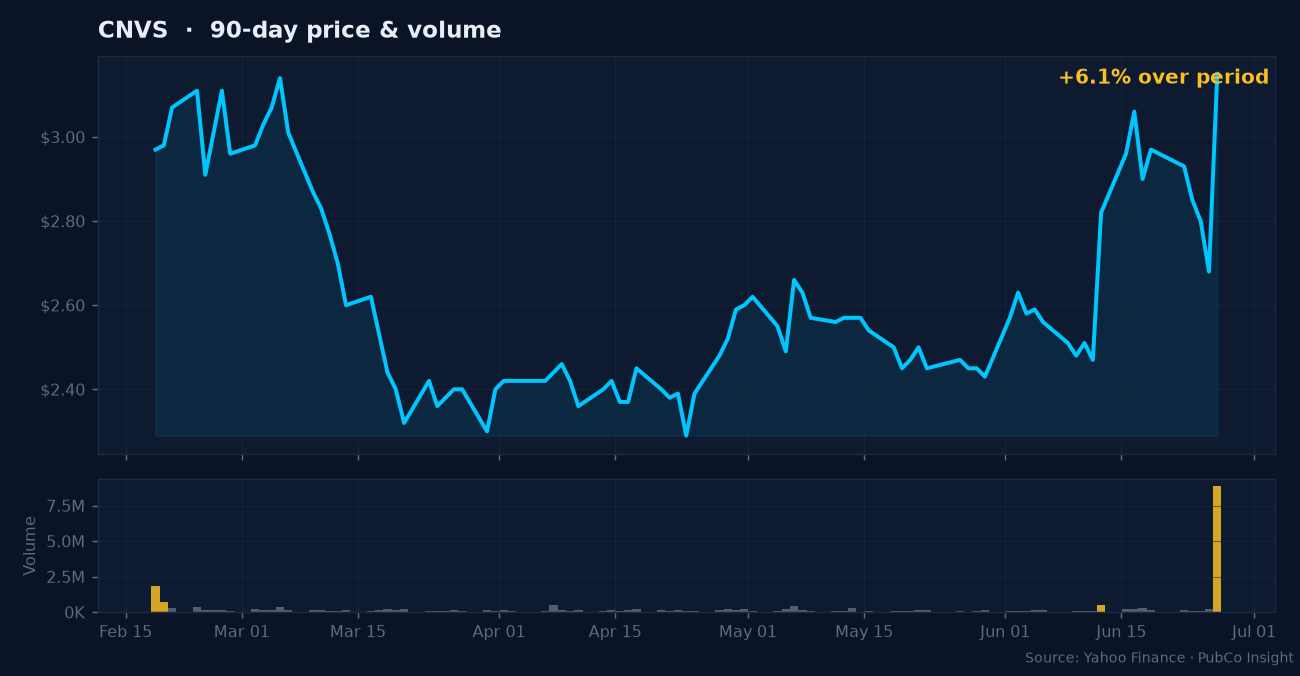
The 10-Q for the period ending June 30, 2026, outlines the company's financial position, which included a working capital deficit. This context is important when evaluating the new debt. While the credit facility provides immediate liquidity, it doesn't erase the potential for future equity issuances that have historically been part of Cineverse Corp.'s capital strategy. Investors should recall that such arrangements can lead to ongoing dilution, impacting the per-share value of existing holdings.
Specifically, the company has a history of utilizing equity offerings. The new debt, while seemingly a different financing path, does not preclude further equity raises to manage its balance sheet or fund operations. It's a fundamental truth that companies with ongoing capital needs often tap multiple sources, and equity remains a readily available option, albeit one that directly affects existing shareholders.
Shareholders should consider the implications of these financing structures. The new credit facility adds debt to the balance sheet, which comes with its own set of obligations and covenants. Concurrently, the mechanisms for issuing new shares are still in place, creating a dual-pronged risk profile. Understanding the full scope of potential dilution requires looking beyond just the latest headline and into the details of the company's registration statements and quarterly reports. For more on understanding dilution risk, see our guide.
For Cineverse Corp., the challenge lies in balancing its capital needs with minimizing the impact on its existing shareholder base. The recent filings paint a picture of a company actively managing its finances, but the methods employed carry inherent risks for those holding shares. As always, a thorough read of the actual filings, rather than just press releases, is essential for any investor in the microcap space.
Primary sources (SEC EDGAR)
8-K 2026-09-17: https://www.sec.gov/Archives/edgar/data/1173204/000119312526394472/cnvs-20260915.htm8-K 2026-09-04: https://www.sec.gov/Archives/edgar/data/1173204/000119312526383714/cnvs-20260831.htm4 2026-08-20: https://www.sec.gov/Archives/edgar/data/1173204/000119312526359706/xslF345X06/ownership.xml144 2026-08-19: https://www.sec.gov/Archives/edgar/data/1173204/000195917326006234/xsl144X01/primary_doc.xmlSCHEDULE 13G/A 2026-08-14: https://www.sec.gov/Archives/edgar/data/1173204/000101359426000919/xslSCHEDULE_13G_X02/primary_doc.xml10-Q 2026-08-13: https://www.sec.gov/Archives/edgar/data/1173204/000119312526349428/cnvs-20260630.htmSee the dilution and promotion flags before you see the pitch.
Each week: the micro and small-caps now showing dilution or paid-promotion signals, with the SEC filing behind every flag. No recommendations, no price targets.