AMERICAS CARMART INC (CRMT): Governance Reshuffles and Material Agreements Cloud the Picture
CRMT
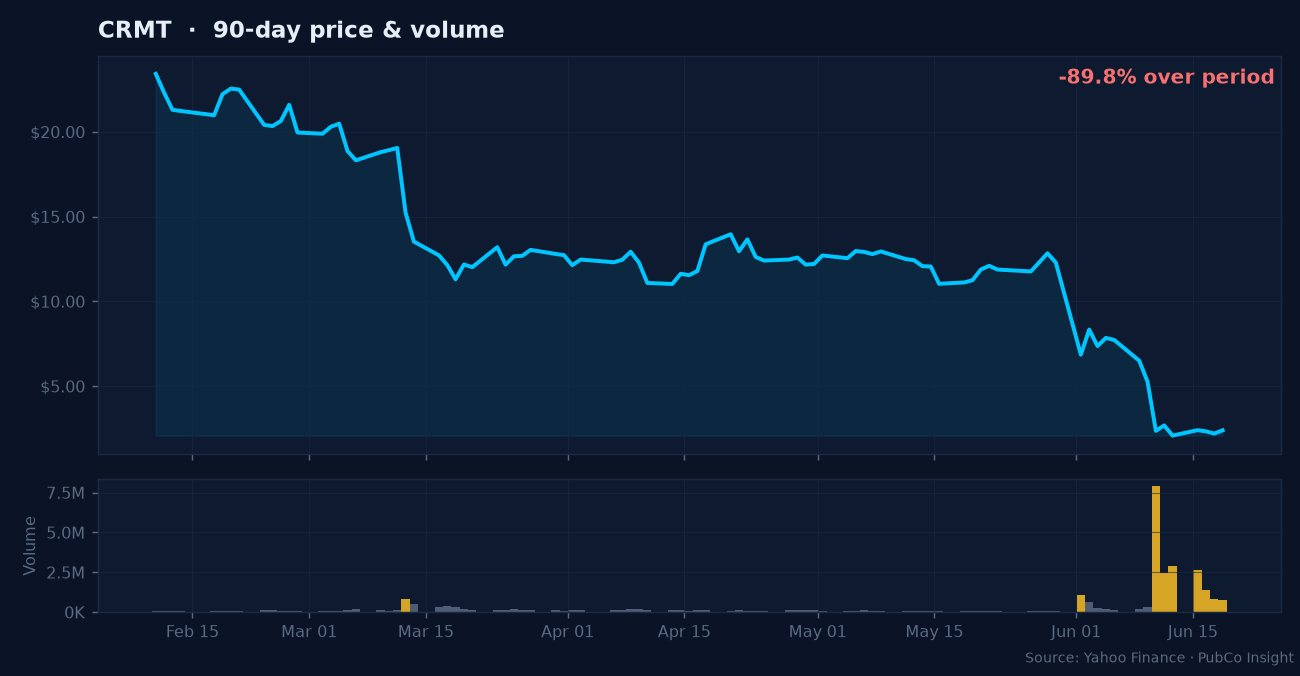
When an established name trades down to a micro-cap valuation, the public record rarely reflects business as usual. AMERICAS CARMART INC trades on the Nasdaq under CRMT with a market capitalization of roughly $25.5 million across 8.33 million shares outstanding. While the headline story of automotive retail often focuses on sales inventory and consumer demand, the regulatory record tells a story anchored in governance adjustments and repetitive material contracts.
A review of recent corporate disclosures shows a persistent sequence of major contract updates throughout the early summer. Between late May and late June, AMERICAS CARMART INC logged four separate Item 1.01 material agreement disclosures, frequently paired with Item 5.02 executive and governance notifications. That steady clip of contractual adjustments and leadership shifts points to an operational backdrop that is actively being reworked behind the scenes.
By mid-August, the company layered proxy disclosures, annual meeting materials, and fresh institutional ownership statements onto the docket. The filings included a DEF 14A definitive proxy statement, an annual report packet, and multiple Schedule 13G statements indicating shifting stakes among major holders. Paired with three 424B prospectus supplements recorded in the broader regulatory history, investors must pay attention to how corporate structuring intersects with potential dilution risk over time.
The automotive dealership space carries heavy working capital demands, and frequent contract modifications typically reflect evolving credit facilities, restructuring pacts, or tightened operational covenants. When these agreements coincide with executive turnover and proxy battles, the equity story stops being about car lots and becomes entirely about balance sheet mechanics and governance control.
For retail investors watching CRMT, the takeaway requires looking past generic sector trends. When a company's regulatory docket is dominated by repeated material contracts and governance updates, the biggest risks live directly inside the fine print of those agreements.
Primary sources (SEC EDGAR)
ARS 2026-08-14: https://www.sec.gov/Archives/edgar/data/799850/000162828026057074/cmrt-20260430x10k1.htmDEFA14A 2026-08-14: https://www.sec.gov/Archives/edgar/data/799850/000162828026057072/cmrt-20260430xadditionalpr.htmDEF 14A 2026-08-14: https://www.sec.gov/Archives/edgar/data/799850/000162828026057070/crmt-20260814.htmSCHEDULE 13G 2026-08-14: https://www.sec.gov/Archives/edgar/data/799850/000119312526351007/xslSCHEDULE_13G_X02/primary_doc.xmlSCHEDULE 13G/A 2026-08-14: https://www.sec.gov/Archives/edgar/data/799850/000139834426014540/xslSCHEDULE_13G_X02/primary_doc.xml3 2026-08-10: https://www.sec.gov/Archives/edgar/data/799850/000168316826006172/xslF345X06/ownership.xmlSee the dilution and promotion flags before you see the pitch.
Each week: the micro and small-caps now showing dilution or paid-promotion signals, with the SEC filing behind every flag. No recommendations, no price targets.