AMERICAS CARMART INC (CRMT): Recent Filings Signal Ongoing Capital Needs
CRMT
Recent filings for AMERICAS CARMART INC (CRMT) show a pattern of activity that, while typical for a public company, points to an ongoing need for careful capital management. The volume of recent 8-K filings detailing material agreements, alongside regular proxy statements and ownership disclosures, suggests a company navigating its financial structure rather than resting on operational surpluses.
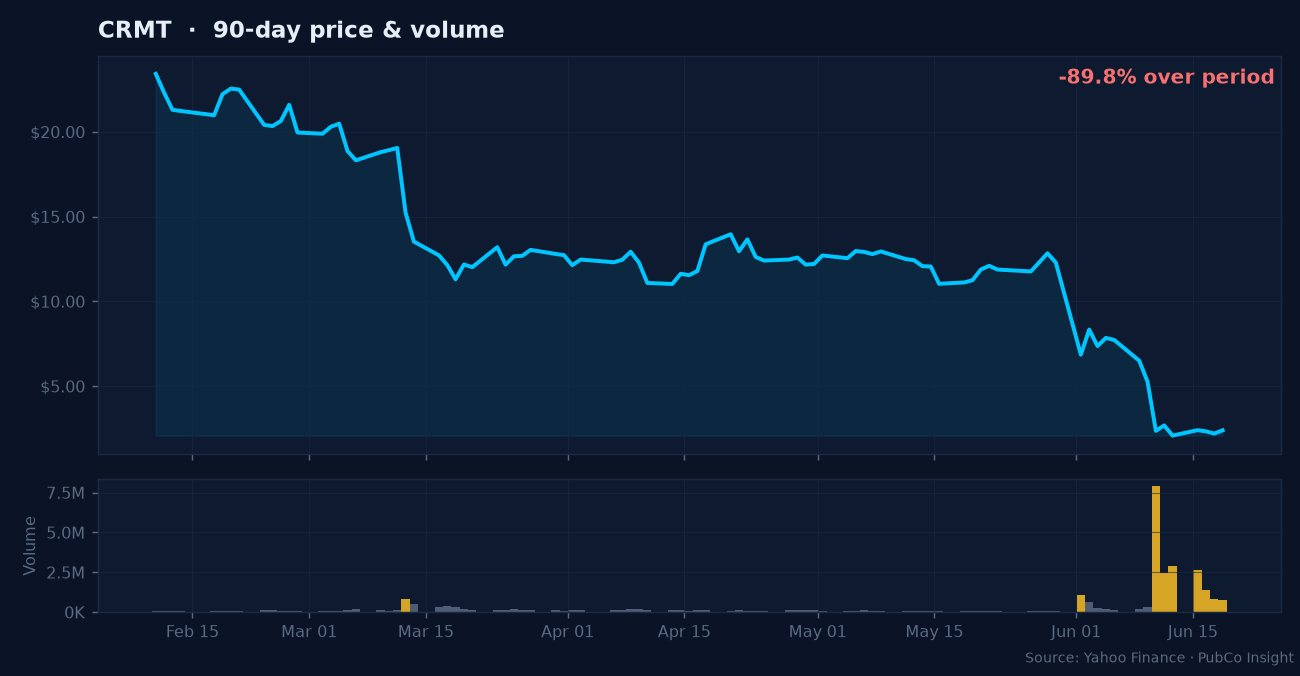
For example, the presence of multiple 8-K filings detailing material agreements, such as those dated June 5, June 12, and June 25, 2026, indicates AMERICAS CARMART INC is regularly entering into new financial or operational commitments. While the specific nature of these agreements requires a deep dive into each filing, their frequency alone suggests a company actively seeking to adjust or secure its operational and financial footing.
The DEF 14A and DEFA14A filings from August 14, 2026, are standard proxy materials, but in the context of a micro-cap company, they bear extra scrutiny. These documents outline proposals for shareholder votes, including board elections and potential executive compensation. Such proposals can sometimes hint at a company's strategic direction or financial health, especially if they involve changes to capital structure or governance that could impact shareholder value.
Investors should also note the SCHEDULE 13G and 13G/A filings on August 14, 2026. These indicate significant ownership stakes by institutional investors or activist shareholders. While sometimes seen as a positive, the reasons behind these positions and any associated intentions are crucial for understanding potential future share activity or corporate actions. Large holders can influence corporate decisions, which may or may not align with the interests of smaller retail shareholders.
Ultimately, the consistent stream of filings for AMERICAS CARMART INC (CRMT) paints a picture of a company in constant motion, particularly around its financial and governance structures. For retail investors, this means the story isn't just in the headline, but in the details of each SEC submission. Understanding these documents is essential to truly know what you own, especially when the market capitalization is modest and external capital needs can have outsized effects on share value. For a deeper look at how such activities can affect share count, investors can review our dilution risk resources.
Primary sources (SEC EDGAR)
ARS 2026-08-14: https://www.sec.gov/Archives/edgar/data/799850/000162828026057074/cmrt-20260430x10k1.htmDEFA14A 2026-08-14: https://www.sec.gov/Archives/edgar/data/799850/000162828026057072/cmrt-20260430xadditionalpr.htmDEF 14A 2026-08-14: https://www.sec.gov/Archives/edgar/data/799850/000162828026057070/crmt-20260814.htmSCHEDULE 13G 2026-08-14: https://www.sec.gov/Archives/edgar/data/799850/000119312526351007/xslSCHEDULE_13G_X02/primary_doc.xmlSCHEDULE 13G/A 2026-08-14: https://www.sec.gov/Archives/edgar/data/799850/000139834426014540/xslSCHEDULE_13G_X02/primary_doc.xml3 2026-08-10: https://www.sec.gov/Archives/edgar/data/799850/000168316826006172/xslF345X06/ownership.xmlSee the dilution and promotion flags before you see the pitch.
Each week: the micro and small-caps now showing dilution or paid-promotion signals, with the SEC filing behind every flag. No recommendations, no price targets.