AMERICAS CARMART INC (CRMT) Logs Rapid-Fire Material Agreements in September
CRMT
When a retail dealership operator files three separate Item 1.01 material agreements across two weeks of trading, paying attention to the documentation is not optional. AMERICAS CARMART INC (CRMT) has maintained a crowded corporate calendar throughout September 2026, dropping fresh disclosures onto the SEC register almost as quickly as investors can process them. The rush of paperwork comes while the company trades on the Nasdaq with a compressed market capitalization of roughly $14.5 million across 8.33 million outstanding shares.
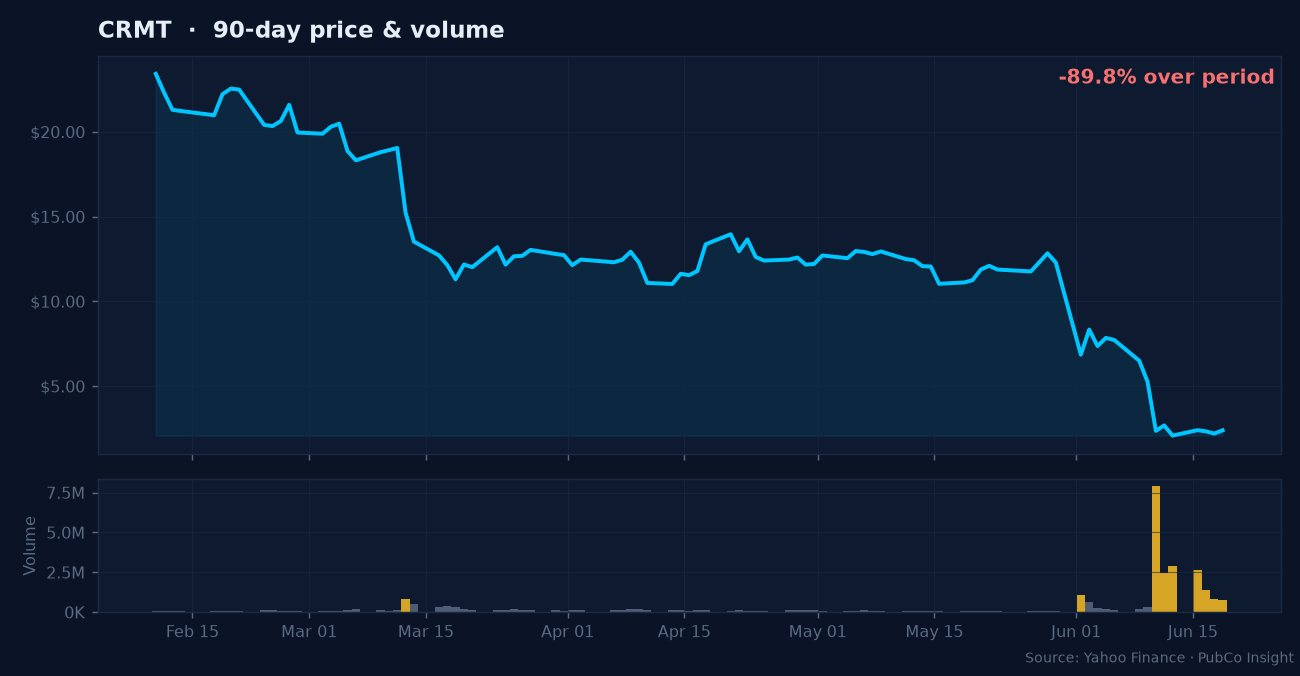
The sequence began immediately after Labor Day. On September 4, 2026, AMERICAS CARMART INC submitted an 8-K under Items 1.01 and 8.01 disclosing entry into a material definitive agreement. Five days later, on September 9, the company published its quarterly 10-Q report alongside an Item 2.02 earnings release. Rather than drawing a line under the quarter, the regulatory machinery kept churning. Another Item 1.01 and 8.01 filing landed on September 11, followed by yet another on September 18.
A cluster of three contract announcements within fourteen calendar days is an aggressive cadence for an auto retailer. When companies routinely amend facilities, execute covenants, or restructure operational arrangements in real time, the terms inside those exhibits dictate the trajectory of equity value far more than retail narrative does. In micro-cap territory, capital restructuring and credit mechanics frequently carry downstream exposure for common shareholders, making tools like our dilution risk index a critical checkpoint for monitoring prospective equity adjustments.
Underneath the flurry of filings sits an active news footprint, with 16 reported items tracked across three separate sources over a two-week period. That level of media visibility, paired with an institutional ownership change noted in a September 3 Schedule 13G/A, shows market participants are actively watching the tape. However, headline volume cannot substitute for structural clarity. Operational updates mean little if liquidity constraints or restrictive contractual covenants bind the balance sheet behind closed doors.
Owning retail auto operators at micro-cap valuations requires looking beyond the showroom window and directly into the EDGAR exhibit list. When AMERICAS CARMART INC turns contract modifications into a weekly filing routine, common stockholders must read every contract provision rather than assuming business as usual.
Primary sources (SEC EDGAR)
8-K 2026-09-18: https://www.sec.gov/Archives/edgar/data/799850/000117184326006114/f8k_091826.htm8-K 2026-09-11: https://www.sec.gov/Archives/edgar/data/799850/000117184326005989/f8k_091026.htm10-Q 2026-09-09: https://www.sec.gov/Archives/edgar/data/799850/000162828026061105/crmt-20260731.htm8-K 2026-09-09: https://www.sec.gov/Archives/edgar/data/799850/000117184326005948/f8k_090926.htm8-K 2026-09-04: https://www.sec.gov/Archives/edgar/data/799850/000117184326005895/f8k_090426.htmSCHEDULE 13G/A 2026-09-03: https://www.sec.gov/Archives/edgar/data/799850/000139834426016517/xslSCHEDULE_13G_X02/primary_doc.xmlSee the dilution and promotion flags before you see the pitch.
Each week: the micro and small-caps now showing dilution or paid-promotion signals, with the SEC filing behind every flag. No recommendations, no price targets.