Charlotte's Web (CWBHF) Reshapes its Capital Structure as New Filings Signal Dilution Risk
CWBHF
Charlotte's Web Holdings, Inc. was once the undisputed poster child of the CBD craze, but a look at its recent regulatory filings shows a business quietly restructuring its operational and financial plumbing. On June 3, 2026, the company filed a comprehensive Form 8-K detailing material agreements, terminations, and unregistered sales of equity. When a microcap company with a 132 million dollar market cap starts swapping out contracts and issuing shares behind the scenes, retail investors should pay close attention to the mechanics under the hood.
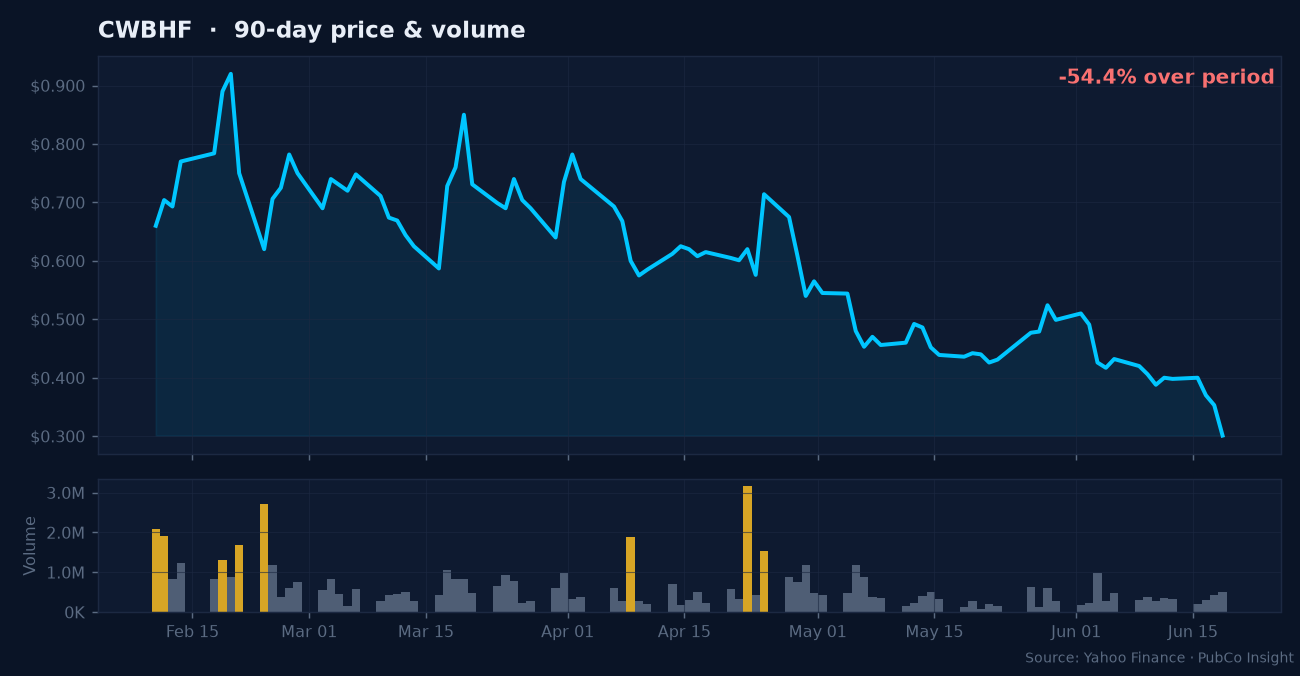
The June 3 filing package includes Items 1.01, 1.02, and 3.02, indicating that Charlotte's Web has entered into new material agreements while simultaneously terminating older ones and completing private placements of equity. This was immediately followed on June 5 by a Form D filing, which outlines an unregistered offering of securities, and a Form 8-K under Item 5.02 announcing changes to its management or board. For a company operating in the highly competitive and regulatory-stalled cannabis and hemp sector, these rapid-fire structural shifts suggest a push to preserve capital and realign incentives.
The risk for existing retail shareholders is the classic microcap squeeze play of dilution. The unregistered sale of equity under Item 3.02 means new shares are entering the ecosystem outside of public market channels, potentially diluting the fractional ownership of public investors. While these private placements can provide a quick injection of cash or satisfy outstanding obligations, they rarely occur on terms that favor the everyday retail holder. With 190.4 million shares outstanding, further equity issuances only spread the company's future earnings potential thinner.
Adding to the complexity are the Form 4 filings submitted by multiple insiders on June 3. When executives and board members are adjusting their holdings alongside a corporate restructuring, it is a clear sign that the internal playbook is being rewritten. Investors who rely solely on marketing presentations about brand equity and CBD market share are missing the real story. The filings show a company actively managing its liabilities, renegotiating its core agreements, and using its equity as a currency to navigate a challenging financial landscape.
Primary sources (SEC EDGAR)
8-K 2026-06-05: https://www.sec.gov/Archives/edgar/data/1750155/000175015526000097/cweb-20260603.htmD 2026-06-05: https://www.sec.gov/Archives/edgar/data/1750155/000175015526000095/xslFormDX08/primary_doc.xml8-K 2026-06-03: https://www.sec.gov/Archives/edgar/data/1750155/000175015526000094/cweb-20260528.htm4 2026-06-03: https://www.sec.gov/Archives/edgar/data/1750155/000175015526000092/xslF345X06/wk-form4_1780502301.xml4 2026-06-03: https://www.sec.gov/Archives/edgar/data/1750155/000175015526000089/xslF345X06/wk-form4_1780502183.xml4 2026-06-03: https://www.sec.gov/Archives/edgar/data/1750155/000175015526000086/xslF345X06/wk-form4_1780501987.xmlSee the dilution and promotion flags before you see the pitch.
Each week: the micro and small-caps now showing dilution or paid-promotion signals, with the SEC filing behind every flag. No recommendations, no price targets.