INOVIO PHARMACEUTICALS, INC. (INO): Recent Filings Signal Ongoing Dilution Risk
INO
INOVIO PHARMACEUTICALS, INC. (INO) shareholders have seen a flurry of recent Schedule 13G filings, alongside an August 12, 2026, 10-Q and an 8-K. While these updates might suggest increased institutional interest, the core financial picture presented in the 10-Q points to a company that continues to rely on capital raises, a pattern that has historically led to significant dilution for retail investors.
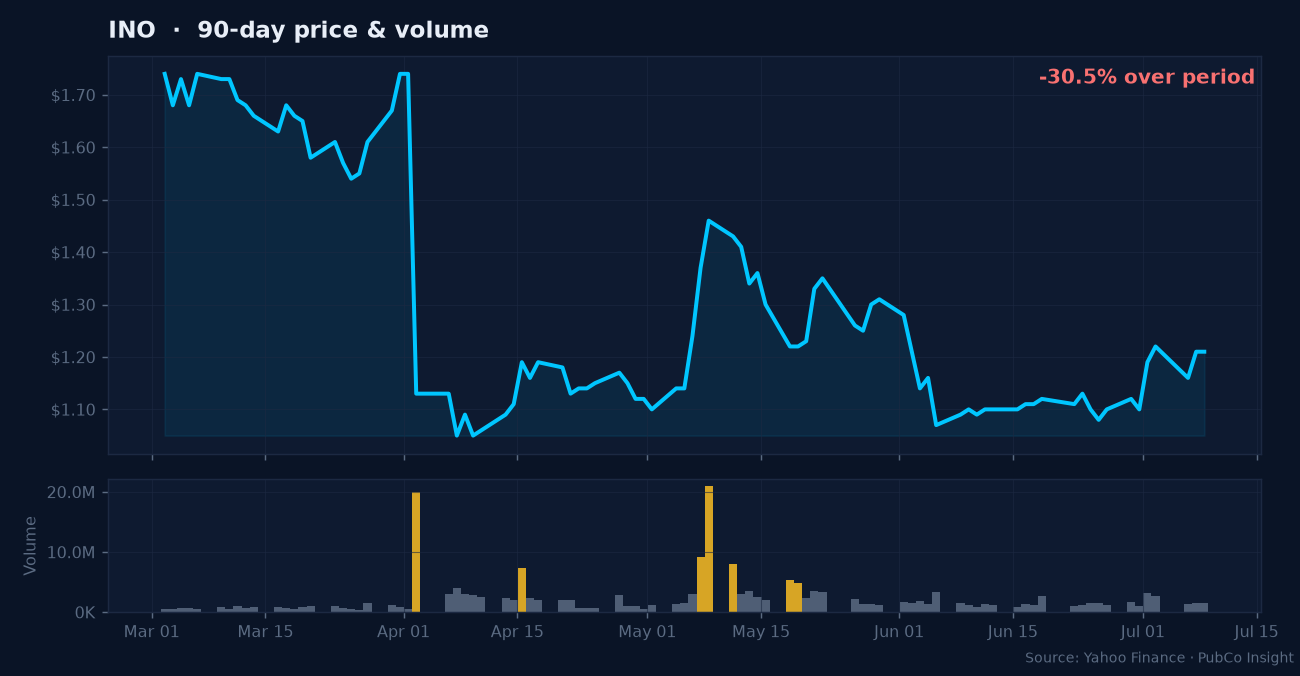
The latest 10-Q, filed August 12, 2026, covers the period ending June 30, 2026. For a company with a market capitalization of roughly $79.56 million and 82.27 million shares outstanding, the ongoing need for financing is a critical consideration. Biotech firms often require substantial capital, but the repeated Schedule 13G filings, indicating changes in beneficial ownership, should be viewed in the context of how this capital is raised and its impact on per-share value.
A review of INOVIO's filings over time, particularly any S-1 or S-3 registration statements and associated 424B prospectuses, would likely reveal a consistent strategy of financing operations through equity issuance. This mechanism, while necessary for many development-stage companies, directly increases the share count and can depress the value of existing holdings. Investors should recognize that new capital often comes at the cost of existing shareholder equity.
The company's recent 8-K, also filed on August 12, 2026, detailing an earnings release, provides further insight into its operational burn rate. Without significant revenue generation, the path to funding research and development, as well as general administrative expenses, typically involves tapping capital markets. This creates a structural risk where future operational needs could translate directly into additional share issuances, a dynamic that PubCo Insight's dilution risk tools are designed to highlight.
Investors considering INOVIO PHARMACEUTICALS, INC. should examine the full financial statements in the latest 10-Q carefully, particularly the statements of cash flows and changes in stockholders' equity. Understanding the company's burn rate and how it plans to fund future operations is essential. The biotech sector is inherently risky, and while the promise of new treatments can drive speculative interest, the unglamorous reality of financing often dictates shareholder returns.
Knowing what you own means understanding not just the potential upside, but also the mechanisms through which the company sustains itself. For INO, those mechanisms appear to include ongoing reliance on equity financing, a fact that warrants careful consideration for any long-term investor.
Primary sources (SEC EDGAR)
8-K 2026-08-12: https://www.sec.gov/Archives/edgar/data/1055726/000105572626000024/ino-20260812.htm10-Q 2026-08-12: https://www.sec.gov/Archives/edgar/data/1055726/000105572626000023/ino-20260630.htmSCHEDULE 13G/A 2026-08-12: https://www.sec.gov/Archives/edgar/data/1055726/000091957426004959/xslSCHEDULE_13G_X02/primary_doc.xmlSCHEDULE 13G 2026-08-07: https://www.sec.gov/Archives/edgar/data/1055726/000134682426000216/xslSCHEDULE_13G_X02/primary_doc.xmlSCHEDULE 13G/A 2026-08-06: https://www.sec.gov/Archives/edgar/data/1055726/000031506626002045/xslSCHEDULE_13G_X02/primary_doc.xmlSCHEDULE 13G 2026-07-31: https://www.sec.gov/Archives/edgar/data/1055726/000210011926001406/xslSCHEDULE_13G_X02/primary_doc.xmlSee the dilution and promotion flags before you see the pitch.
Each week: the micro and small-caps now showing dilution or paid-promotion signals, with the SEC filing behind every flag. No recommendations, no price targets.