INOVIO PHARMACEUTICALS, INC. (INO): The Cost of Staying Afloat
INO
INOVIO PHARMACEUTICALS, INC. (INO) recently released its Q2 earnings via an 8-K filing on August 12, 2026, alongside its 10-Q. While the market often focuses on top-line numbers and pipeline updates, the filings quietly confirm a trend that should concern any shareholder: a steadily expanding share count. The company’s reported shares outstanding sit at 82.27 million, a figure that has grown over time.
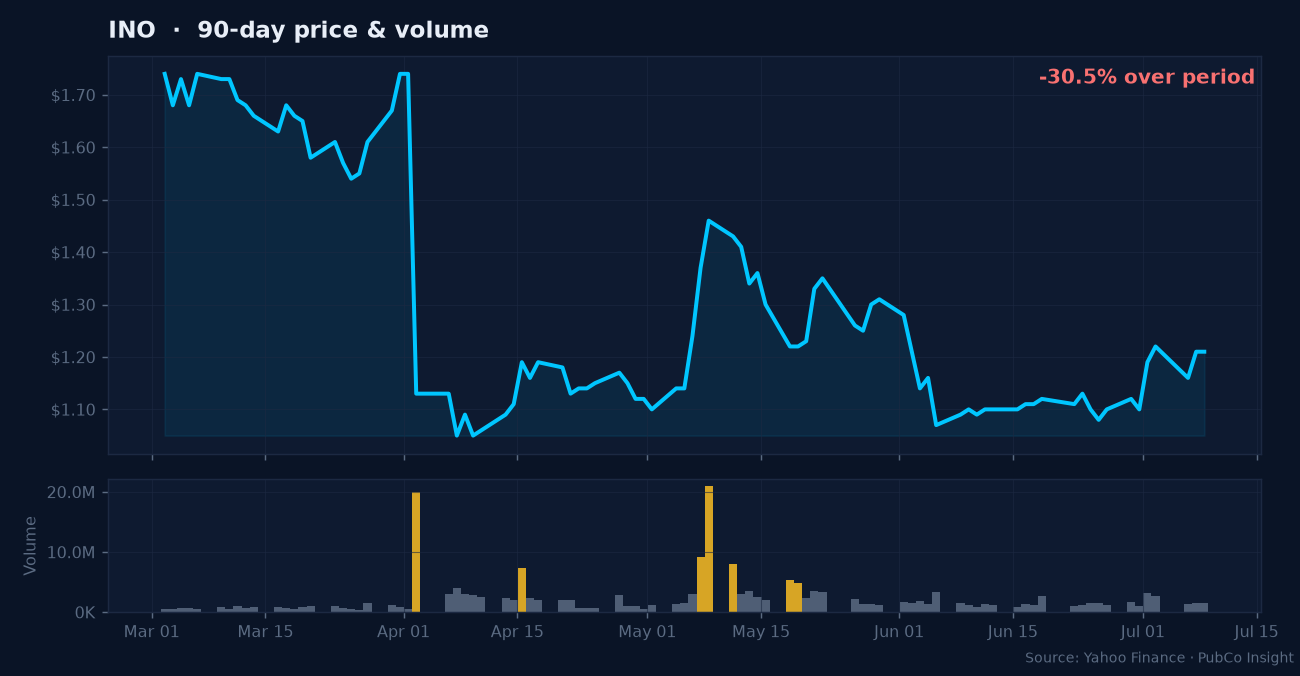
Biotech companies frequently rely on capital raises to fund research and development, and INO is no exception. However, the mechanism of these raises often involves issuing new equity, which directly dilutes the ownership stake of existing shareholders. This is a common practice, but for retail investors, understanding the cadence and scale of these events is critical to assess the true cost of holding shares.
Examining INO's filing history, particularly its repeated S-filings and 424B prospectuses, indicates a consistent strategy of leveraging equity markets. These filings are the company's way of telling the market it intends to sell more shares. While necessary for funding, this creates a structural headwind for per-share value, as the company’s market capitalization is spread across an ever-larger number of shares.
The company's dilution risk profile, as indicated by its S-filings and 424B activity, suggests that this trend is likely to continue. Investors should recognize that each new share issued, whether through direct offerings or other equity-based financing, reduces the proportional ownership of every share already held. This isn't a judgment on the company's scientific merits, but a sober assessment of its financial mechanics.
For INOVIO PHARMACEUTICALS, INC., the path to funding its pipeline appears to include a continued reliance on equity. This is a standard practice in the sector, but it means that the gains from any operational successes must be weighed against the persistent increase in the denominator of shares outstanding. Investors should factor this into their understanding of the stock's long-term performance potential.
Primary sources (SEC EDGAR)
8-K 2026-08-12: https://www.sec.gov/Archives/edgar/data/1055726/000105572626000024/ino-20260812.htm10-Q 2026-08-12: https://www.sec.gov/Archives/edgar/data/1055726/000105572626000023/ino-20260630.htmSCHEDULE 13G/A 2026-08-12: https://www.sec.gov/Archives/edgar/data/1055726/000091957426004959/xslSCHEDULE_13G_X02/primary_doc.xmlSCHEDULE 13G 2026-08-07: https://www.sec.gov/Archives/edgar/data/1055726/000134682426000216/xslSCHEDULE_13G_X02/primary_doc.xmlSCHEDULE 13G/A 2026-08-06: https://www.sec.gov/Archives/edgar/data/1055726/000031506626002045/xslSCHEDULE_13G_X02/primary_doc.xmlSCHEDULE 13G 2026-07-31: https://www.sec.gov/Archives/edgar/data/1055726/000210011926001406/xslSCHEDULE_13G_X02/primary_doc.xmlSee the dilution and promotion flags before you see the pitch.
Each week: the micro and small-caps now showing dilution or paid-promotion signals, with the SEC filing behind every flag. No recommendations, no price targets.