INO: Institutional Churn and Financing Filings Cloud INOVIO PHARMACEUTICALS, INC.
INO
INOVIO PHARMACEUTICALS, INC. trades like a promise that science is about to outrun the balance sheet, but regulatory dockets tell a far more mechanical story. With a market capitalization hovering near 122 million dollars across roughly 82.27 million shares, the company remains squarely in the crosshairs of constant capital maintenance. The filings do not showcase comfortable cash accumulation. Instead, they capture a recurring rhythm of compliance deadlines, material agreements, and paperwork designed to keep the engine fueled.
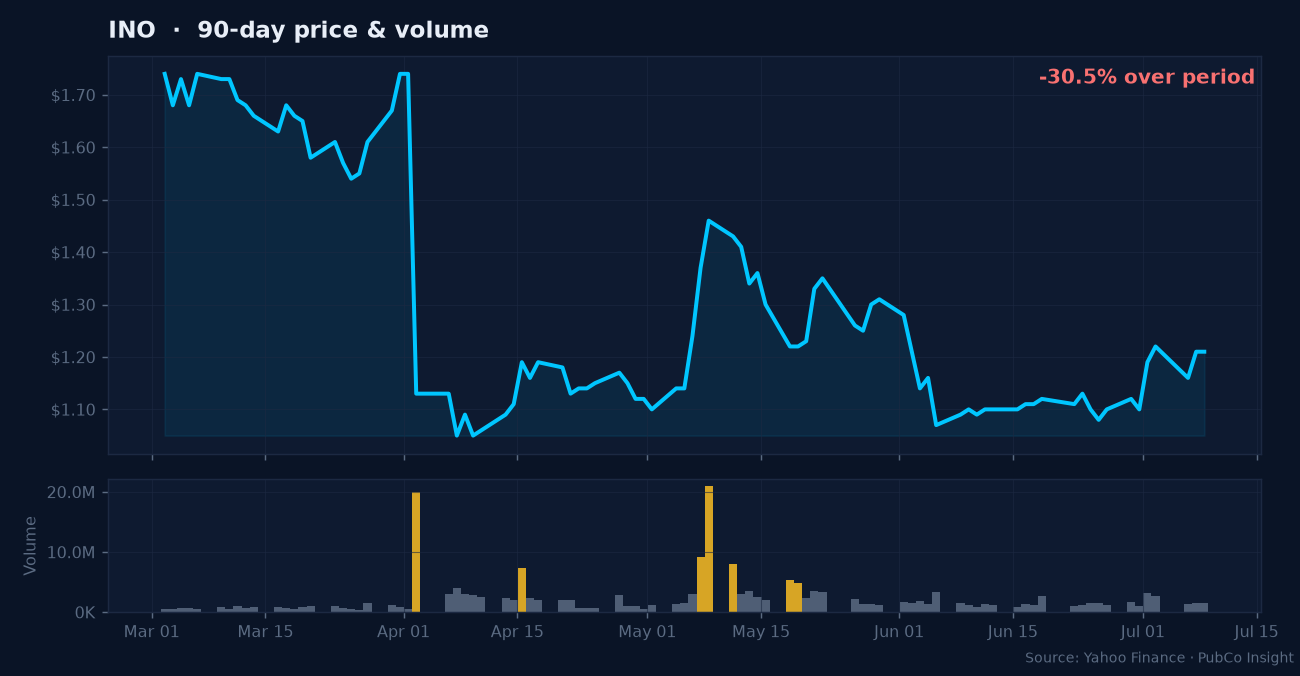
A look under the hood reveals the machinery at work. Regulatory records document multiple 424B prospectuses and registration filings alongside regular quarterly reports. In commercial biotechnology, that pattern is familiar: developing pharmaceutical preparations requires relentless cash, and when internal revenue cannot shoulder the load, the equity market must. Retail investors who follow clinical headlines often miss the trailing paperwork that quietly increases share counts and expands authorized capacity over time.
Tracking the mechanics of these equity offerings is where capital risk actually materializes. Investors monitoring the company can evaluate how ongoing prospectus supplements reshape the equity base by reviewing the dilution risk profiles typical of clinical-stage developers. When a company registers shares to fund ongoing burn, earlier equity positions invariably bear the brunt of that expanded supply, regardless of how promising the underlying pipeline may sound.
Compounding this dynamic is a flurry of recent institutional ownership disclosures. Between late July and mid-August, INOVIO PHARMACEUTICALS, INC. logged four separate Schedule 13G and 13G/A filings in rapid succession. Major institutional positions are adjusting, shuffling in and out while the company simultaneously files an Item 1.01 material agreement and multiple Item 2.02 earnings announcements. When large holders recalibrate their stakes against a backdrop of fresh financing filings, retail market participants are usually the last to understand which way the liquidity is flowing.
None of this requires assuming ill intent; it is simply the reality of pharmaceutical development in public markets. Clinical ambition costs money, and equity sales are the currency that pays for it. If you hold INO, the primary risk is rarely what happens in the lab next week. It is what happens to your fractional slice of ownership every time another financing filing crosses the wire.
Primary sources (SEC EDGAR)
8-K 2026-08-12: https://www.sec.gov/Archives/edgar/data/1055726/000105572626000024/ino-20260812.htm10-Q 2026-08-12: https://www.sec.gov/Archives/edgar/data/1055726/000105572626000023/ino-20260630.htmSCHEDULE 13G/A 2026-08-12: https://www.sec.gov/Archives/edgar/data/1055726/000091957426004959/xslSCHEDULE_13G_X02/primary_doc.xmlSCHEDULE 13G 2026-08-07: https://www.sec.gov/Archives/edgar/data/1055726/000134682426000216/xslSCHEDULE_13G_X02/primary_doc.xmlSCHEDULE 13G/A 2026-08-06: https://www.sec.gov/Archives/edgar/data/1055726/000031506626002045/xslSCHEDULE_13G_X02/primary_doc.xmlSCHEDULE 13G 2026-07-31: https://www.sec.gov/Archives/edgar/data/1055726/000210011926001406/xslSCHEDULE_13G_X02/primary_doc.xmlSee the dilution and promotion flags before you see the pitch.
Each week: the micro and small-caps now showing dilution or paid-promotion signals, with the SEC filing behind every flag. No recommendations, no price targets.