iQSTEL Inc (IQST) Board Seeks Reverse Split Authority
IQST
iQSTEL Inc (IQST) recently filed a PRE 14C and DEF 14C, signaling the company's intent to seek shareholder approval for a reverse stock split. This move, while often presented as a path to uplisting or improved market perception, primarily addresses compliance with minimum bid price requirements for exchanges like Nasdaq or NYSE American. For existing shareholders, it means fewer shares, each theoretically higher priced, but with no change to the underlying value of their total holdings.
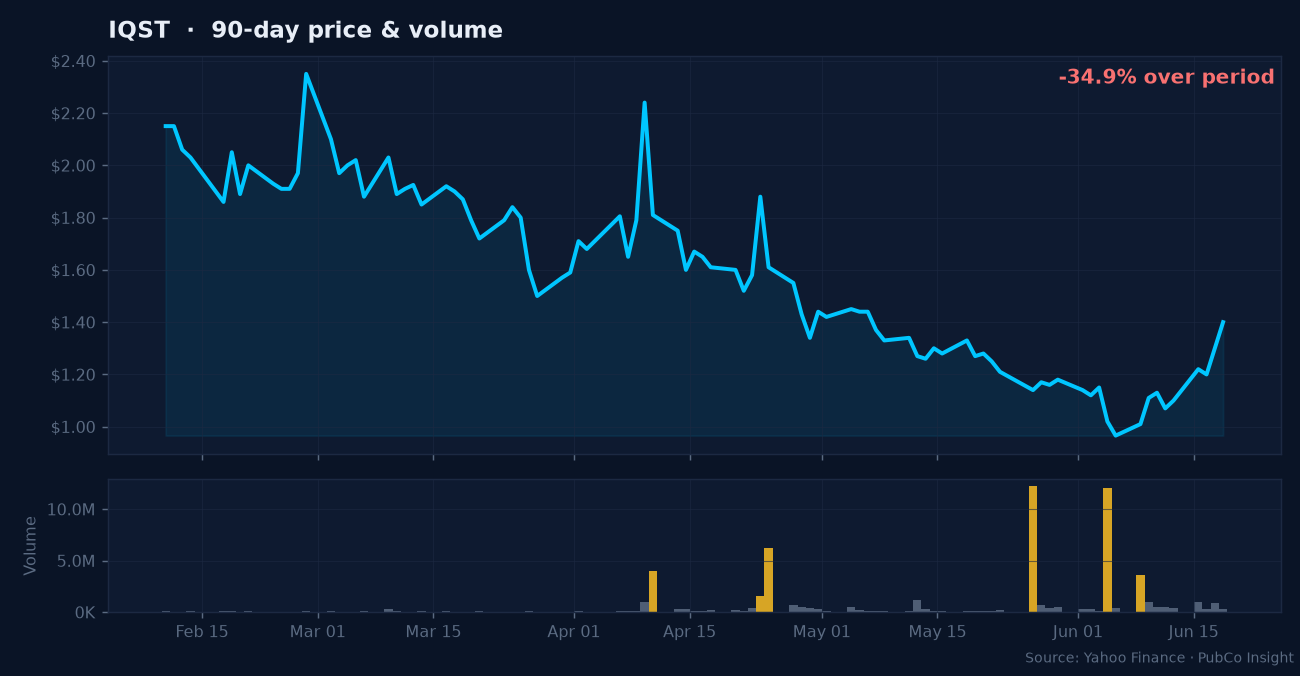
The DEF 14C, filed on July 27, 2026, details the board's proposal to amend the company's certificate of incorporation to effect a reverse stock split at a ratio ranging from 1-for-2 to 1-for-25. The board is asking for broad discretion to set the ratio and the timing, a common practice that gives management flexibility but offers less certainty to investors. Such proposals are not unusual for micro-cap companies trading on OTC markets, particularly those with aspirations of moving to a national exchange.
While a reverse split can make a stock appear more substantial by increasing its per-share price, it does not fundamentally alter the company's market capitalization or financial health. The primary risk for shareholders is often the subsequent dilution that can follow such a corporate action. Companies frequently couple reverse splits with new equity financings, as the higher per-share price can make new share issuances more palatable to institutional investors, even if the underlying company fundamentals remain unchanged.
Moreover, the filings do not provide new details regarding iQSTEL Inc's operational performance or strategic shifts that would independently justify a higher valuation. The company's recent 8-K filings, including one on July 16, 2026, reporting earnings, and others detailing material agreements, offer pieces of the corporate narrative, but the reverse split proposal stands as a distinct capital markets event.
Investors in iQSTEL Inc should recognize that a reverse split, by itself, is a cosmetic change to the share structure. The real impact on shareholder value will depend on whether the company can leverage this structural adjustment into sustained operational improvements or more favorable financing terms without excessive dilution. Understanding the mechanics of such proposals, rather than focusing solely on the nominal share price, is key to evaluating the actual risks involved.
Primary sources (SEC EDGAR)
DEF 14C 2026-07-27: https://www.sec.gov/Archives/edgar/data/1527702/000166357726000234/iqst_def14c.htm8-K 2026-07-16: https://www.sec.gov/Archives/edgar/data/1527702/000166357726000220/iqst8k071626.htm8-K 2026-07-10: https://www.sec.gov/Archives/edgar/data/1527702/000166357726000210/iqst8k070826.htm8-K 2026-07-10: https://www.sec.gov/Archives/edgar/data/1527702/000166357726000208/iqst8k070726.htmPRE 14C 2026-07-10: https://www.sec.gov/Archives/edgar/data/1527702/000166357726000206/iqst_pre14c.htm8-K 2026-06-25: https://www.sec.gov/Archives/edgar/data/1527702/000166357726000196/iqst8k062526.htmSee the dilution and promotion flags before you see the pitch.
Each week: the micro and small-caps now showing dilution or paid-promotion signals, with the SEC filing behind every flag. No recommendations, no price targets.